
uitsluitend voor onderzoeksdoeleinden
Onalespib (AT13387) HSP90-remmer
Cat.Nr.S1163
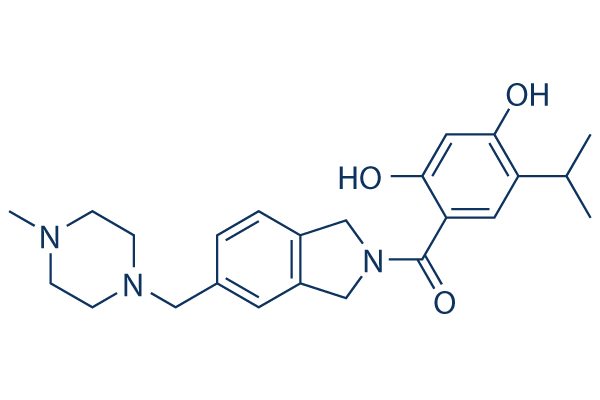
Chemische structuur
Moleculair gewicht: 409.52
Kwaliteitscontrole
| Gerelateerde doelwitten | Akt Wnt/beta-catenin PKC ROCK Microtubule Associated Integrin Bcr-Abl Actin FAK Kinesin |
|---|---|
| Overige HSP Inhibitoren | Tanespimycin (17-AAG) Elesclomol (STA-4783) Luminespib (NVP-AUY922) Ganetespib (STA-9090) Alvespimycin (17-DMAG) Hydrochloride VER-155008 BIIB021 Zelavespib (PU-H71) HSP990 (NVP-HSP990) NVP-BEP800 |
Celkweek, behandeling & werkconcentratie
| Cellijnen | Assaytype | Concentratie | Incubatietijd | Formulering | Activiteitsbeschrijving | PMID |
|---|---|---|---|---|---|---|
| human HCT116 cells | Cytotoxic assay | Cytotoxicity against human HCT116 cells by Alamar blue assay, IC50=0.048 μM | 20662534 | |||
| human HCT116 cells | Function assay | 10 nM | 18 h | Induction of apoptosis in human HCT116 cells assessed as upregulation of Hsp70 level at 10 nM after 18 hrs by immunoblotting | 20662534 | |
| human HCT116 cells | Function assay | 30 nM | 18 h | Induction of apoptosis in human HCT116 cells assessed as reduction of CDK4 level at 30 nM after 18 hrs by immunoblotting | 20662534 | |
| human HCT116 cells | Function assay | 30 nM | 18 h | Induction of apoptosis in human HCT116 cells assessed as reduction of Raf-1 level at 30 nM after 18 hrs by immunoblotting | 20662534 | |
| human HCT116 cells | Proliferation assay | 48 h | Antiproliferative activity against human HCT116 cells after 48 hrs by MTT assay, IC50=0.08 μM | 24763261 | ||
| human SKBR3 cells | Proliferation assay | 48 h | Antiproliferative activity against human SKBR3 cells after 48 hrs by MTT assay, IC50=0.14 μM | 24763261 | ||
| human MCF7 cells | Proliferation assay | 48 h | Antiproliferative activity against human MCF7 cells after 48 hrs by MTT assay, IC50=0.28 μM | 24763261 | ||
| human A231 cells | Proliferation assay | 48 h | Antiproliferative activity against human A231 cells after 48 hrs by MTT assay, IC50=1.01 μM | 24763261 | ||
| GIST430 | Cytotoxicity assay | 7 days | Cytotoxicity against imatinib-resistant human GIST430 cells assessed as decrease in cell viability after 7 days by alamar blue assay, IC50=0.034μM. | 26844689 | ||
| GIST48 | Cytotoxicity assay | 7 days | Cytotoxicity against imatinib-resistant human GIST48 cells assessed as decrease in cell viability after 7 days by alamar blue assay, IC50=0.055μM. | 26844689 | ||
| MCF7 | Antiproliferative assay | 72 hrs | Antiproliferative activity against human MCF7 cells incubated for 72 hrs by MTT assay, IC50=0.032μM. | 29028527 | ||
| SKBR3 | Antiproliferative assay | 72 hrs | Antiproliferative activity against human SKBR3 cells incubated for 72 hrs by MTT assay, IC50=0.045μM. | 29028527 | ||
| TC32 | qHTS assay | qHTS of pediatric cancer cell lines to identify multiple opportunities for drug repurposing: Primary screen for TC32 cells | 29435139 | |||
| DAOY | qHTS assay | qHTS of pediatric cancer cell lines to identify multiple opportunities for drug repurposing: Primary screen for DAOY cells | 29435139 | |||
| SJ-GBM2 | qHTS assay | qHTS of pediatric cancer cell lines to identify multiple opportunities for drug repurposing: Primary screen for SJ-GBM2 cells | 29435139 | |||
| A673 | qHTS assay | qHTS of pediatric cancer cell lines to identify multiple opportunities for drug repurposing: Primary screen for A673 cells | 29435139 | |||
| SK-N-MC | qHTS assay | qHTS of pediatric cancer cell lines to identify multiple opportunities for drug repurposing: Primary screen for SK-N-MC cells | 29435139 | |||
| NB-EBc1 | qHTS assay | qHTS of pediatric cancer cell lines to identify multiple opportunities for drug repurposing: Primary screen for NB-EBc1 cells | 29435139 | |||
| Saos-2 | qHTS assay | qHTS of pediatric cancer cell lines to identify multiple opportunities for drug repurposing: Primary screen for Saos-2 cells | 29435139 | |||
| SK-N-SH | qHTS assay | qHTS of pediatric cancer cell lines to identify multiple opportunities for drug repurposing: Primary screen for SK-N-SH cells | 29435139 | |||
| NB1643 | qHTS assay | qHTS of pediatric cancer cell lines to identify multiple opportunities for drug repurposing: Primary screen for NB1643 cells | 29435139 | |||
| LAN-5 | qHTS assay | qHTS of pediatric cancer cell lines to identify multiple opportunities for drug repurposing: Primary screen for LAN-5 cells | 29435139 | |||
| Rh18 | qHTS assay | qHTS of pediatric cancer cell lines to identify multiple opportunities for drug repurposing: Primary screen for Rh18 cells | 29435139 | |||
| OHS-50 | qHTS assay | qHTS of pediatric cancer cell lines to identify multiple opportunities for drug repurposing: Primary screen for OHS-50 cells | 29435139 | |||
| RD | qHTS assay | qHTS of pediatric cancer cell lines to identify multiple opportunities for drug repurposing: Primary screen for RD cells | 29435139 | |||
| NB1643 | qHTS assay | qHTS of pediatric cancer cell lines to identify multiple opportunities for drug repurposing: Confirmatory screen for NB1643 cells | 29435139 | |||
| A673 | qHTS assay | qHTS of pediatric cancer cell lines to identify multiple opportunities for drug repurposing: Confirmatory screen for A673 cells) | 29435139 | |||
| SK-N-MC | qHTS assay | qHTS of pediatric cancer cell lines to identify multiple opportunities for drug repurposing: Confirmatory screen for SK-N-MC cells | 29435139 | |||
| BT-12 | qHTS assay | qHTS of pediatric cancer cell lines to identify multiple opportunities for drug repurposing: Confirmatory screen for BT-12 cells | 29435139 | |||
| LAN-5 | qHTS assay | qHTS of pediatric cancer cell lines to identify multiple opportunities for drug repurposing: Confirmatory screen for LAN-5 cells | 29435139 | |||
| BT-37 | qHTS assay | qHTS of pediatric cancer cell lines to identify multiple opportunities for drug repurposing: Confirmatory screen for BT-37 cells | 29435139 | |||
| TC32 | qHTS assay | qHTS of pediatric cancer cell lines to identify multiple opportunities for drug repurposing: Confirmatory screen for TC32 cells | 29435139 | |||
| U-2 OS | qHTS assay | qHTS of pediatric cancer cell lines to identify multiple opportunities for drug repurposing: Confirmatory screen for U-2 OS cells | 29435139 | |||
| Rh41 | qHTS assay | qHTS of pediatric cancer cell lines to identify multiple opportunities for drug repurposing: Confirmatory screen for Rh41 cells | 29435139 | |||
| RD | qHTS assay | qHTS of pediatric cancer cell lines to identify multiple opportunities for drug repurposing: Confirmatory screen for RD cells | 29435139 | |||
| Rh18 | qHTS assay | qHTS of pediatric cancer cell lines to identify multiple opportunities for drug repurposing: Confirmatory screen for Rh18 cells | 29435139 | |||
| Rh30 | qHTS assay | qHTS of pediatric cancer cell lines to identify multiple opportunities for drug repurposing: Confirmatory screen for Rh30 cells | 29435139 | |||
| SK-N-SH | qHTS assay | qHTS of pediatric cancer cell lines to identify multiple opportunities for drug repurposing: Confirmatory screen for SK-N-SH cells | 29435139 | |||
| NCI-H3122 | Antiproliferative assay | 72 hrs | Antiproliferative activity against human NCI-H3122 cells after 72 hrs by SRB assay, IC50=0.052μM. | 29698859 | ||
| PANC1 | Function assay | 1 uM | 36 hrs | Inhibition of HSP90alpha in human PANC1 cells assessed as up-regulation of Hsp70 at 1 uM after 36 hrs by Western blot analysis | 30351001 | |
| PANC1 | Function assay | 1 uM | 36 hrs | Inhibition of HSP90alpha in human PANC1 cells assessed as akt degradation at 1 uM after 36 hrs by Western blot analysis | 30351001 | |
| MCF7 | Antiproliferative assay | 72 hrs | Antiproliferative activity against human MCF7 cells after 72 hrs by MTT assay, IC50=0.29μM. | 30784881 | ||
| NCI-H1299 | Antiproliferative assay | 72 hrs | Antiproliferative activity against human NCI-H1299 cells after 72 hrs by MTT assay, IC50=0.37μM. | 30784881 | ||
| A549 | Antiproliferative assay | 72 hrs | Antiproliferative activity against human A549 cells after 72 hrs by MTT assay, IC50=0.44μM. | 30784881 | ||
| Vero E6 | Function assay | 48 hrs | IC50 for antiviral activity against SARS-CoV-2 in the Vero E6 cell line at 48 h by immunofluorescence-based assay (detecting the viral NP protein in the nucleus of the Vero E6 cells), IC50=0.15488μM. | 32353859 | ||
| Klik om meer experimentele gegevens over de cellijn te bekijken | ||||||
Chemische informatie, Opslag en Stabiliteit
| Moleculair gewicht | 409.52 | Formule | C24H31N3O3 |
Opslag (Vanaf de ontvangstdatum) | |
|---|---|---|---|---|---|
| CAS-nr. | 912999-49-6 | SDF downloaden | Opslag van stamoplossingen |
|
|
| Synoniemen | N/A | Smiles | CC(C)C1=CC(=C(C=C1O)O)C(=O)N2CC3=C(C2)C=C(C=C3)CN4CCN(CC4)C | ||
Oplosbaarheid
|
In vitro |
DMSO
: 25 mg/mL
(61.04 mM)
Water : Insoluble Ethanol : Insoluble |
Molariteitscalculator
|
In vivo |
|||||
In vivo Formuleringscalculator (Heldere oplossing)
Stap 1: Voer de onderstaande informatie in (Aanbevolen: Een extra dier voor het geval van verlies tijdens het experiment)
Stap 2: Voer de in vivo formulering in (Dit is alleen de calculator, geen formulering. Neem eerst contact met ons op als er geen in vivo formulering is in het gedeelte Oplosbaarheid.)
Berekeningsresultaten:
Werkconcentratie: mg/ml;
Methode voor het bereiden van DMSO-mastervloeistof: mg geneesmiddel vooraf opgelost in μL DMSO ( Concentratie mastervloeistof mg/mL, Neem eerst contact met ons op als de concentratie de DMSO-oplosbaarheid van de partij geneesmiddel overschrijdt. )
Methode voor het bereiden van in vivo formulering: Neem μL DMSO mastervloeistof, voeg vervolgens toeμL PEG300, mengen en helder maken, voeg vervolgens toeμL Tween 80, mengen en helder maken, voeg vervolgens toe μL ddH2O, mengen en helder maken.
Methode voor het bereiden van in vivo formulering: Neem μL DMSO mastervloeistof, voeg vervolgens toe μL Maïsolie, mengen en helder maken.
Opmerking: 1. Zorg ervoor dat de vloeistof helder is voordat u het volgende oplosmiddel toevoegt.
2. Zorg ervoor dat u het/de oplosmiddel(en) in de juiste volgorde toevoegt. U moet ervoor zorgen dat de verkregen oplossing, bij de vorige toevoeging, een heldere oplossing is voordat u verdergaat met het toevoegen van het volgende oplosmiddel. Fysische methoden zoals vortexen, echografie of een warmwaterbad kunnen worden gebruikt om het oplossen te bevorderen.
Werkingsmechanisme
| Targets/IC50/Ki |
HSP90
(Cell-free assay) 18 nM
|
|---|---|
| In vitro |
De Kd voor Onalespib (AT13387)-binding is 0,7 nM. Dit vergeleken met een Kd van 6,7 nM voor de binding van het ansamycine 17-AAG aan dezelfde site. De gemiddelde stoichiometrie van binding voor deze verbinding is 1,03. De remming van een aantal geïsoleerde kinasen wordt ook onderzocht, waaronder CDK1, CDK2, CDK4, FGFR3, PKB-b, JAK2, VEGFR2, PDGFRβ en Aurora B. Geen van de geteste kinasen wordt significant geremd bij concentraties onder 30 μM. Het is een potente remmer van de proliferatie en overleving van vele verschillende cellijnen (zoals de MES-SA-cellijn) uit een verscheidenheid aan verschillende tumortypes. Over een panel van 30 tumorcellijnen remt het potent de celproliferatie met GI50-waarden in het bereik van 13–260 nM. De verbinding remt ook de proliferatie van de niet-tumorogene menselijke prostaatepitheelcellijn PNT2 met een GI50-waarde van 480 nM.
|
| Kinase Assay |
HSP90-competitie isotherme calorimetrie
|
|
Kd-waarden voor Onalespib (AT13387)-binding aan HSP90 worden bepaald met een competitie Isothermal Calorimetry (ITC)-formaat. ITC-experimenten worden uitgevoerd op een Micro Cal VP-ITC bij 25 °C in een buffer bestaande uit 25 mM Tris, 100 mM NaCl, 1 mM MgCl2 en 1 mM Tris(2-carboxyethyl)fosfine bij pH 7,4 om de hogere affiniteit te behouden
|
|
| In vivo |
Indien intermitterend toegediend, kon Onalespib (AT13387) worden verdragen in doses tot 70 mg/kg tweemaal per week of 90 mg/kg eenmaal per week. Gewichtsverlies bij muizen bedraagt niet meer dan 20% voordat het in alle gevallen behalve één herstelt, en het verlies is het hoogst na de tweede dosis. Tumorremming is vergelijkbaar in NCI-H1975 voor beide doseringsschema's. Het behoud van antitumorale effecten met een dergelijke langdurige behandelingsvrije periode is consistent met de verlengde farmacodynamische werking van deze verbinding waargenomen voor gemuteerd EGFR en andere biomarkers in vitro en in vivo en de verlengde retentie ervan in tumoren.
|
Referenties |
|
Toepassingen
| Methoden | Biomarkers | Afbeeldingen | PMID |
|---|---|---|---|
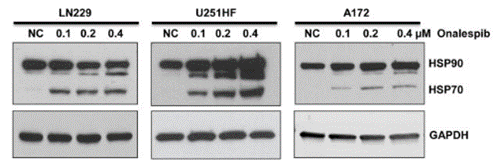
| Western blot | HSP90 / HSP70 EGFR / p-EGFR / AKT / p-AKT / ERK / p-ERK / S6 / p-S6 AXL / c-Myc / p-Mnk1 / Mnk1 / p-eIF4E / eIF4E |
|
28679777 |
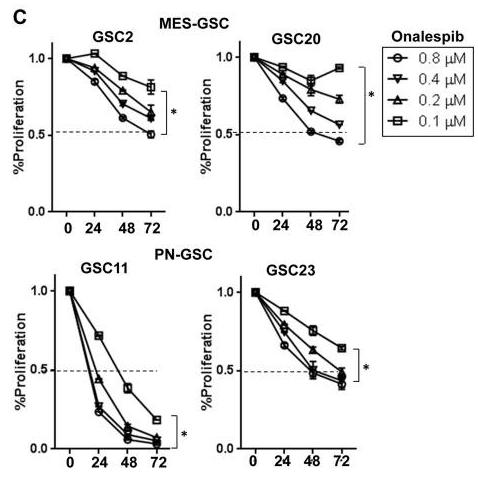
| Growth inhibition assay | Cell viability |
|
28679777 |
Informatie klinische proef
(gegevens van https://clinicaltrials.gov, bijgewerkt op 2024-05-22)
| NCT-nummer | Rekrutering | Aandoeningen | Sponsor/Medewerkers | Startdatum | Fasen |
|---|---|---|---|---|---|
| NCT02898207 | Completed | Metastatic High Grade Fallopian Tube Serous Adenocarcinoma|Metastatic Malignant Solid Neoplasm|Metastatic Primary Peritoneal Serous Adenocarcinoma|Metastatic Triple-Negative Breast Carcinoma|Platinum-Resistant Fallopian Tube Carcinoma|Platinum-Resistant Ovarian Carcinoma|Platinum-Resistant Primary Peritoneal Carcinoma|Recurrent Breast Carcinoma|Recurrent High Grade Fallopian Tube Serous Adenocarcinoma|Recurrent High Grade Ovarian Serous Adenocarcinoma|Recurrent Primary Peritoneal High Grade Serous Adenocarcinoma|Recurrent Triple-Negative Breast Carcinoma|Refractory Fallopian Tube Serous Adenocarcinoma|Refractory Ovarian Serous Adenocarcinoma|Refractory Primary Peritoneal Serous Adenocarcinoma|Refractory Triple-Negative Breast Carcinoma|Unresectable High Grade Fallopian Tube Serous Adenocarcinoma|Unresectable Malignant Solid Neoplasm|Unresectable Primary Peritoneal Serous Adenocarcinoma |
National Cancer Institute (NCI) |
May 19 2017 | Phase 1 |
Technische ondersteuning
Tel: +1-832-582-8158 Ext:3
Als u nog andere vragen heeft, kunt u een bericht achterlaten.
Veelgestelde vragen
Vraag 1:
How to prepare it for in vivo studies?
Antwoord:
It can be dissolved in 2% DMSO/30% PEG 300/ddH2O at 10 mg/ml as a clear solution. But after stayed for about 1 hour, the precipitation will goes out. So it is recommended to be prepared before use.

Producten zijn uitsluitend voor onderzoeksdoeleinden. Niet voor menselijk gebruik. Wij verkopen niet aan patiënten.
©Copyright 2013 Selleck Chemicals. Alle rechten voorbehouden.