
uitsluitend voor onderzoeksdoeleinden
BIIB021 HSP remmer
Cat.Nr.S1175
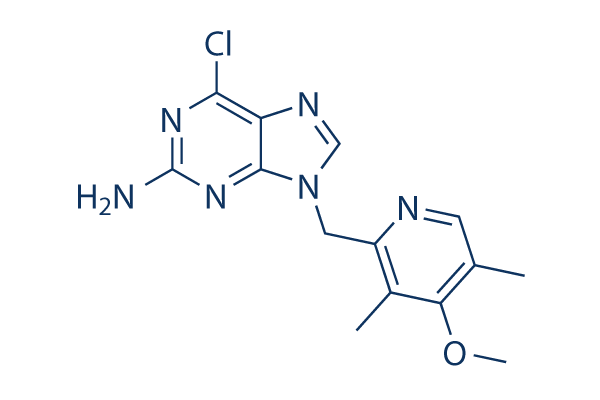
Chemische structuur
Moleculair gewicht: 318.76
Kwaliteitscontrole
Celkweek, behandeling & werkconcentratie
| Cellijnen | Assaytype | Concentratie | Incubatietijd | Formulering | Activiteitsbeschrijving | PMID |
|---|---|---|---|---|---|---|
| MCF7 | Function assay | Inhibition of HSP90-mediated client protein HER2 degradation in human MCF7 cells, IC50=0.038μM | 20055425 | |||
| BT474 | Function assay | Binding affinity to Hsp90 nucleotide binding domain in human BT474 cells, IC50=0.14μM | 20608738 | |||
| MCF7 | Function assay | Inhibition of HSP90alpha in human MCF7 cells assessed as degradation of Her-2, EC50=0.038μM | 22938030 | |||
| NCI-H295 | Cytotoxicity assay | 120 mg/kg | 5 days | Cytotoxicity against human NCI-H295 cells overexpressing PGP xenografted in athymic mouse assessed as inhibition of tumor growth at 120 mg/kg, po qd for 5 days per week for 4 weeks | 22938030 | |
| Sf9 | Function assay | 3 hrs | Binding affinity to human N-terminal polyHis-tagged HSP90alpha (D9 to E236) alpha-helix conformation expressed in insect sf9 cells after 3 hrs by fluorescence polarization assay, Ki=0.002μM | 24332488 | ||
| Sf9 | Function assay | 3 hrs | Binding affinity to human N-terminal polyHis-tagged HSP90beta (D9 to E236) expressed in insect sf9 cells after 3 hrs by fluorescence polarization assay, Ki=0.004μM | 24332488 | ||
| NCI-H1299 | Function assay | 12 hrs | Reduction in oxygen consumption rate in human NCI-H1299 cells incubated for 12 hrs | 25383915 | ||
| HeLa | Function assay | 10 uM | 6 hrs | Inhibition of HSP90 in human HeLa cells assessed as induction of chk1 degradation at 10 uM after 6 hrs by Western blot method | 28816449 | |
| HeLa | Function assay | 10 uM | 6 hrs | Inhibition of HSP90 in human HeLa cells assessed as induction of Akt degradation at 10 uM after 6 hrs by Western blot method | 28816449 | |
| HeLa | Function assay | 10 uM | 6 hrs | Inhibition of HSP90 in human HeLa cells assessed as induction of HSP70 protein expression at 10 uM after 6 hrs by Western blot method | 28816449 | |
| PC3 | Function assay | 10 uM | 6 hrs | Inhibition of HSP90 in human PC3 cells assessed as induction of chk1 degradation at 10 uM after 6 hrs by Western blot method | 28816449 | |
| PC3 | Function assay | 10 uM | 6 hrs | Inhibition of HSP90 in human PC3 cells assessed as induction of Akt degradation at 10 uM after 6 hrs by Western blot method | 28816449 | |
| PC3 | Function assay | 10 uM | 6 hrs | Inhibition of HSP90 in human PC3 cells assessed as induction of HSP70 protein expression at 10 uM after 6 hrs by Western blot method | 28816449 | |
| TC32 | qHTS assay | qHTS of pediatric cancer cell lines to identify multiple opportunities for drug repurposing: Primary screen for TC32 cells | 29435139 | |||
| SJ-GBM2 | qHTS assay | qHTS of pediatric cancer cell lines to identify multiple opportunities for drug repurposing: Primary screen for SJ-GBM2 cells | 29435139 | |||
| A673 | qHTS assay | qHTS of pediatric cancer cell lines to identify multiple opportunities for drug repurposing: Primary screen for A673 cells | 29435139 | |||
| SK-N-MC | qHTS assay | qHTS of pediatric cancer cell lines to identify multiple opportunities for drug repurposing: Primary screen for SK-N-MC cells | 29435139 | |||
| NB-EBc1 | qHTS assay | qHTS of pediatric cancer cell lines to identify multiple opportunities for drug repurposing: Primary screen for NB-EBc1 cells | 29435139 | |||
| SK-N-SH | qHTS assay | qHTS of pediatric cancer cell lines to identify multiple opportunities for drug repurposing: Primary screen for SK-N-SH cells | 29435139 | |||
| NB1643 | qHTS assay | qHTS of pediatric cancer cell lines to identify multiple opportunities for drug repurposing: Primary screen for NB1643 cells | 29435139 | |||
| LAN-5 | qHTS assay | qHTS of pediatric cancer cell lines to identify multiple opportunities for drug repurposing: Primary screen for LAN-5 cells | 29435139 | |||
| Rh18 | qHTS assay | qHTS of pediatric cancer cell lines to identify multiple opportunities for drug repurposing: Primary screen for Rh18 cells | 29435139 | |||
| OHS-50 | qHTS assay | qHTS of pediatric cancer cell lines to identify multiple opportunities for drug repurposing: Primary screen for OHS-50 cells | 29435139 | |||
| Rh41 | qHTS assay | qHTS of pediatric cancer cell lines to identify multiple opportunities for drug repurposing: Primary screen for Rh41 cells | 29435139 | |||
| HCT116 | Antiproliferative assay | 48 hrs | Antiproliferative activity against human HCT116 cells after 48 hrs by sulforhodamine B assay, GI50=0.15μM | 29567459 | ||
| A549 | Antiproliferative assay | 48 hrs | Antiproliferative activity against human A549 cells after 48 hrs by sulforhodamine B assay, GI50=0.33μM | 29567459 | ||
| NCI-H1975 | Antiproliferative assay | 48 hrs | Antiproliferative activity against human NCI-H1975 cells after 48 hrs by sulforhodamine B assay, GI50=0.38μM | 29567459 | ||
| HL60 | Antiproliferative assay | 48 hrs | Antiproliferative activity against human HL60 cells after 48 hrs by sulforhodamine B assay, GI50=0.59μM | 29567459 | ||
| HL60 | Function assay | 1 uM | 24 hrs | Inhibition of HSP90 in human HL60 cells assessed as induction of HSP70 expression at 1 uM after 24 hrs by Western blot analysis | 29567459 | |
| HL60 | Function assay | 1 uM | 24 hrs | Inhibition of HSP90 in human HL60 cells assessed as downregulation of phosphorylated Akt expression at 1 uM after 24 hrs by Western blot analysis | 29567459 | |
| HL60 | Function assay | 1 uM | 24 hrs | Inhibition of HSP90 in human HL60 cells assessed as downregulation of phosphorylated STAT3 expression at 1 uM after 24 hrs by Western blot analysis | 29567459 | |
| HL60 | Function assay | 1 uM | 24 hrs | Inhibition of HDAC in human HL60 cells assessed as upregulation of acetyl-alpha-tubulin levels at 1 uM after 24 hrs by Western blot analysis | 29567459 | |
| HL60 | Function assay | 1 uM | 24 hrs | Inhibition of HDAC in human HL60 cells assessed as upregulation of acetylated histone H3 levels at 1 uM after 24 hrs by Western blot analysis | 29567459 | |
| MCF7 | Antiproliferative assay | Antiproliferative activity against human MCF7 cells, IC50=0.31μM | 31663736 | |||
| Klik om meer experimentele gegevens over de cellijn te bekijken | ||||||
Chemische informatie, Opslag en Stabiliteit
| Moleculair gewicht | 318.76 | Formule | C14H15ClN6O |
Opslag (Vanaf de ontvangstdatum) | |
|---|---|---|---|---|---|
| CAS-nr. | 848695-25-0 | SDF downloaden | Opslag van stamoplossingen |
|
|
| Synoniemen | CNF2024 | Smiles | CC1=CN=C(C(=C1OC)C)CN2C=NC3=C2N=C(N=C3Cl)N | ||
Oplosbaarheid
|
In vitro |
DMSO
: 64 mg/mL
(200.77 mM)
Ethanol : 12 mg/mL Water : Insoluble |
Molariteitscalculator
|
In vivo |
|||||
In vivo Formuleringscalculator (Heldere oplossing)
Stap 1: Voer de onderstaande informatie in (Aanbevolen: Een extra dier voor het geval van verlies tijdens het experiment)
Stap 2: Voer de in vivo formulering in (Dit is alleen de calculator, geen formulering. Neem eerst contact met ons op als er geen in vivo formulering is in het gedeelte Oplosbaarheid.)
Berekeningsresultaten:
Werkconcentratie: mg/ml;
Methode voor het bereiden van DMSO-mastervloeistof: mg geneesmiddel vooraf opgelost in μL DMSO ( Concentratie mastervloeistof mg/mL, Neem eerst contact met ons op als de concentratie de DMSO-oplosbaarheid van de partij geneesmiddel overschrijdt. )
Methode voor het bereiden van in vivo formulering: Neem μL DMSO mastervloeistof, voeg vervolgens toeμL PEG300, mengen en helder maken, voeg vervolgens toeμL Tween 80, mengen en helder maken, voeg vervolgens toe μL ddH2O, mengen en helder maken.
Methode voor het bereiden van in vivo formulering: Neem μL DMSO mastervloeistof, voeg vervolgens toe μL Maïsolie, mengen en helder maken.
Opmerking: 1. Zorg ervoor dat de vloeistof helder is voordat u het volgende oplosmiddel toevoegt.
2. Zorg ervoor dat u het/de oplosmiddel(en) in de juiste volgorde toevoegt. U moet ervoor zorgen dat de verkregen oplossing, bij de vorige toevoeging, een heldere oplossing is voordat u verdergaat met het toevoegen van het volgende oplosmiddel. Fysische methoden zoals vortexen, echografie of een warmwaterbad kunnen worden gebruikt om het oplossen te bevorderen.
Werkingsmechanisme
| Targets/IC50/Ki |
HSP90
(Cell-free assay) 1.7 nM(Ki)
|
|---|---|
| In vitro |
BIIB021 bindt in de ATP-bindingspocket van Hsp90, interfereert met de chaperonnefunctie van Hsp90, en resulteert in afbraak van cliëntproteïnen en remming van tumorgroei. Deze verbinding remt de proliferatie van tumorcellen (BT474, MCF-7, N87, HT29, H1650, H1299, H69 en H82) met een IC50 van 0,06-0,31 μM. Het induceert de afbraak van Hsp90-cliëntproteïnen waaronder HER-2, Akt en Raf-1 en verhoogde expressie van de heat shock-proteïnen Hsp70 en Hsp27. Deze chemische stof remt Hodgkin-lymfoomcellen (KM-H2, L428, L540, L540cy, L591, L1236 en DEV) met een IC50 van 0,24-0,8 μM. Het toont lage activiteit in lymfocyten van gezonde individuen. Deze verbinding remt de constitutieve activiteit van NF-κB ondanks defect IκB. Het induceert de expressie van liganden voor de activerende NK-celreceptor NKG2D op Hodgkin-lymfoomcellen, wat resulteert in een verhoogde gevoeligheid voor NK-cel-gemedieerde killing. Deze chemische stof verbeterde de in vitro radiogevoeligheid van HNSCCA-cellijnen (UM11B en JHU12) met een overeenkomstige vermindering in de expressie van belangrijke radiogevoelige proteïnen, verhoogde apoptotische cellen en versterkte G2-arrest. Het is aanzienlijk actiever dan 17-AAG tegen adrenocorticaal carcinoom H295R, zowel in vitro als in vivo. De cytotoxische activiteit van deze verbinding wordt niet beïnvloed door verlies van NQO1 of Bcl-2-overexpressie, moleculaire laesies die cliëntverlies niet voorkomen, maar desondanks geassocieerd zijn met verminderde celdoding door 17-AAG. Het is ook actief in 17-AAG-resistente cellijnen (NIH-H69, MES SA Dx5, NCI-ADR-RES, Nalm6 en enz.).
|
| Kinase Assay |
Hsp90 Binding Assay
|
|
Voor fluorescentiepolarisatiecompetitiemetingen wordt de FITC-geldanamycineprobe (20 nM) gereduceerd met 2 mM TCEP bij kamertemperatuur gedurende 3 uur, waarna de oplossing in aliquots wordt verdeeld en op -80 °C wordt bewaard tot gebruik. Recombinant humaan Hsp90α (0,8 nM) en gereduceerd FITC-geldanamycine (2 nM) worden gedurende 3 uur bij kamertemperatuur geïncubeerd in een 96-wells microplaat in aanwezigheid van assaybuffer die 20 mM HEPES (pH 7.4), 50 mM KCl, 5 mM MgCl2, 20 mM Na2MoO4, 2 mM DTT, 0.1 mg/mL BGG en 0.1% (v/v) CHAPS bevat. Na deze pre-incubatie wordt deze chemische stof in 100% DMSO toegevoegd tot eindconcentraties van 0,2 nM tot 10 μM (eindvolume 100 μL, 2% DMSO). De reactie wordt gedurende 16 uur bij kamertemperatuur geïncubeerd en de fluorescentie wordt vervolgens gemeten in een Analyst-plaatlezer, excitatie = 485 nm, emissie = 535 nm. Hoge en lage controles bevatten respectievelijk geen van deze chemicaliën of geen Hsp90. De gegevens worden aangepast aan een vierparametercurve en IC50 wordt gegenereerd.
|
|
| In vivo |
Orale toediening van BIIB021 leidt tot remming van tumorgroei in vele tumorxenograftmodellen, waaronder N87, BT474, CWR22, U87, SKOV3 en Panc-1. Deze verbinding remt effectief de groei van L540cy-tumoren bij een dosis van 120 mg/kg. Het verhoogt significant het antitumorale groeieffect van straling in JHU12-xenograft.
|
Referenties |
|
Informatie klinische proef
(gegevens van https://clinicaltrials.gov, bijgewerkt op 2024-05-22)
| NCT-nummer | Rekrutering | Aandoeningen | Sponsor/Medewerkers | Startdatum | Fasen |
|---|---|---|---|---|---|
| NCT01017198 | Completed | Advanced Solid Tumors |
Biogen |
November 2009 | Phase 1 |
| NCT01004081 | Completed | Breast Cancer |
Biogen |
November 2009 | Phase 2 |
| NCT00618735 | Completed | Advanced Solid Tumors |
Biogen |
February 2008 | Phase 1 |
| NCT00618319 | Completed | GIST |
Biogen |
February 2008 | Phase 2 |
Technische ondersteuning
Tel: +1-832-582-8158 Ext:3
Als u nog andere vragen heeft, kunt u een bericht achterlaten.

Producten zijn uitsluitend voor onderzoeksdoeleinden. Niet voor menselijk gebruik. Wij verkopen niet aan patiënten.
©Copyright 2013 Selleck Chemicals. Alle rechten voorbehouden.