
réservé à la recherche
Monastrol Kinesin inhibiteur
N° Cat.S8439
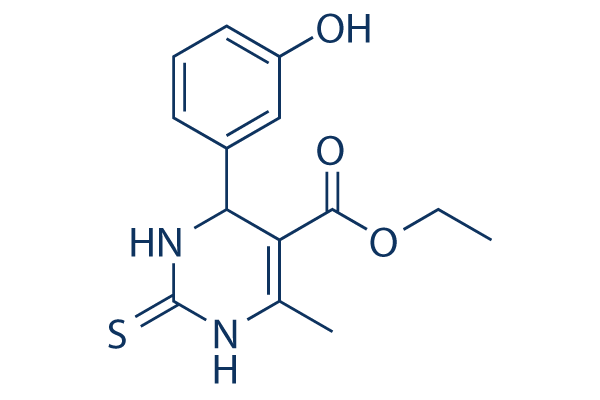
Structure chimique
Poids moléculaire: 292.35
Contrôle qualité
| Cibles apparentées | Akt Wnt/beta-catenin PKC HSP ROCK Microtubule Associated Integrin Bcr-Abl Actin FAK |
|---|---|
| Autre Kinesin Inhibiteurs | GSK923295 Ispinesib (SB-715992) SB743921 HCl ARQ 621 K 858 BTB-1 VLS-1488(KIF18A-IN-6 ) H-Cys(Trt)-OH Filanesib hydrochloride GW406108X |
Culture cellulaire, traitement et concentration de travail
| Lignées cellulaires | Type dessai | Concentration | Temps dincubation | Formulation | Description de lactivité | PMID |
|---|---|---|---|---|---|---|
| HeLa | Function assay | 12 hrs | Inhibition of Eg5 ATPase activity expressed in HeLa cells after 12 hrs, IC50=6.1μM | 17587586 | ||
| HCT116 | Cell cycle assay | Effect on cell cycle progression in human HCT116 cells assessed as mitotic arrest measured by doubling DNA content by fluorescence microscopy, EC50=1.2μM | 18793847 | |||
| HCT116 | Cell cycle assay | Effect on cell cycle progression in human HCT116 cells assessed as increase in phospho-histone H3 by fluorescence microscopy, EC50=1.5μM | 18793847 | |||
| KBV1/KB3-1 | Function assay | Drug resistant ratio of EC50 for human KBV1 cells overexpressing MDR1 to EC50 for KB3-1 cells, EC50=0.0012μM | 20597485 | |||
| HCT116 | Antiproliferative assay | 72 hrs | Antiproliferative activity against human HCT116 cells after 72 hrs by Alamar blue assay, EC50=24.155μM | 20597485 | ||
| hTERT-HME1 | Antiproliferative assay | 72 hrs | Antiproliferative activity against human hTERT-HME1 cells after 72 hrs by Alamar blue assay, EC50=45.082μM | 20597485 | ||
| KBV1 | Antiproliferative assay | 72 hrs | Antiproliferative activity against human KBV1 cells overexpressing MDR1 after 72 hrs by Alamar blue assay in presence of zosuquidar, EC50=45.394μM | 20597485 | ||
| HL-60(TB) | Growth inhibition assay | Growth inhibition of human HL-60(TB) cells, GI50=25.1μM | 21855351 | |||
| M14 | Growth inhibition assay | Growth inhibition of human M14 cells, GI50=25.1μM | 21855351 | |||
| CCRF-CEM | Growth inhibition assay | Growth inhibition of human CCRF-CEM cells, GI50=31.6μM | 21855351 | |||
| K562 | Growth inhibition assay | Growth inhibition of human K562 cells, GI50=31.6μM | 21855351 | |||
| MOLT4 | Growth inhibition assay | Growth inhibition of human MOLT4 cells, GI50=31.6μM | 21855351 | |||
| SR | Growth inhibition assay | Growth inhibition of human SR cells, GI50=31.6μM | 21855351 | |||
| NCI-H522 | Growth inhibition assay | Growth inhibition of human NCI-H522 cells, GI50=31.6μM | 21855351 | |||
| COLO205 | Growth inhibition assay | Growth inhibition of human COLO205 cells, GI50=31.6μM | 21855351 | |||
| HCT116 | Growth inhibition assay | Growth inhibition of human HCT116 cells, GI50=31.6μM | 21855351 | |||
| KM12 | Growth inhibition assay | Growth inhibition of human KM12 cells, GI50=31.6μM | 21855351 | |||
| SF295 | Growth inhibition assay | Growth inhibition of human SF295 cells, GI50=31.6μM | 21855351 | |||
| U251 | Growth inhibition assay | Growth inhibition of human U251 cells, GI50=31.6μM | 21855351 | |||
| SK-MEL-2 | Growth inhibition assay | Growth inhibition of human SK-MEL-2 cells, GI50=31.6μM | 21855351 | |||
| RPMI8266 | Growth inhibition assay | Growth inhibition of human RPMI8266 cells, GI50=31.6μM | 21855351 | |||
| NCI-H322M | Growth inhibition assay | Growth inhibition of human NCI-H322M cells, GI50=39.8μM | 21855351 | |||
| HCC2998 | Growth inhibition assay | Growth inhibition of human HCC2998 cells, GI50=39.8μM | 21855351 | |||
| HCT15 | Growth inhibition assay | Growth inhibition of human HCT15 cells, GI50=39.8μM | 21855351 | |||
| SW620 | Growth inhibition assay | Growth inhibition of human SW620 cells, GI50=39.8μM | 21855351 | |||
| SNB75 | Growth inhibition assay | Growth inhibition of human SNB75 cells, GI50=39.8μM | 21855351 | |||
| SK-MEL-5 | Growth inhibition assay | Growth inhibition of human SK-MEL-5 cells, GI50=39.8μM | 21855351 | |||
| UACC62 | Growth inhibition assay | Growth inhibition of human UACC62 cells, GI50=39.8μM | 21855351 | |||
| SN12C | Growth inhibition assay | Growth inhibition of human SN12C cells, GI50=39.8μM | 21855351 | |||
| HL-60(TB) | Growth inhibition assay | 24 hrs | Growth inhibition of human HL-60(TB) cells incubated for 24 hrs by MTT assay, IC50=0.147μM | 28667871 | ||
| MOLT4 | Growth inhibition assay | 24 hrs | Growth inhibition of human MOLT4 cells incubated for 24 hrs by MTT assay, IC50=0.215μM | 28667871 | ||
| TC32 | qHTS assay | qHTS of pediatric cancer cell lines to identify multiple opportunities for drug repurposing: Primary screen for TC32 cells | 29435139 | |||
| DAOY | qHTS assay | qHTS of pediatric cancer cell lines to identify multiple opportunities for drug repurposing: Primary screen for DAOY cells | 29435139 | |||
| SJ-GBM2 | qHTS assay | qHTS of pediatric cancer cell lines to identify multiple opportunities for drug repurposing: Primary screen for SJ-GBM2 cells | 29435139 | |||
| A673 | qHTS assay | qHTS of pediatric cancer cell lines to identify multiple opportunities for drug repurposing: Primary screen for A673 cells | 29435139 | |||
| SK-N-MC | qHTS assay | qHTS of pediatric cancer cell lines to identify multiple opportunities for drug repurposing: Primary screen for SK-N-MC cells | 29435139 | |||
| NB-EBc1 | qHTS assay | qHTS of pediatric cancer cell lines to identify multiple opportunities for drug repurposing: Primary screen for NB-EBc1 cells | 29435139 | |||
| LAN-5 | qHTS assay | qHTS of pediatric cancer cell lines to identify multiple opportunities for drug repurposing: Primary screen for LAN-5 cells | 29435139 | |||
| BT-12 | qHTS assay | qHTS of pediatric cancer cell lines to identify multiple opportunities for drug repurposing: Primary screen for BT-12 cells | 29435139 | |||
| OHS-50 | qHTS assay | qHTS of pediatric cancer cell lines to identify multiple opportunities for drug repurposing: Primary screen for OHS-50 cells | 29435139 | |||
| A673 | qHTS assay | qHTS of pediatric cancer cell lines to identify multiple opportunities for drug repurposing: Confirmatory screen for A673 cells) | 29435139 | |||
| SK-N-MC | qHTS assay | qHTS of pediatric cancer cell lines to identify multiple opportunities for drug repurposing: Confirmatory screen for SK-N-MC cells | 29435139 | |||
| TC32 | qHTS assay | qHTS of pediatric cancer cell lines to identify multiple opportunities for drug repurposing: Confirmatory screen for TC32 cells | 29435139 | |||
| U-2 OS | qHTS assay | qHTS of pediatric cancer cell lines to identify multiple opportunities for drug repurposing: Confirmatory screen for U-2 OS cells | 29435139 | |||
| McCoy | Cytotoxicity assay | 72 hrs | Cytotoxicity against mouse McCoy cells assessed as decrease in cell viability after 72 hrs by MTT assay, IC50=26.8μM | 29908443 | ||
| MM1S | Antiproliferative assay | 72 hrs | Antiproliferative activity against human MM1S cells incubated for 72 hrs by MTT assay, IC50=8.7μM | ChEMBL | ||
| HCT116 | Antiproliferative assay | 72 hrs | Antiproliferative activity against human HCT116 cells incubated for 72 hrs by MTT assay, IC50=9μM | ChEMBL | ||
| C6 | Antiproliferative assay | 100 uM | 24 hrs | Antiproliferative activity against rat C6 cells assessed as reduction in cell viability at 100 uM after 24 hrs by MTS assay relative to control | ChEMBL | |
| C6 | Cell cycle assay | 100 uM | 24 hrs | Cell cycle arrest in rat C6 cells assessed as accumulation at G2/M phase at 100 uM after 24 hrs by propidium iodide staining based flow cytometry | ChEMBL | |
| U138MG | Apoptosis assay | 200 uM | 48 hrs | Induction of apoptosis in human U138MG cells at 200 uM after 48 hrs by Annexin V/propidium iodide staining based flow cytometry | ChEMBL | |
| U138MG | Necrosis assay | 200 uM | 48 hrs | Induction of necrosis in human U138MG cells at 200 uM after 48 hrs by Annexin V/propidium iodide staining based flow cytometry | ChEMBL | |
| C6 | Apoptosis assay | 100 uM | 48 hrs | Induction of apoptosis in rat C6 cells at 100 uM after 48 hrs by Annexin V/propidium iodide staining based flow cytometry | ChEMBL | |
| U138MG | Function assay | 200 uM | 24 hrs | Inhibition of EG5 in human U138MG cells assessed as monopolar spindle formation at 200 uM after 24 hrs by Hoechst staining based immunofluorescence microscopic method | ChEMBL | |
| C6 | Function assay | 100 uM | 24 hrs | Inhibition of EG5 in rat C6 cells assessed as monopolar spindle formation at 100 uM after 24 hrs by Hoechst staining based immunofluorescence microscopic method | ChEMBL | |
| C6 | Antiproliferative assay | 5 to 50 uM | 48 hrs | Antiproliferative activity against rat C6 cells at 5 to 50 uM after 48 hrs by Neubauer chamber method | ChEMBL | |
| MCF7 | Antiproliferative assay | 25 uM | 48 hrs | Antiproliferative activity against human MCF7 cells at 25 uM after 48 hrs by sulforhodamine B assay | ChEMBL | |
| NCI/ADR-RES | Antiproliferative assay | 25 uM | 48 hrs | Antiproliferative activity against human NCI/ADR-RES cells at 25 uM after 48 hrs by sulforhodamine B assay | ChEMBL | |
| 786-0 | Antiproliferative assay | 25 uM | 48 hrs | Antiproliferative activity against human 786-0 cells at 25 uM after 48 hrs by sulforhodamine B assay | ChEMBL | |
| HT-29 | Antiproliferative assay | 25 uM | 48 hrs | Antiproliferative activity against human HT-29 cells at 25 uM after 48 hrs by sulforhodamine B assay | ChEMBL | |
| UACC62 | Antiproliferative assay | 25 uM | 48 hrs | Antiproliferative activity against human UACC62 cells at 25 uM after 48 hrs by sulforhodamine B assay | ChEMBL | |
| PC3 | Antiproliferative assay | 25 uM | 48 hrs | Antiproliferative activity against human PC3 cells at 25 uM after 48 hrs by sulforhodamine B assay | ChEMBL | |
| OVCAR3 | Antiproliferative assay | 25 uM | 48 hrs | Antiproliferative activity against human OVCAR3 cells at 25 uM after 48 hrs by sulforhodamine B assay | ChEMBL | |
| Cliquez pour voir plus de données expérimentales sur les lignées cellulaires | ||||||
Informations chimiques, stockage et stabilité
| Poids moléculaire | 292.35 | Formule | C14H16N2O3S |
Stockage (À partir de la date de réception) | 3 years -20°C(in the dark) powder |
|---|---|---|---|---|---|
| N° CAS | 329689-23-8 | Télécharger le SDF | Stockage des solutions mères |
|
|
| Synonymes | (±)-Monastrol | Smiles | CCOC(=O)C1=C(NC(=S)NC1C2=CC(=CC=C2)O)C | ||
Solubilité
|
In vitro |
DMSO
: 58 mg/mL
(198.39 mM)
Ethanol : 58 mg/mL Water : Insoluble |
Calculateur de molarité
|
In vivo |
|||||
Calculateur de formulation in vivo (Solution claire)
Étape 1 : Entrez les informations ci-dessous (Recommandé : Un animal supplémentaire pour tenir compte des pertes pendant lexpérience)
Étape 2 : Entrez la formulation in vivo (Ceci nest que le calculateur, pas la formulation. Veuillez nous contacter dabord sil ny a pas de formulation in vivo dans la section Solubilité.)
Résultats du calcul :
Concentration de travail : mg/ml;
Méthode de préparation du liquide maître DMSO : mg médicament prédissous dans μL DMSO ( Concentration du liquide maître mg/mL, Veuillez nous contacter dabord si la concentration dépasse la solubilité du DMSO du lot de médicament. )
Méthode de préparation de la formulation in vivo : Prendre μL DMSO liquide maître, ajouter ensuiteμL PEG300, mélanger et clarifier, ajouter ensuiteμL Tween 80, mélanger et clarifier, ajouter ensuite μL ddH2O, mélanger et clarifier.
Méthode de préparation de la formulation in vivo : Prendre μL DMSO liquide maître, ajouter ensuite μL Huile de maïs, mélanger et clarifier.
Remarque : 1. Assurez-vous que le liquide est clair avant dajouter le solvant suivant.
2. Assurez-vous dajouter le(s) solvant(s) dans lordre. Vous devez vous assurer que la solution obtenue lors de lajout précédent est une solution claire avant de procéder à lajout du solvant suivant. Des méthodes physiques telles que le vortex, les ultrasons ou le bain-marie peuvent être utilisées pour faciliter la dissolution.
Mécanisme daction
| Targets/IC50/Ki |
KIF11(Eg5)
(Cell-based assay) 14 μM
|
|---|---|
| In vitro |
Monastrol n'inhibe pas la progression à travers les phases S et G2 du cycle cellulaire ou la duplication des centrosomes. L'arrêt mitotique dû à ce composé est également rapidement réversible. Il inhibe également la formation de fuseaux bipolaires dans les extraits d'œufs de Xénope. Ce produit chimique arrête les cellules en mitose avec des fuseaux monoastraux composés d'un réseau radial de microtubules entouré d'un anneau de chromosomes, tandis qu'il n'affecte pas les microtubules dans les cellules en interphase ou la polymérisation des microtubules in vitro. L'exposition de neurones sympathiques cultivés à ce composé pendant quelques heures augmente à la fois le nombre et le taux de croissance des axones. Avec un temps supplémentaire, les longueurs globales des axones sont indiscernables des contrôles. Les neurones sensoriels montrent une augmentation similaire à court terme du taux de croissance axonal. Cependant, une exposition prolongée entraîne des axones plus courts, suggérant que les neurones sensoriels peuvent être plus sensibles aux effets toxiques du médicament. Néanmoins, la santé globale des cultures est encore bien plus robuste que les cultures traitées au taxol, un médicament couramment utilisé pour la thérapie anticancéreuse. Dans les cellules HeLa, ce composé active le point de contrôle du fuseau, entraînant un arrêt mitotique et une apoptose. |
Références |
|
Applications
| Méthodes | Biomarqueurs | Images | PMID |
|---|---|---|---|
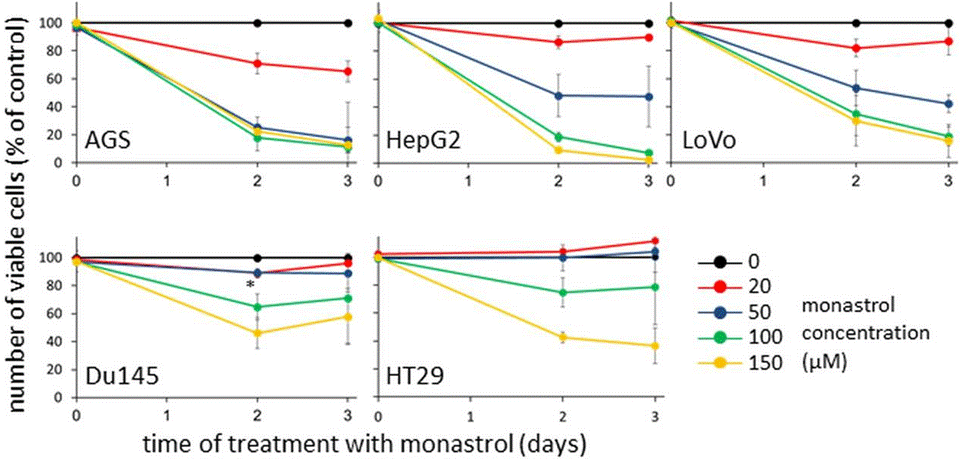
| Growth inhibition assay | Cell viability |
|
26035434 |
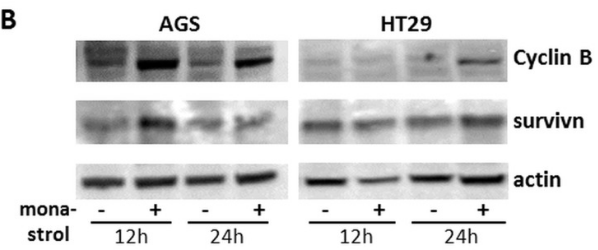
| Western blot | Cyclin B / Survivin |
|
26035434 |
Support technique
Tel: +1-832-582-8158 Ext:3
Si vous avez dautres questions, veuillez laisser un message.

Les produits sont destinés à la recherche uniquement. Non destinés à lusage humain. Nous ne vendons pas aux patients.
©Copyright 2013 Selleck Chemicals. Tous droits réservés.