
Datos técnicos
| Fórmula | C26H23F2N3O3 |
||||||
| Peso molecular | 463.48 | Número CAS | 209984-56-5 | ||||
| Solubilidad (25°C)* | In vitro | DMSO | 93 mg/mL (200.65 mM) | ||||
| Water | Insoluble | ||||||
| Ethanol | Insoluble | ||||||
| In vivo (Agregue los solventes al producto individualmente y en orden.) |
|
||||||
|
* <1 mg/ml significa ligeramente soluble o insoluble. * Tenga en cuenta que Selleck prueba la solubilidad de todos los compuestos internamente, y la solubilidad real puede diferir ligeramente de los valores publicados. Esto es normal y se debe a ligeras variaciones entre lotes. * Envío a temperatura ambiente (Las pruebas de estabilidad demuestran que este producto se puede enviar sin medidas de refrigeración.) |
|||||||
Preparación de soluciones madre
Actividad biológica
| Descripción | DBZ (Dibenzazepina) es un inhibidor dipeptídico de γ-secretase con un IC50 de 2,6 nM y 2,9 nM en ensayos sin células para la escisión de APPL y Notch, respectivamente. | ||||
|---|---|---|---|---|---|
| Objetivos |
|
||||
| In vitro | YO-01027 interactúa directamente con el complejo γ-secretase y se dirige al fragmento N-terminal de Presenilina. El aumento de las concentraciones de YO-01027 administradas a células que expresan APPL o Notch conduce a la acumulación progresiva de fragmentos APPL CTF y a una disminución de la producción de NICD de manera estrictamente dependiente de la dosis. 10 μM de YO-01027 reduce el número y la actividad de las células madre de cáncer de mama (BCSC). Una investigación reciente indica que YO-01027 deteriora la biosíntesis de la proteína mucina MUC16 de manera dependiente de la concentración en células indiferenciadas en las etapas pre-confluente y confluente a través de la inhibición de Notch, pero no en células estratificadas posmitóticas. | ||||
| In vivo | YO-01027, que se administra a 1 mg/mL por inyección i.p. el día de la inyección celular y cada 3 días posteriores, disminuye significativamente los tumores MCF7 pero no los tumores MDA-MB-231 y aumenta la latencia en comparación con los ratones control (18-28 días). Los tumores MCF7 tratados con YO-01027 que se formaron tuvieron volúmenes tumorales significativamente reducidos. El tratamiento de ratones C57BL/6 con YO-01027 inhibe la proliferación de células epiteliales e induce la diferenciación de células caliciformes en adenomas intestinales de manera dosis-dependiente. } |
Protocolo (de referencia)
| Ensayo de quinasa: |
|
|---|---|
| Ensayo celular: |
|
| Estudio en animales: |
|
Referencias
|
Validación de productos por parte del cliente
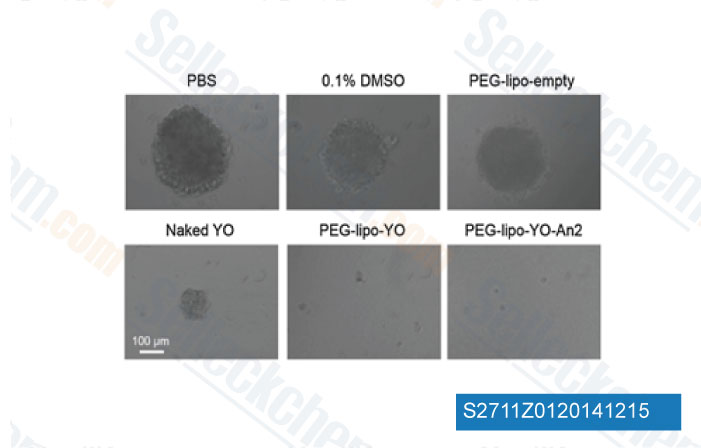
-
Datos de [ Journal of Pharmaceutical Investigation , 2014 , 10.1007/s40005-014-0151-2 ]
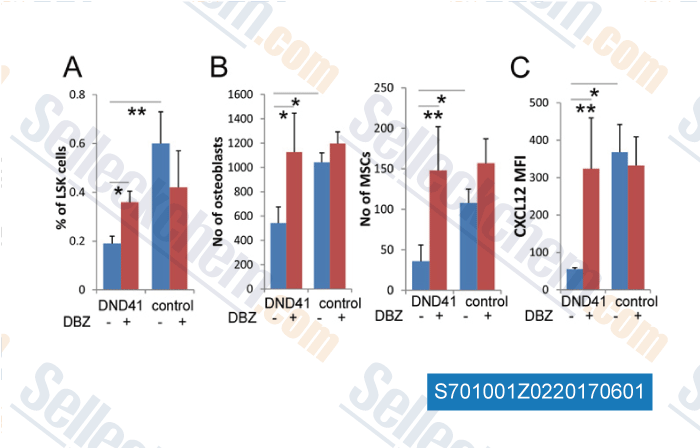
-
Datos de [ , , Cancer Res, 2016, 76(6):1641-52 ]
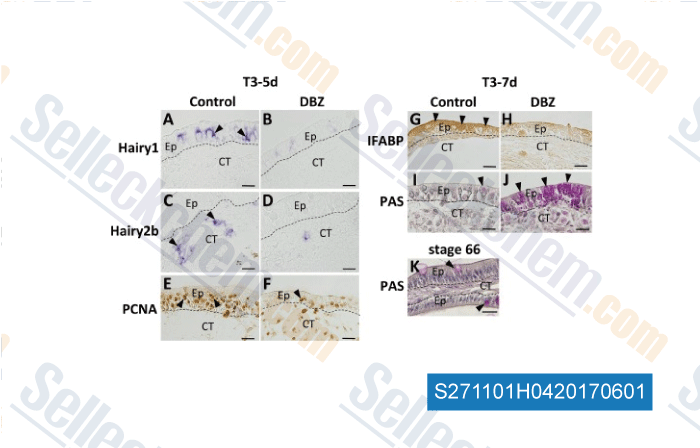
-
Datos de [ , , Stem Cells, 2017, 35(4):1028-1039 ]
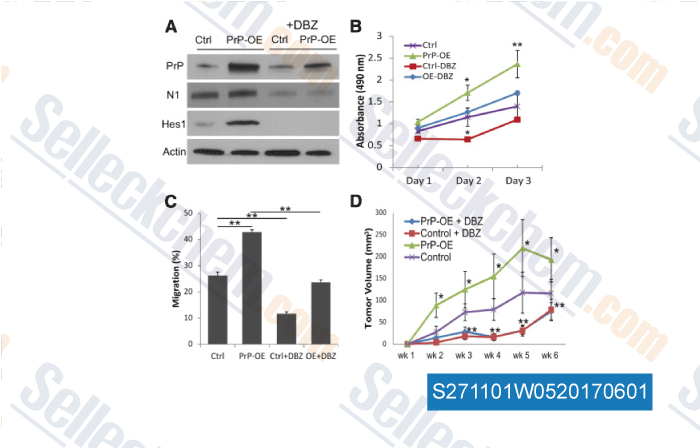
-
Datos de [ , , Am J Pathol, 2016, 186(11):2945-2956 ]
Sellecks Dibenzazepine (YO-01027) Ha sido citado por 40 Publicaciones
| GSK3 acts as a switch for transcriptional programs in a model of low-grade gliomagenesis [ Acta Neuropathol Commun, 2025, 13(1):87] | PubMed: 40307935 |
| Activation of notch signaling pathway is a potential mechanism for mucin2 reduction and intestinal mucosal barrier dysfunction in high-altitude hypoxia [ Sci Rep, 2025, 15(1):12154] | PubMed: 40204779 |
| A noncoding variant confers pancreatic differentiation defect and contributes to diabetes susceptibility by recruiting RXRA [ Nat Commun, 2024, 15(1):9771] | PubMed: 39532884 |
| Notch1 blockade by a novel, selective anti-Notch1 neutralizing antibody improves immunotherapy efficacy in melanoma by promoting an inflamed TME [ J Exp Clin Cancer Res, 2024, 43(1):295] | PubMed: 39491031 |
| GPA33 expression in colorectal cancer can be induced by WNT inhibition and targeted by cellular therapy [ Oncogene, 2024, ] | PubMed: 39472498 |
| Patient-Induced Pluripotent Stem Cell-Derived Hepatostellate Organoids Establish a Basis for Liver Pathologies in Telomeropathies [ Cell Mol Gastroenterol Hepatol, 2023, 16(3):451-472] | PubMed: 37302654 |
| HDAC6 and ERK/ADAM17 Regulate VEGF-Induced NOTCH Signaling in Lung Endothelial Cells [ Cells, 2023, 12(18)2231] | PubMed: 37759454 |
| Incongruence between transcriptional and vascular pathophysiological cell states [ Nat Cardiovasc Res, 2023, 2:2023530-549] | PubMed: 37745941 |
| Inhibition of LSD1 with bomedemstat sensitizes small cell lung cancer to immune checkpoint blockade and T cell killing [ Clin Cancer Res, 2022, CCR-22-1128] | PubMed: 35920742 |
| Notch signaling functions in noncanonical juxtacrine manner in platelets to amplify thrombogenicity [ Elife, 2022, 11e79590] | PubMed: 36190110 |
POLÍTICA DE DEVOLUCIÓN
La Política de Devolución Incondicional de Selleck Chemical garantiza una experiencia de compra en línea fluida para nuestros clientes. Si no está satisfecho con su compra de alguna manera, puede devolver cualquier artículo(s) dentro de los 7 días posteriores a su recepción. En caso de problemas de calidad del producto, ya sean problemas relacionados con el protocolo o con el producto, puede devolver cualquier artículo(s) dentro de los 365 días a partir de la fecha de compra original. Siga las instrucciones a continuación al devolver productos.
ENVÍO Y ALMACENAMIENTO
Los productos Selleck se transportan a temperatura ambiente. Si recibe el producto a temperatura ambiente, tenga la seguridad de que el Departamento de Inspección de Calidad de Selleck ha realizado experimentos para verificar que la colocación a temperatura normal durante un mes no afectará la actividad biológica de los productos en polvo. Después de la recogida, guarde el producto de acuerdo con los requisitos descritos en la hoja de datos. La mayoría de los productos Selleck son estables en las condiciones recomendadas.
NO PARA USO HUMANO, DIAGNÓSTICO VETERINARIO O TERAPÉUTICO.