
Datos técnicos
| Fórmula | C26H30N6O3 |
||||||
| Peso molecular | 474.55 | Número CAS | 1234480-50-2 | ||||
| Solubilidad (25°C)* | In vitro | DMSO | 95 mg/mL (200.18 mM) | ||||
| Ethanol | 2 mg/mL (4.21 mM) | ||||||
| Water | Insoluble | ||||||
| In vivo (Agregue los solventes al producto individualmente y en orden.) |
|
||||||
|
* <1 mg/ml significa ligeramente soluble o insoluble. * Tenga en cuenta que Selleck prueba la solubilidad de todos los compuestos internamente, y la solubilidad real puede diferir ligeramente de los valores publicados. Esto es normal y se debe a ligeras variaciones entre lotes. * Envío a temperatura ambiente (Las pruebas de estabilidad demuestran que este producto se puede enviar sin medidas de refrigeración.) |
|||||||
Preparación de soluciones madre
Actividad biológica
| Descripción | XMD8-92 es un potente y selectivo inhibidor dual de la gran MAP quinasa (BMK1, ERK5) y de las proteínas que contienen bromodominios (BRDs, BET) con una Kd de 80 nM y 170 nM para ERK5 y BRD4(1), respectivamente. | ||||
|---|---|---|---|---|---|
| Objetivos |
|
||||
| In vitro | XMD8-92, mediante la inhibición de la activación de BMK1, induce significativamente la expresión de p21 en las células y media la supresión de la proliferación de células cancerosas. Este compuesto anula marcadamente los efectos inhibidores de la hidroxisafrol amarillo A (HSYA) sobre la activación de las células estrelladas hepáticas (HSC) y bloquea la regulación a la baja de MEF2C mediada por HSYA. |
||||
| In vivo | XMD8-92 (50 mg/kg i.p.) inhibe significativamente el crecimiento de los tumores humanos xenoinjertados o de ratones singénicos al bloquear la proliferación de células tumorales y la angiogénesis asociada al tumor. Este compuesto inhibe el crecimiento del xenoinjerto de tumor pancreático mediante una regulación a la baja significativa de DCLK1 y de varios de sus objetivos posteriores. |
Protocolo (de referencia)
| Estudio en animales: |
|
|---|
Referencias
|
Validación de productos por parte del cliente
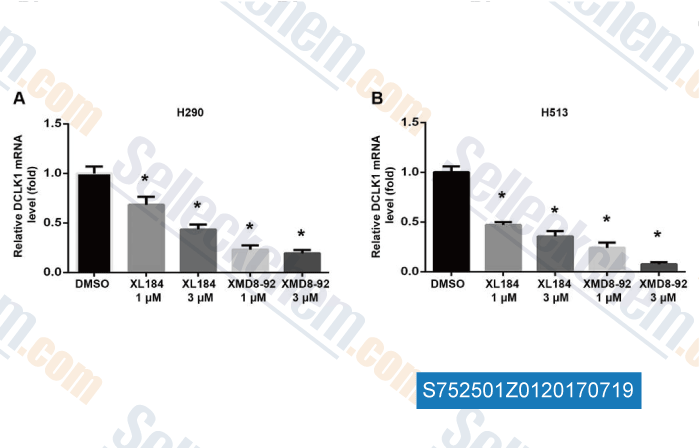
-
, , Int J Oncol, 2017, 51(1):91-103
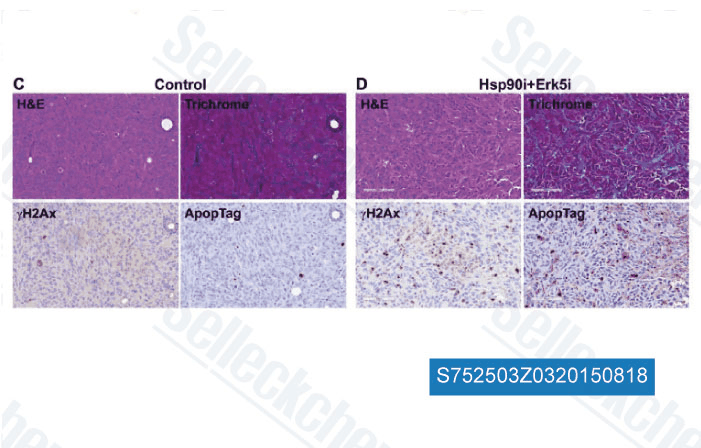
-
Datos de [ , , Oncotarget, 2014, 5(10): 3145-58 ]
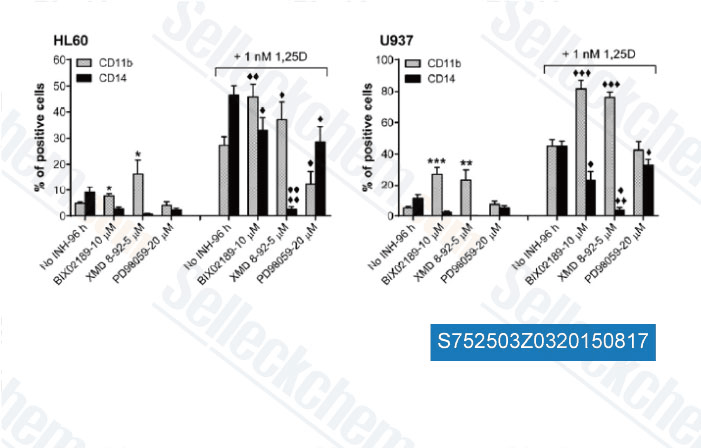
-
Datos de [ , , J Cell Physiol, 2014, 229(7): 856-67 ]
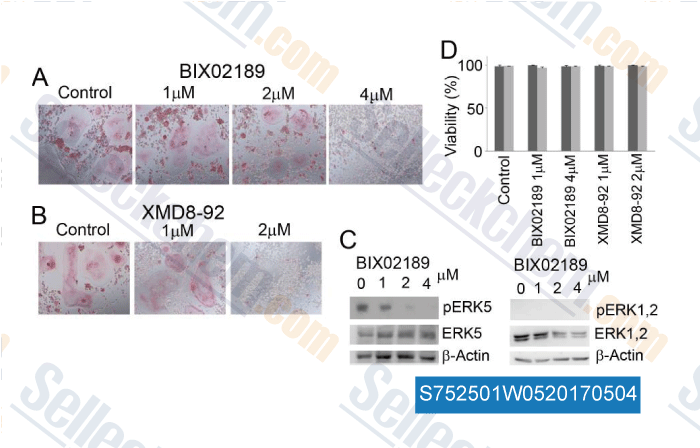
-
Datos de [ , , PLoS One, 2015, 10(4):e0125054 ]
Sellecks XMD8-92 Ha sido citado por 33 Publicaciones
| ERK5 promotes autocrine expression to sustain mitogenic balance for cell fate specification in human pluripotent stem cells [ Stem Cell Reports, 2024, S2213-6711(24)00216-9] | PubMed: 39151429 |
| GLP-1(7-36) protected against oxidative damage and neuronal apoptosis in the hippocampal CA region after traumatic brain injury by regulating ERK5/CREB [ Mol Biol Rep, 2024, 51(1):313] | PubMed: 38374452 |
| Protective effects of macrophage-specific integrin α5 in myocardial infarction are associated with accentuated angiogenesis [ Nat Commun, 2023, 10.1038/s41467-023-43369-x] | PubMed: 37985764 |
| Extracellular signal-Regulated Kinase 5 (ERK5) is required for the Yes-associated protein (YAP) co-transcriptional activity [ Cell Death Dis, 2023, 14(1):32] | PubMed: 36650140 |
| Endothelial activation and fibrotic changes are impeded by laminar flow-induced CHK1-SENP2 activity through mechanisms distinct from endothelial-to-mesenchymal cell transition [ Front Cardiovasc Med, 2023, 10:1187490] | PubMed: 37711550 |
| Identification of a Novel ERK5 (MAPK7) Inhibitor, MHJ-627, and Verification of Its Potent Anticancer Efficacy in Cervical Cancer HeLa Cells [ Curr Issues Mol Biol, 2023, 45(7):6154-6169] | PubMed: 37504304 |
| Glucose Starvation or Pyruvate Dehydrogenase Activation Induce a Broad, ERK5-Mediated, Metabolic Remodeling Leading to Fatty Acid Oxidation [ Cells, 2022, 11(9)1392] | PubMed: 35563698 |
| ERK5 Is a Major Determinant of Chemical Sarcomagenesis: Implications in Human Pathology [ Cancers (Basel), 2022, 14(14)3509] | PubMed: 35884568 |
| Establishment and characterization of immortalized sweat gland myoepithelial cells [ Sci Rep, 2022, 12(1):7] | PubMed: 34997030 |
| Ulinastatin promotes macrophage efferocytosis and ameliorates lung inflammation via the ERK5/Mer signaling pathway [ FEBS Open Bio, 2022, 12(8):1498-1508] | PubMed: 35778889 |
POLÍTICA DE DEVOLUCIÓN
La Política de Devolución Incondicional de Selleck Chemical garantiza una experiencia de compra en línea fluida para nuestros clientes. Si no está satisfecho con su compra de alguna manera, puede devolver cualquier artículo(s) dentro de los 7 días posteriores a su recepción. En caso de problemas de calidad del producto, ya sean problemas relacionados con el protocolo o con el producto, puede devolver cualquier artículo(s) dentro de los 365 días a partir de la fecha de compra original. Siga las instrucciones a continuación al devolver productos.
ENVÍO Y ALMACENAMIENTO
Los productos Selleck se transportan a temperatura ambiente. Si recibe el producto a temperatura ambiente, tenga la seguridad de que el Departamento de Inspección de Calidad de Selleck ha realizado experimentos para verificar que la colocación a temperatura normal durante un mes no afectará la actividad biológica de los productos en polvo. Después de la recogida, guarde el producto de acuerdo con los requisitos descritos en la hoja de datos. La mayoría de los productos Selleck son estables en las condiciones recomendadas.
NO PARA USO HUMANO, DIAGNÓSTICO VETERINARIO O TERAPÉUTICO.