
Datos técnicos
| Fórmula | C25H34N4O2.C4H4O4 |
||||||
| Peso molecular | 538.64 | Número CAS | 1092679-51-0 | ||||
| Solubilidad (25°C)* | In vitro | DMSO | 85 mg/mL (157.8 mM) | ||||
| Ethanol | 85 mg/mL (157.8 mM) | ||||||
| Water | Insoluble | ||||||
| In vivo (Agregue los solventes al producto individualmente y en orden.) |
|
||||||
|
* <1 mg/ml significa ligeramente soluble o insoluble. * Tenga en cuenta que Selleck prueba la solubilidad de todos los compuestos internamente, y la solubilidad real puede diferir ligeramente de los valores publicados. Esto es normal y se debe a ligeras variaciones entre lotes. * Envío a temperatura ambiente (Las pruebas de estabilidad demuestran que este producto se puede enviar sin medidas de refrigeración.) |
|||||||
Preparación de soluciones madre
Actividad biológica
| Descripción | El maleato de WAY-100635 es un potente y selectivo antagonista del receptor 5-HT con una IC50 de 0,95 nM. | ||
|---|---|---|---|
| Objetivos |
|
||
| In vitro | En rebanadas del núcleo dorsal del rafe (DRN) superfundidas con WAY 100635 (10 nM), la mayoría de las neuronas putativas de 5-HT aumentan su tasa de disparo (13% de la tasa basal). Además, WAY 100635 previene completamente la disminución de la tasa de disparo producida por 5-HT (3-15 μM), 8-OH-DPAT (10 nM), 5-carboxamidotriptamina (20 nM) y lesopitrona (100 nM). El antagonismo ejercido por WAY 100635 se supera completamente aumentando la concentración de 5-HT a 300 μM con una IC50 de 0,95 nM. En rebanadas hipocampales, WAY 100635 (0,5 nM -10 nM) no altera el potencial de membrana en reposo ni la resistencia de entrada de la membrana de las células piramidales CA1 registradas intracelularmente. Sin embargo, WAY 100635 previene completamente no solo la hiperpolarización, con una IC50 de 1,3 nM, sino también la disminución de la resistencia de entrada de la membrana producida por 5-HT y 5-carboxamidotriptamina con IC50 de 22,5 μM y 50 nM, respectivamente. WAY 100635 tiene una IC50 de 1,35 nM y es > 100 veces más selectivo para el sitio 5-HT1A en relación con una variedad de otros receptores del SNC. El Bmax de la unión específica de [3H]WAY 100635 es consistentemente 50-60% mayor que el del radioligando agonista, [3H]8-OH-DPAT. El Mn2+, pero no los nucleótidos de guanina, inhibe la unión específica de [3H]WAY 100635. WAY 100635 no tiene acciones agonistas del receptor 5-HT1A, pero bloquea de forma dosis-dependiente los efectos de los agonistas tanto en el receptor 5-HT1A postsináptico en la región CA1 del hipocampo, como en el receptor 5-HT1A somatodendrítico que se localiza en las neuronas 5-HT del rafe dorsal. [3H]WAY 100635 tiene una Kd de aproximadamente 2,5 nM. En el íleon aislado de cobaya, WAY 100635 es un antagonista potente e, a altas concentraciones, insuperable de la acción agonista del receptor 5-HT1A de 5-carboxamidotriptamina, con un valor de pA2 aparente (a 0,3 nM) de 9,71. Cinco minutos después de la inyección i.v. de [3H]WAY 100635 (4 μCi -7,6 μCi por ratón), la cantidad de tritio encontrada en todo el cerebro representó solo el 1,5-1,8% de la radioactividad inyectada, las diferencias regionales en la acumulación de 3H ya correspondían a las de la densidad del receptor 5-HT1A. A la luz de su actividad dopaminérgica recientemente descubierta, las conclusiones extraídas de estudios que emplean WAY 100635 como un antagonista selectivo de 5-HT1A pueden necesitar ser reevaluadas. | ||
| In vivo | Se ha demostrado que [3H]WAY 100635 se une selectivamente a los receptores 5-HT1A cerebrales tras la administración intravenosa a ratones. WAY 100635 también bloquea de forma dosis-dependiente la capacidad del 8-OH-DPAT para inhibir el disparo de las neuronas 5-HT del rafe dorsal y para inducir el 'síndrome 5-HT', hipotermia, hiperfagia y para elevar los niveles plasmáticos de ACTH. En el modelo de ansiedad de la caja de luz/oscuridad en ratones, WAY 100635 induce efectos ansiolíticos. WAY 100635 no tiene un efecto intrínseco sobre la cognición en el modelo de memoria a corto plazo de emparejamiento retardado a la posición en la rata, pero revierte los efectos disruptivos de 8-OH-DPAT sobre el rendimiento motivacional motor. WAY 100635 bloquea la acción inhibidora de 8-OH-DPAT sobre el disparo neuronal del rafe dorsal en la rata anestesiada a dosis que no tienen acción inhibidora per se. En modelos conductuales, WAY 100635 en sí mismo no induce cambios conductuales manifiestos, pero antagoniza potentemente el síndrome conductual inducido por 8-OH-DPAT en la rata y el cobaya (dosis mínima efectiva = 0,003 mg/kg s.c. e ID50 = 0,01 mg/kg s.c., respectivamente). WAY 100635 también bloquea la hipotermia inducida por 8-OH-DPAT en ratones y ratas con valores de ID50 de 0,01 mg/kg s.c. | ||
| Características | Caracterizado como el primer radioligando antagonista 5-HT1A. |
Protocolo (de referencia)
| Ensayo celular: |
|
|---|---|
| Estudio en animales: |
|
Referencias
|
Validación de productos por parte del cliente
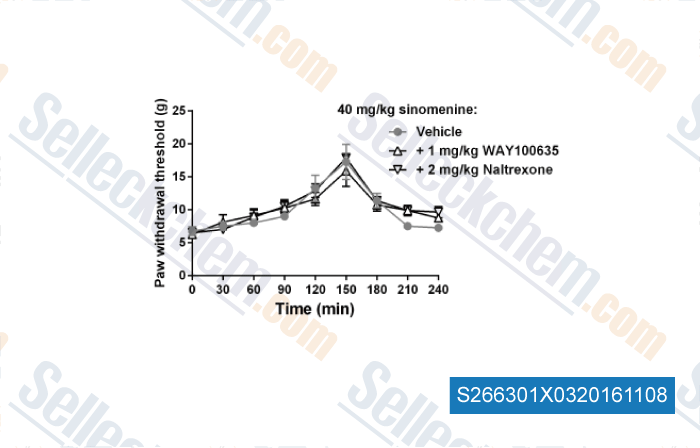
-
, , Sci Rep, 2014, 4:7270.
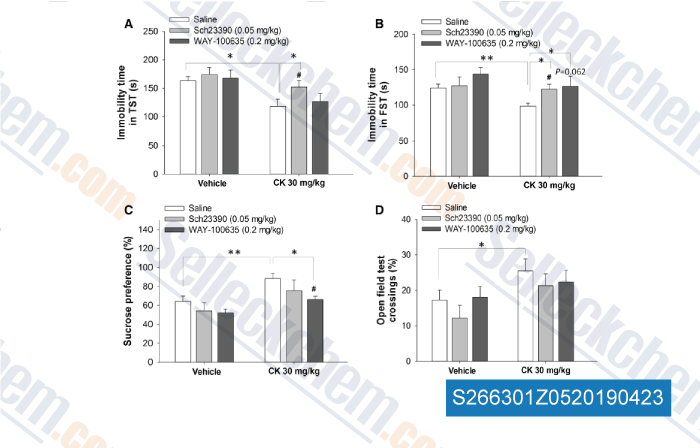
-
Datos de [ , , Neurochem Res, 2018, 43(7):1371-1382 ]
Sellecks WAY-100635 Maleate Ha sido citado por 9 Publicaciones
| Single-dose psilocybin rapidly and sustainably relieves allodynia and anxiodepressive-like behaviors in mouse models of chronic pain [ Nat Neurosci, 2025, 28(11):2285-2295] | PubMed: 41039182 |
| Targeting 5-Hydroxytryptamine Receptor 1A in the Portal Vein to Decrease Portal Hypertension [ Gastroenterology, 2024, 167(5):993-1007] | PubMed: 38906512 |
| Regular Aerobic Exercise Attenuates Pain and Anxiety in Mice by Restoring Serotonin-Modulated Synaptic Plasticity in the Anterior Cingulate Cortex [ Med Sci Sports Exerc, 2022, 54(4):566-581] | PubMed: 34935710 |
| N-Demethylsinomenine, an active metabolite of sinomenine, attenuates chronic neuropathic and inflammatory pain in mice [ Sci Rep, 2021, 11(1):9300] | PubMed: 33927244 |
| Spinal Serotonin 1A Receptor Contributes to the Analgesia of Acupoint Catgut Embedding by Inhibiting Phosphorylation of the N-Methyl-d-Aspartate Receptor GluN1 Subunit in Complete Freund's Adjuvant-Induced Inflammatory Pain in Rats [Cui WQ, et al. J Pain, 2019, 20(1):16.e1-16.e16] | PubMed: 30102991 |
| Antidepressant Effects of the Ginsenoside Metabolite Compound K, Assessed by Behavioral Despair Test and Chronic Unpredictable Mild Stress Model [Song W, et al. Neurochem Res, 2018, 43(7):1371-1382] | PubMed: 29790069 |
| Levo-Tetrahydroberberrubine Produces Anxiolytic-Like Effects in Mice through the 5-HT1A Receptor. [Mi G, et al. PLoS One, 2017, 12(1):e0168964] | PubMed: 28085967 |
| Stimulation of Anxiety-Like Behavior via ERK Pathway by Competitive Serotonin Receptors 2A and 1A in Post-Traumatic Stress Disordered Mice. [ Neurosignals, 2017, 25(1):39-53] | PubMed: 28977803 |
| Antinociceptive effects of sinomenine in a rat model of neuropathic pain. [Zhu Q, et al. Sci Rep, 2014, 4:7270] | PubMed: 25434829 |
POLÍTICA DE DEVOLUCIÓN
La Política de Devolución Incondicional de Selleck Chemical garantiza una experiencia de compra en línea fluida para nuestros clientes. Si no está satisfecho con su compra de alguna manera, puede devolver cualquier artículo(s) dentro de los 7 días posteriores a su recepción. En caso de problemas de calidad del producto, ya sean problemas relacionados con el protocolo o con el producto, puede devolver cualquier artículo(s) dentro de los 365 días a partir de la fecha de compra original. Siga las instrucciones a continuación al devolver productos.
ENVÍO Y ALMACENAMIENTO
Los productos Selleck se transportan a temperatura ambiente. Si recibe el producto a temperatura ambiente, tenga la seguridad de que el Departamento de Inspección de Calidad de Selleck ha realizado experimentos para verificar que la colocación a temperatura normal durante un mes no afectará la actividad biológica de los productos en polvo. Después de la recogida, guarde el producto de acuerdo con los requisitos descritos en la hoja de datos. La mayoría de los productos Selleck son estables en las condiciones recomendadas.
NO PARA USO HUMANO, DIAGNÓSTICO VETERINARIO O TERAPÉUTICO.