
Datos técnicos
| Fórmula | C19H14Cl2N2O3S |
||||||
| Peso molecular | 421.3 | Número CAS | 879085-55-9 | ||||
| Solubilidad (25°C)* | In vitro | DMSO | 84 mg/mL (199.38 mM) | ||||
| Water | Insoluble | ||||||
| Ethanol | Insoluble | ||||||
| In vivo (Agregue los solventes al producto individualmente y en orden.) |
|
||||||
|
* <1 mg/ml significa ligeramente soluble o insoluble. * Tenga en cuenta que Selleck prueba la solubilidad de todos los compuestos internamente, y la solubilidad real puede diferir ligeramente de los valores publicados. Esto es normal y se debe a ligeras variaciones entre lotes. * Envío a temperatura ambiente (Las pruebas de estabilidad demuestran que este producto se puede enviar sin medidas de refrigeración.) |
|||||||
Preparación de soluciones madre
Actividad biológica
| Descripción | Vismodegib (GDC-0449) es un inhibidor potente, nuevo y específico de hedgehog con una IC50 de 3 nM y también inhibe la P-gp con una IC50 de 3.0 μM en un ensayo sin células. | ||
|---|---|---|---|
| Objetivos |
|
||
| In vitro | Vismodegib (GDC-0449) se dirige a la vía de señalización Hedgehog, bloqueando las actividades de los receptores de superficie celular PTCH y/o SMO del ligando Hedgehog y suprimiendo la señalización Hedgehog. Este compuesto previene múltiples transportadores de casete de unión a ATP (ABC) y también bloquea ABCG2, Pgp y MRP1, importantes transportadores ABC asociados con la MDR. Es un potente inhibidor de los transportadores ABC, ABCG2/BCRP y ABCB1/Pgp, y un inhibidor suave de ABCC1/MRP1. En células HEK293 que sobreexpresan ABCG2, aumenta la retención del sustrato fluorescente de ABCG2 BODIPY y resensibiliza estas células. En células de riñón canino Madin-Darby II diseñadas para sobreexpresar Pgp o MRP1, aumenta la retención de calceína-AM y las resensibiliza. También resensibiliza las células de carcinoma de pulmón no microcítico humano NCI-H460/par y NCI-H460/MX20, que sobreexpresan ABCG2 en respuesta a SN-38. Los valores de IC50 para la prevención de ABCG2 y Pgp son aproximadamente 1,4 μM y 3,0 μM, respectivamente. Además, altera la homeostasis intracelular de Ca2+ e inhibe el crecimiento celular en células de cáncer de pulmón resistentes. |
||
| In vivo | Vismodegib (GDC-0449) se ha utilizado para tratar el meduloblastoma en modelos animales. Previene el crecimiento de xenoinjertos pancreáticos primarios sin inhibir inespecíficamente la proliferación de células pancreáticas. La dosificación oral de este compuesto provoca regresiones tumorales en el modelo de aloinjerto de meduloblastoma Ptch(+/-) a dosis ≥25 mg/kg e inhibición del crecimiento tumoral a dosis de hasta 92 mg/kg administradas dos veces al día en dos modelos de cáncer colorrectal dependientes del ligando, D5123 y 1040830. El análisis de la actividad de la vía Hh y el modelado PK/PD revelan que inhibe Gli1 con una IC50 similar tanto en el modelo de meduloblastoma como en el D5123 (0,165 μM y 0,267 μM, respectivamente). La modulación de la vía se vincula a la eficacia mediante un modelo PK/PD integrado que revela una relación pronunciada donde > 50% de la actividad de GDC-0449 se asocia con > 80% de represión de la vía Hh. |
Protocolo (de referencia)
| Ensayo celular: |
|
|---|---|
| Estudio en animales: |
|
Referencias
|
Validación de productos por parte del cliente
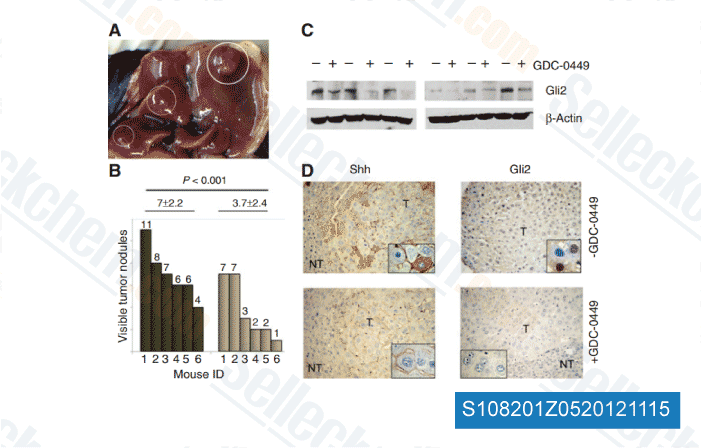
-
Datos de [ Cancer Res , 2014 , 72, 5912-20 ]
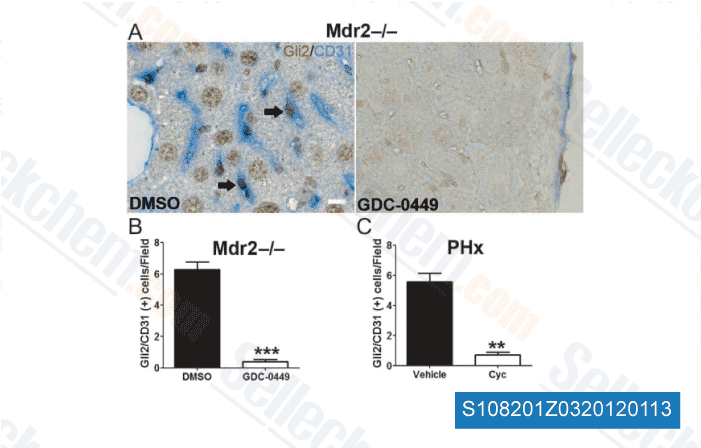
-
Datos de [ Gut , 2013 , 62, 299-309 ]
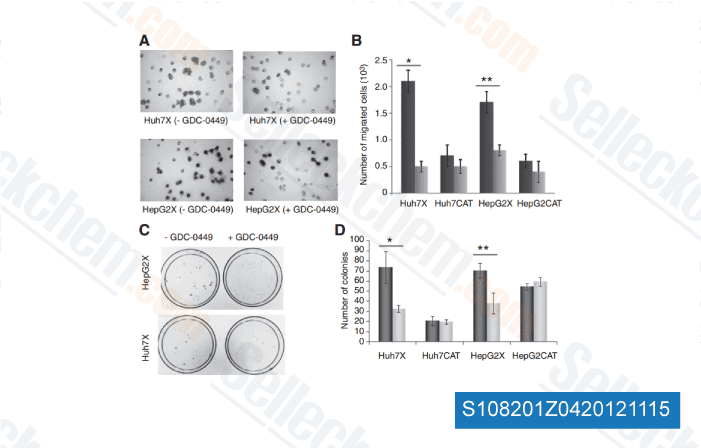
-
Datos de [ Cancer Res , 2013 , 72, 5912-20 ]
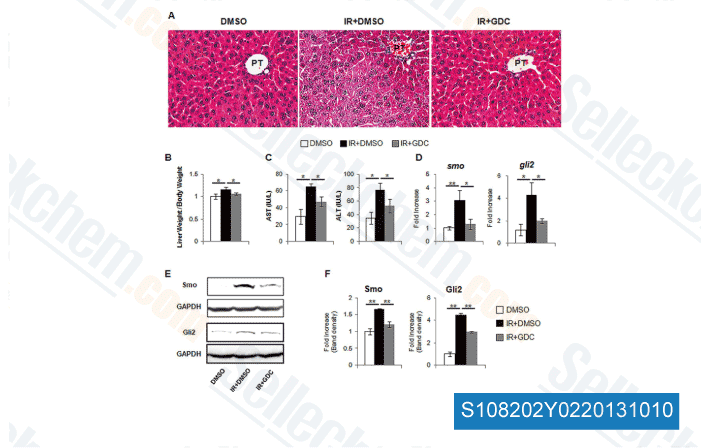
-
Datos de [ PLoS One , 2013 , 8, e74141 ]
Sellecks Vismodegib (GDC-0449) Ha sido citado por 225 Publicaciones
| Sonic hedgehog medulloblastomas are dependent on Netrin-1 for survival [ Nat Commun, 2025, 16(1):5137] | PubMed: 40461501 |
| OLIG2 mediates a rare targetable stem cell fate transition in sonic hedgehog medulloblastoma [ Nat Commun, 2025, 16(1):1092] | PubMed: 39904987 |
| The O-glycosyltransferase C1GALT1 promotes EWSR1::FLI1 expression and is a therapeutic target for Ewing sarcoma [ Nat Commun, 2025, 16(1):1267] | PubMed: 39894896 |
| BBS8-dependent ciliary Hedgehog signaling governs cell fate in the white adipose tissue [ EMBO J, 2025, 10.1038/s44318-025-00524-y] | PubMed: 40836034 |
| GPR137-RAB8A activation promotes ovarian cancer development via the Hedgehog pathway [ J Exp Clin Cancer Res, 2025, 44(1):22] | PubMed: 39856733 |
| BCL2 drives castration resistance in castration-sensitive prostate cancer by orchestrating reciprocal crosstalk between oncogenic pathways [ Cell Rep, 2025, 44(6):115779] | PubMed: 40448998 |
| The acetylation GLI1 affects arsenical-induced renal fibrosis by mediating the Hedgehog signalling pathway [ Ecotoxicol Environ Saf, 2025, 302:118676] | PubMed: 40669272 |
| Cranial base synostosis in mice caused by upregulation of Wnt following partial inhibition of Shh [ BMC Biol, 2025, 23(1):268] | PubMed: 40859304 |
| Spatially organized tumor-stroma boundary determines the efficacy of immunotherapy in colorectal cancer patients [ Nat Commun, 2024, 15(1):10259] | PubMed: 39592630 |
| Basal-to-inflammatory transition and tumor resistance via crosstalk with a pro-inflammatory stromal niche [ Nat Commun, 2024, 15(1):8134] | PubMed: 39289380 |
POLÍTICA DE DEVOLUCIÓN
La Política de Devolución Incondicional de Selleck Chemical garantiza una experiencia de compra en línea fluida para nuestros clientes. Si no está satisfecho con su compra de alguna manera, puede devolver cualquier artículo(s) dentro de los 7 días posteriores a su recepción. En caso de problemas de calidad del producto, ya sean problemas relacionados con el protocolo o con el producto, puede devolver cualquier artículo(s) dentro de los 365 días a partir de la fecha de compra original. Siga las instrucciones a continuación al devolver productos.
ENVÍO Y ALMACENAMIENTO
Los productos Selleck se transportan a temperatura ambiente. Si recibe el producto a temperatura ambiente, tenga la seguridad de que el Departamento de Inspección de Calidad de Selleck ha realizado experimentos para verificar que la colocación a temperatura normal durante un mes no afectará la actividad biológica de los productos en polvo. Después de la recogida, guarde el producto de acuerdo con los requisitos descritos en la hoja de datos. La mayoría de los productos Selleck son estables en las condiciones recomendadas.
NO PARA USO HUMANO, DIAGNÓSTICO VETERINARIO O TERAPÉUTICO.