
Datos técnicos
| Fórmula | C18H14BrNO5S2 |
||||||
| Peso molecular | 468.34 | Número CAS | 518303-20-3 | ||||
| Solubilidad (25°C)* | In vitro | DMSO | 93 mg/mL (198.57 mM) | ||||
| Ethanol | 93 mg/mL (198.57 mM) | ||||||
| Water | Insoluble | ||||||
| In vivo (Agregue los solventes al producto individualmente y en orden.) |
|
||||||
|
* <1 mg/ml significa ligeramente soluble o insoluble. * Tenga en cuenta que Selleck prueba la solubilidad de todos los compuestos internamente, y la solubilidad real puede diferir ligeramente de los valores publicados. Esto es normal y se debe a ligeras variaciones entre lotes. * Envío a temperatura ambiente (Las pruebas de estabilidad demuestran que este producto se puede enviar sin medidas de refrigeración.) |
|||||||
Preparación de soluciones madre
Actividad biológica
| Descripción | El UMI-77 es un inhibidor selectivo de Mcl-1 con un Ki de 490 nM, que muestra selectividad sobre otros miembros de la familia Bcl-2. | ||
|---|---|---|---|
| Objetivos |
|
||
| In vitro | El UMI-77 interrumpe eficazmente las interacciones entre BL-Noxa y Mcl-1 celular, así como las interacciones proteína-proteína Mcl-1/Bax. Este compuesto inhibe el crecimiento de las células cancerosas pancreáticas con un IC50 de 3,4, 4,4, 12,5, 16,1 y 5,5 μM para las células BxPC-3, Panc-1, MiaPaCa-2, AsPC-1 y Capan-2, respectivamente. Indujo la apoptosis en el cáncer de páncreas a través de la activación de la vía apoptótica intrínseca y/o el cambio conformacional de Bax. | ||
| In vivo | En un modelo de ratón con xenoinjerto BxPC-3, el UMI-77 (60 mg/kg i.v.) muestra actividad antitumoral como agente único sin dañar los tejidos normales. |
Protocolo (de referencia)
| Ensayo de quinasa: |
|
|---|---|
| Ensayo celular: |
|
| Estudio en animales: |
|
Referencias
|
Validación de productos por parte del cliente
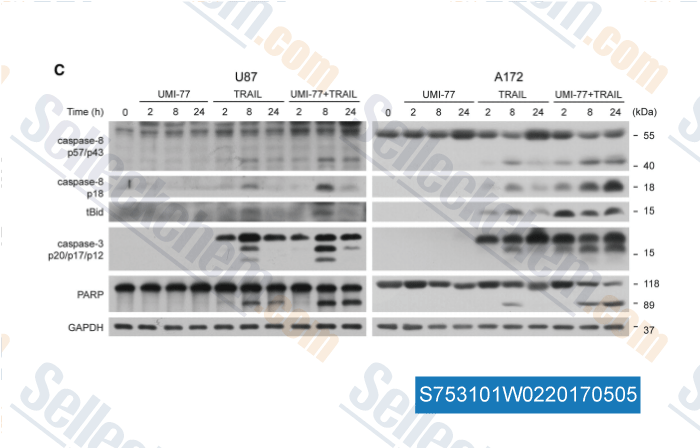
-
, , Mol Cell Biochem, 2017, 432(1-2):55-65
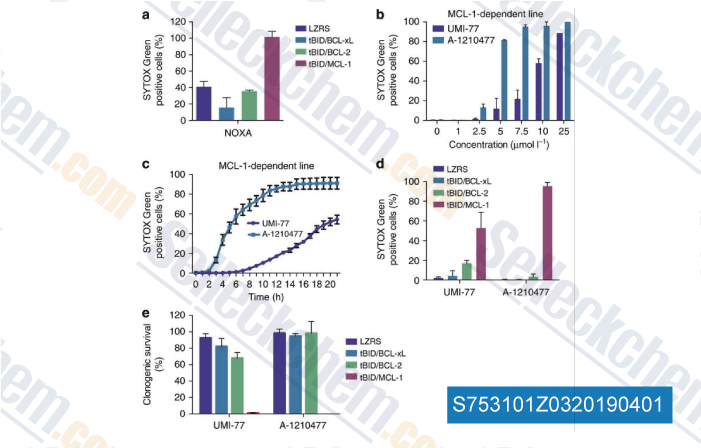
-
Datos de [ , , Nat Commun, 2016, 7:10538 ]
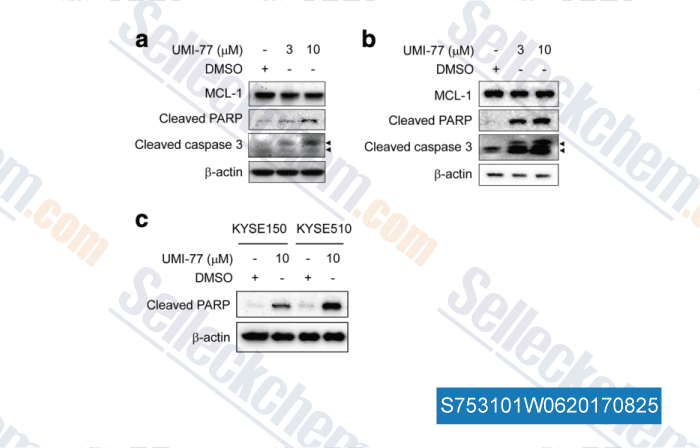
-
Datos de [ , , BMC Cancer, 2017, 17(1):449 ]
Sellecks UMI-77 Ha sido citado por 21 Publicaciones
| Therapy-induced normal tissue damage promotes breast cancer metastasis [ iScience, 2024, 27(1):108503] | PubMed: 38161426 |
| Deregulation and epigenetic modification of BCL2-family genes cause resistance to venetoclax in hematologic malignancies [ Blood, 2022, blood.2021014304] | PubMed: 35704690 |
| Proteogenomics refines the molecular classification of chronic lymphocytic leukemia [ Nat Commun, 2022, 13(1):6226] | PubMed: 36266272 |
| AXL/MERTK inhibitor ONO-7475 potently synergizes with venetoclax and overcomes venetoclax resistance to kill FLT3-ITD acute myeloid leukemia [ Haematologica, 2021, 10.3324/haematol.2021.278369] | PubMed: 34732043 |
| Development of potent and selective inhibitors targeting the papain-like protease of SARS-CoV-2 [ Cell Chem Biol, 2021, S2451-9456(21)00213-0] | PubMed: 33979649 |
| Mesothelioma Cells Depend on the Antiapoptotic Protein Bcl-xL for Survival and Are Sensitized to Ionizing Radiation by BH3-Mimetics. [ Int J Radiat Oncol Biol Phys, 2020, 15;106(4):867-877] | PubMed: 31786278 |
| Targeting the Synthetic Vulnerability of PTEN-Deficient Glioblastoma Cells with MCL1 Inhibitors [ Mol Cancer Ther, 2020, 19(10):2001-2011] | PubMed: 32737157 |
| AT101 [(-)-Gossypol] Selectively Inhibits MCL1 and Sensitizes Carcinoma to BH3 Mimetics by Inducing and Stabilizing NOXA [ Cancers (Basel), 2020, 12(8):E2298] | PubMed: 32824203 |
| Alveolar Macrophage Apoptosis-associated Bacterial Killing Helps Prevent Murine Pneumonia. [ Am J Respir Crit Care Med, 2019, 200(1):84-97] | PubMed: 30649895 |
| Confounding off-target effects of BH3 mimetics at commonly used concentrations: MIM1, UMI-77, and A-1210477 [ Cell Death Dis, 2019, 10(3):185] | PubMed: 30796196 |
POLÍTICA DE DEVOLUCIÓN
La Política de Devolución Incondicional de Selleck Chemical garantiza una experiencia de compra en línea fluida para nuestros clientes. Si no está satisfecho con su compra de alguna manera, puede devolver cualquier artículo(s) dentro de los 7 días posteriores a su recepción. En caso de problemas de calidad del producto, ya sean problemas relacionados con el protocolo o con el producto, puede devolver cualquier artículo(s) dentro de los 365 días a partir de la fecha de compra original. Siga las instrucciones a continuación al devolver productos.
ENVÍO Y ALMACENAMIENTO
Los productos Selleck se transportan a temperatura ambiente. Si recibe el producto a temperatura ambiente, tenga la seguridad de que el Departamento de Inspección de Calidad de Selleck ha realizado experimentos para verificar que la colocación a temperatura normal durante un mes no afectará la actividad biológica de los productos en polvo. Después de la recogida, guarde el producto de acuerdo con los requisitos descritos en la hoja de datos. La mayoría de los productos Selleck son estables en las condiciones recomendadas.
NO PARA USO HUMANO, DIAGNÓSTICO VETERINARIO O TERAPÉUTICO.