
Datos técnicos
| Fórmula | C24H15F3N4O |
||||||||||
| Peso molecular | 432.4 | Número CAS | 1223001-51-1 | ||||||||
| Solubilidad (25°C)* | In vitro | DMSO | 30 mg/mL (69.38 mM) | ||||||||
| Water | Insoluble | ||||||||||
| Ethanol | Insoluble | ||||||||||
| In vivo (Agregue los solventes al producto individualmente y en orden.) |
|
||||||||||
|
* <1 mg/ml significa ligeramente soluble o insoluble. * Tenga en cuenta que Selleck prueba la solubilidad de todos los compuestos internamente, y la solubilidad real puede diferir ligeramente de los valores publicados. Esto es normal y se debe a ligeras variaciones entre lotes. * Envío a temperatura ambiente (Las pruebas de estabilidad demuestran que este producto se puede enviar sin medidas de refrigeración.) |
|||||||||||
Preparación de soluciones madre
Actividad biológica
| Descripción | Torin 2 es un inhibidor potente y selectivo de mTOR con una IC50 de 0,25 nM en la línea celular p53 / - MEFs; 800 veces mayor selectividad para mTOR que PI3K y propiedades farmacocinéticas mejoradas. Este compuesto inhibe ATM/ATR/DNA-PK con una EC50 de 28 nM/35 nM/118 nM,en líneas celulares PC3 respectivamente. Disminuye la viabilidad celular e induce autophagy y apoptosis. | ||||||||
|---|---|---|---|---|---|---|---|---|---|
| Objetivos |
|
||||||||
| In vitro | Torin 2 tiene el mismo modo de unión que PI3Kγ, V882 sirve como punto de unión de bisagra y en el bolsillo hidrofóbico interno Y867, D841 y D964 proporcionan tres enlaces de hidrógeno más con la cadena lateral de aminopiridina análogos a Y2225, D2195 y D2357 de mTOR. Este compuesto inhibe mTORC1, activando así TFEB al promover su translocación nuclear con una EC50 de 1,666 mM. Este químico (< 50 nM) causa una reducción significativa en la viabilidad de las células MZ-CRC-1 y TT. Este (100 nM) ejerce una reducción significativa de la migración de las células MZ-CRC-1 y TT. |
||||||||
| In vivo | Torin 2 exhibe una respuesta farmacodinámica >95% y un tiempo de semivida de 11,7 min en el estudio de estabilidad de microsomas hepáticos de ratón. Este compuesto exhibe la mejor biodisponibilidad (51%), una vida media corta (0,72 horas) y un aclaramiento bajo (19,6 mL/min/kg) en ratones albinos suizos machos después de la administración intravenosa y oral. Este químico (20mg/kg) ablaciona tumores MYCN con reducción en los niveles de proteína MYCN e inducción de apoptosis en ratones Th-MYCN. |
Protocolo (de referencia)
| Ensayo de quinasa: |
|
|---|---|
| Ensayo celular: |
|
| Estudio en animales: |
|
Referencias
|
Validación de productos por parte del cliente
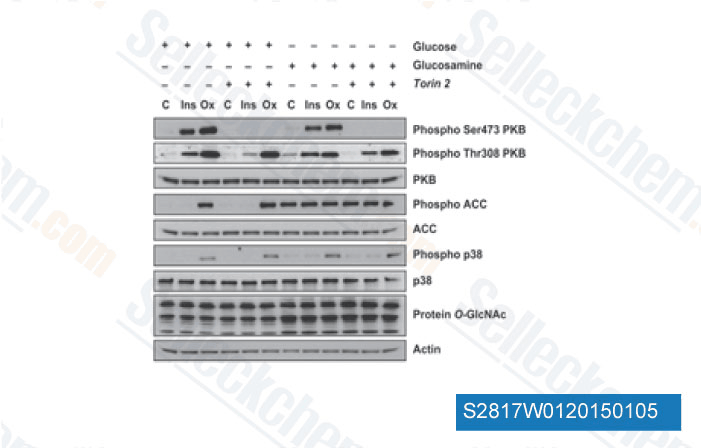
-
Datos de [ FEBS J , 2014 , 281(16), 3591-608 ]
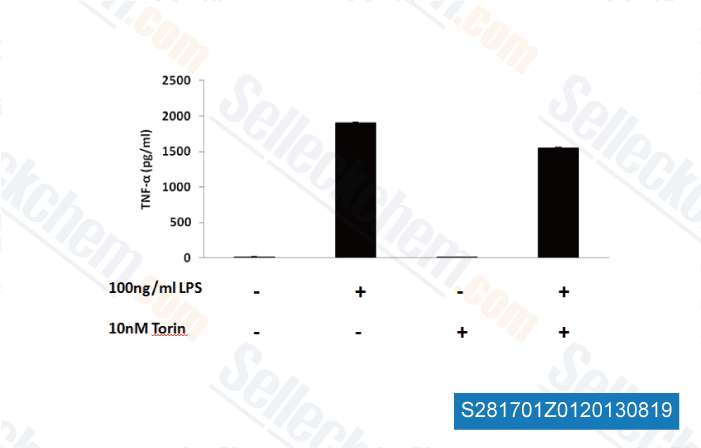
-
,
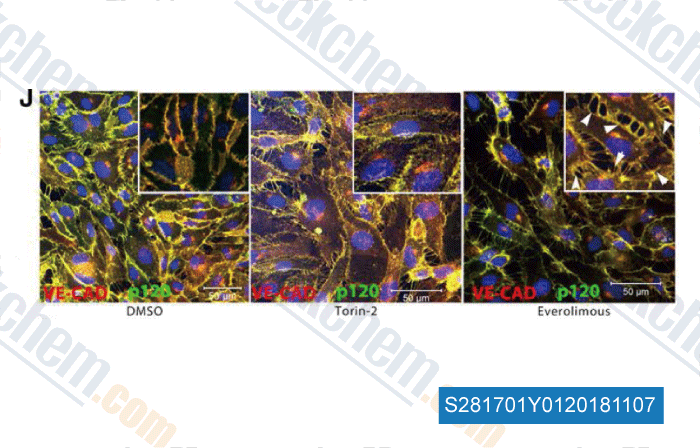
-
Datos de [ , , Arterioscler Thromb Vasc Biol, 2018, doi:10.1161/ATVBAHA.118.311321 ]
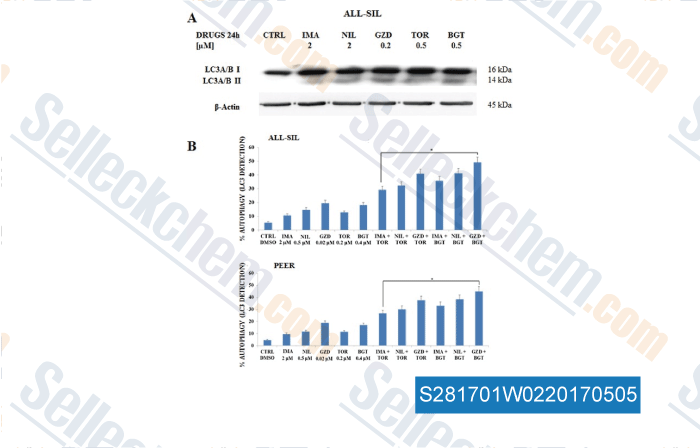
-
Datos de [ , , Oncotarget, 2016, 7(48):79842-79853 ]
Sellecks Torin 2 Ha sido citado por 71 Publicaciones
| Heterogeneous Activation of Signaling Pathways and Therapeutic Vulnerabilities in KSHV-Associated Primary Effusion Lymphoma Cell Lines [ J Med Virol, 2025, 97(8):e70534] | PubMed: 40751690 |
| Dynamic regulation of autophagy during Semliki Forest virus infection of neuroblastoma cells [ J Gen Virol, 2025, 106(3)002086] | PubMed: 40042894 |
| Differentiation stage-specific use of cap-independent and cap-dependent translation initiation in hematopoiesis [ bioRxiv, 2025, 2025.09.24.678136] | PubMed: 41040404 |
| Androgen receptor monomers and dimers regulate opposing biological processes in prostate cancer cells [ Nat Commun, 2024, 15(1):7675] | PubMed: 39227594 |
| Endothelial Mechanistic Target of Rapamycin Activation with Different Strains of R. rickettsii: Possible Role in Rickettsial Pathogenesis [ Microorganisms, 2024, 12(2)296] | PubMed: 38399700 |
| Analysis of ATG4C function in vivo [ Autophagy, 2023, 19(11):2912-2933] | PubMed: 37459465 |
| Continuous sensing of nutrients and growth factors by the mTORC1-TFEB axis [ Elife, 2023, 12e74903] | PubMed: 37698461 |
| Sequential Treatment with Temozolomide Plus Naturally Derived AT101 as an Alternative Therapeutic Strategy: Insights into Chemoresistance Mechanisms of Surviving Glioblastoma Cells [ Int J Mol Sci, 2023, 24(10)9075] | PubMed: 37240419 |
| Myc controls NK cell development, IL-15-driven expansion, and translational machinery [ Life Sci Alliance, 2023, 6(7)e202302069] | PubMed: 37105715 |
| Dephosphorylation of 4EBP1/2 Induces Prenatal Neural Stem Cell Quiescence [ bioRxiv, 2023, 2023.02.14.528513] | PubMed: 36824760 |
POLÍTICA DE DEVOLUCIÓN
La Política de Devolución Incondicional de Selleck Chemical garantiza una experiencia de compra en línea fluida para nuestros clientes. Si no está satisfecho con su compra de alguna manera, puede devolver cualquier artículo(s) dentro de los 7 días posteriores a su recepción. En caso de problemas de calidad del producto, ya sean problemas relacionados con el protocolo o con el producto, puede devolver cualquier artículo(s) dentro de los 365 días a partir de la fecha de compra original. Siga las instrucciones a continuación al devolver productos.
ENVÍO Y ALMACENAMIENTO
Los productos Selleck se transportan a temperatura ambiente. Si recibe el producto a temperatura ambiente, tenga la seguridad de que el Departamento de Inspección de Calidad de Selleck ha realizado experimentos para verificar que la colocación a temperatura normal durante un mes no afectará la actividad biológica de los productos en polvo. Después de la recogida, guarde el producto de acuerdo con los requisitos descritos en la hoja de datos. La mayoría de los productos Selleck son estables en las condiciones recomendadas.
NO PARA USO HUMANO, DIAGNÓSTICO VETERINARIO O TERAPÉUTICO.