
Datos técnicos
| Fórmula | C16H20N6O.C6H8O7 |
||||||
| Peso molecular | 504.49 | Número CAS | 540737-29-9 | ||||
| Solubilidad (25°C)* | In vitro | DMSO | 100 mg/mL (198.21 mM) | ||||
| Water | Insoluble | ||||||
| Ethanol | Insoluble | ||||||
| In vivo (Agregue los solventes al producto individualmente y en orden.) |
|
||||||
|
* <1 mg/ml significa ligeramente soluble o insoluble. * Tenga en cuenta que Selleck prueba la solubilidad de todos los compuestos internamente, y la solubilidad real puede diferir ligeramente de los valores publicados. Esto es normal y se debe a ligeras variaciones entre lotes. * Envío a temperatura ambiente (Las pruebas de estabilidad demuestran que este producto se puede enviar sin medidas de refrigeración.) |
|||||||
Preparación de soluciones madre
Actividad biológica
| Descripción | El citrato de tofacitinib (CP-690550, Tasocitinib) es un nuevo inhibidor de JAK con una IC50 de 1 nM, 20 nM y 112 nM contra JAK3, JAK2 y JAK1, respectivamente. También tiene actividad Anti-infection. | ||||
|---|---|---|---|---|---|
| Objetivos |
|
||||
| In vitro | El citrato de Tofacitinib inhibe la proliferación de blastos de células T humanas mediada por IL-2 y la expresión de CD69 inducida por IL-15 con IC50 de 11 nM y 48 nM, respectivamente. El citrato de Tofacitinib previene la reacción linfocitaria mixta con una IC50 de 87 nM. El tratamiento de células Patersen-receptor de eritropoyetina (FDCP-EpoR) murinas dependientes de factores que albergan JAK2 humano de tipo salvaje o V617F con citrato de Tofacitinib conduce a la prevención de la proliferación celular con IC50 de 2,1 µM y 0,25 µM, respectivamente. El citrato de Tofacitinib inhibe la fosforilación de STAT1 y STAT3 inducida por interleucina-6 con IC50 de 23 nM y 77 nM, respectivamente. Además, el citrato de Tofacitinib genera un efecto proapoptótico significativo en células FDCP-EpoR murinas que portan JAK2VV617F, mientras que se observa un efecto menor para las células que portan JAK2 de tipo salvaje. Esta actividad está acoplada con la inhibición de la fosforilación de los efectores de señalización descendentes clave dependientes de JAK2V617F, el transductor de señal y activador de transcripción (STAT)3, STAT5, y el homólogo del oncogén viral del timoma murino v-akt (AKT). Además, el citrato de Tofacitinib previene la expresión de CD69 inducida por IL-15 en células NK y células T CD8+ humanas y de macaco cangrejero in vitro. | ||||
| In vivo | El citrato de Tofacitinib disminuye una respuesta de hipersensibilidad de tipo retardado y prolonga la supervivencia del aloinjerto cardíaco en modelos murinos. Además, el tratamiento con citrato de Tofacitinib de progenitores eritroides expandidos ex vivo de pacientes con PV positivos para JAK2V617F da como resultado una actividad antiproliferativa específica (IC50 = 0,2 μM) y proapoptótica. En contraste, los progenitores expandidos de controles sanos son menos sensibles al citrato de Tofacitinib en ensayos de proliferación (IC50 > 1,0 μM) y apoptosis. Durante 2 semanas de dosificación con citrato de Tofacitinib a 10 y 30 mg/kg/d, se observa una disminución significativa y dependiente del tiempo en el número de células NK en relación con el tratamiento con el vehículo. El número de células CD8+ de memoria efectora en el grupo tratado con citrato de Tofacitinib es un 55% menor que el observado en animales tratados con el vehículo. |
Protocolo (de referencia)
| Ensayo de quinasa: |
|
|---|---|
| Ensayo celular: |
|
| Estudio en animales: |
|
Referencias
|
Validación de productos por parte del cliente
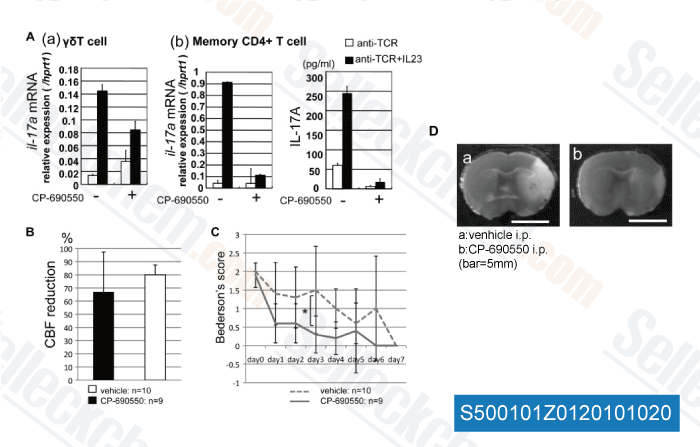
-
Datos de [ Biochem Biophy Res Commun , 2010 , 402, 500–506 ]
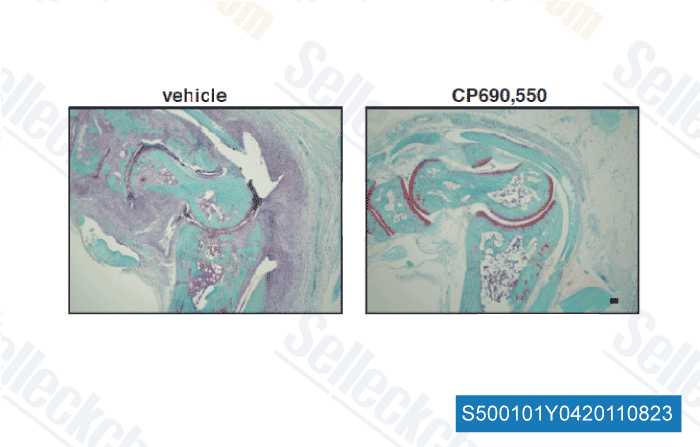
-
, , Dr. Akihiko Yoshimura of Akihiko Yoshimura
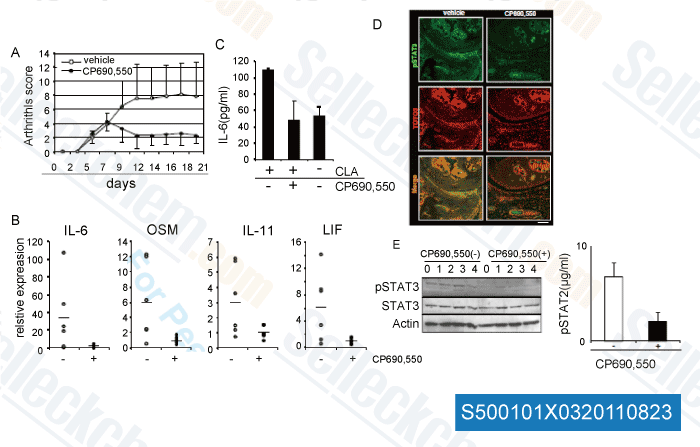
-
, , Saraswati Sukumar of Johns Hopkins University School of Medicine
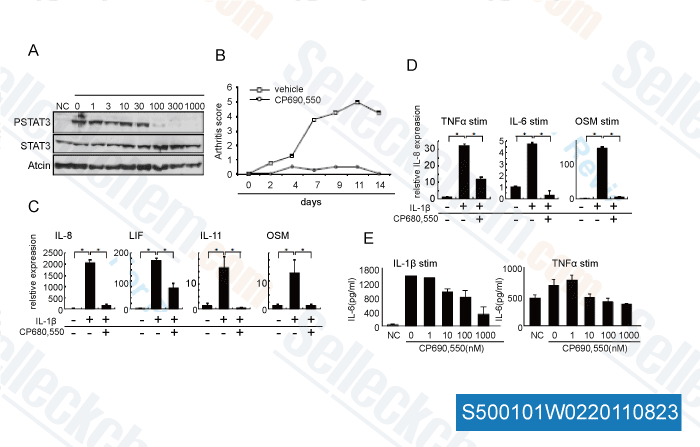
-
, , Dr. Akihiko Yoshimura of Akihiko Yoshimura
Sellecks CP-690550 (Tofacitinib) Citrate Ha sido citado por 198 Publicaciones
| Unveiling the Anti-Angiogenic Potential of Small-Molecule (Kinase) Inhibitors for Application in Rheumatoid Arthritis [ Cells, 2025, 14(2)102] | PubMed: 39851530 |
| Pharmacological evaluation of drug therapies in Aicardi-Goutières syndrome: insights from patient-derived neural stem cells [ Front Pharmacol, 2025, 16:1549183] | PubMed: 40183101 |
| JAK/STAT3 represents a therapeutic target for colorectal cancer patients with stromal-rich tumors [ J Exp Clin Cancer Res, 2024, 43(1):64] | PubMed: 38424636 |
| Patient-derived rhabdomyosarcoma cells recapitulate the genetic and transcriptomic landscapes of primary tumors [ iScience, 2024, 27(10):110862] | PubMed: 39319271 |
| A panel of janus kinase inhibitors identified with anti-inflammatory effects protect mice from lethal influenza virus infection [ Antimicrob Agents Chemother, 2024, 68(4):e0135023.] | PubMed: 38470034 |
| Tofacitinib to prevent anti-drug antibody formation against LMB-100 immunotoxin in patients with advanced mesothelin-expressing cancers [ Front Oncol, 2024, 14:1386190] | PubMed: 38706610 |
| Metabolic signature and proteasome activity controls synovial migration of CDC42hiCD14+ cells in rheumatoid arthritis [ Front Immunol, 2023, 14:1187093] | PubMed: 37662900 |
| Comprehensive protocols for culturing and molecular biological analysis of IBD patient-derived colon epithelial organoids [ Front Immunol, 2023, 14:1097383] | PubMed: 36911731 |
| In vitro and in vivo modelling of mutant JAK3/STAT5 signaling in leukemia [ Heliyon, 2023, 9(11):e22085] | PubMed: 38053908 |
| Cap analysis of gene expression (CAGE) 法を用いた nestin-induced Ikk2 deficient マウスにおける皮膚炎の分子病態解析 [ University of Toyama Graduate School of Medical and Pharmaceutical Education (Doctoral Course), 2023, ] | PubMed: none |
POLÍTICA DE DEVOLUCIÓN
La Política de Devolución Incondicional de Selleck Chemical garantiza una experiencia de compra en línea fluida para nuestros clientes. Si no está satisfecho con su compra de alguna manera, puede devolver cualquier artículo(s) dentro de los 7 días posteriores a su recepción. En caso de problemas de calidad del producto, ya sean problemas relacionados con el protocolo o con el producto, puede devolver cualquier artículo(s) dentro de los 365 días a partir de la fecha de compra original. Siga las instrucciones a continuación al devolver productos.
ENVÍO Y ALMACENAMIENTO
Los productos Selleck se transportan a temperatura ambiente. Si recibe el producto a temperatura ambiente, tenga la seguridad de que el Departamento de Inspección de Calidad de Selleck ha realizado experimentos para verificar que la colocación a temperatura normal durante un mes no afectará la actividad biológica de los productos en polvo. Después de la recogida, guarde el producto de acuerdo con los requisitos descritos en la hoja de datos. La mayoría de los productos Selleck son estables en las condiciones recomendadas.
NO PARA USO HUMANO, DIAGNÓSTICO VETERINARIO O TERAPÉUTICO.