
Datos técnicos
| Fórmula | C27H22Cl2N4O |
||||||
| Peso molecular | 489.4 | Número CAS | 192185-72-1 | ||||
| Solubilidad (25°C)* | In vitro | DMSO | 58 mg/mL (118.51 mM) | ||||
| Water | Insoluble | ||||||
| Ethanol | Insoluble | ||||||
| In vivo (Agregue los solventes al producto individualmente y en orden.) |
|
||||||
|
* <1 mg/ml significa ligeramente soluble o insoluble. * Tenga en cuenta que Selleck prueba la solubilidad de todos los compuestos internamente, y la solubilidad real puede diferir ligeramente de los valores publicados. Esto es normal y se debe a ligeras variaciones entre lotes. * Envío a temperatura ambiente (Las pruebas de estabilidad demuestran que este producto se puede enviar sin medidas de refrigeración.) |
|||||||
Preparación de soluciones madre
Actividad biológica
| Descripción | Tipifarnib es un potente y específico inhibidor de la farnesiltransferasa (FTase) con una IC50 de 0,6 nM; sus efectos antiproliferativos son más prominentes en células mutantes de H-ras o N-ras. Fase 3. | ||
|---|---|---|---|
| Objetivos |
|
||
| In vitro | Usando Tipifarnib 5 μM durante 72 horas, el porcentaje de células apoptóticas es significativamente mayor en las células T LGL tratadas con el fármaco en comparación con las tratadas con DMSO. Usando células T de donantes sanos, este compuesto reduce el porcentaje de células IFNγ-positivas de manera dependiente del tiempo. Reduce la cantidad de Ras activado en los precipitados en comparación con DMSO. Este químico ejerce toxicidad in vitro selectiva contra la hematopoyesis clonal del SMD a concentraciones menores de 10 nM, siendo el efecto más prominente en los progenitores de glóbulos blancos. Esta acción no se debe a la inducción de apoptosis, ya que tanto los progenitores normales como los del SMD muestran una expresión equivalente de DiOC3 y anexina V hasta 72 horas después de la exposición a este compuesto. Su combinación con 10 nM de 4-OH-ICI 46474 en presencia de E2 reduce la IC50 8 veces, de 400 a 50 nM. Induce apoptosis en células U937. Además, este químico inhibe la farnesiltransferasa humana aislada para un péptido de lámina B y para el péptido K-RasB con una IC50 de 0,86 nM y 7,9 nM, respectivamente. |
||
| In vivo | El Ki-67 es menor en los tumores tratados con la retirada de E2 más este compuesto en comparación con la retirada de E2 sola. La combinación de ICI 46474 y este químico resulta en un Ki-67 significativamente menor en comparación con ICI 46474 o este agente solo (media de 5% frente a 16,9% y 67,3%, respectivamente). En contraste, no se observa una diferencia significativa en las puntuaciones apoptóticas entre los grupos de tratamiento. Este compuesto solo también reduce el CTI en comparación con el control. La combinación de ICI 46474 y este agente o este químico junto con la retirada de E2 es más efectiva para reducir el CTI (0,8 y 0,7, respectivamente), lo que puede explicar la disminución del volumen tumoral. |
||
| Características | Un potente y selectivo inhibidor de la farnesil proteína transferasa con efectos antitumorales significativos. |
Protocolo (de referencia)
| Ensayo celular: |
|
|---|---|
| Estudio en animales: |
|
Referencias
|
Validación de productos por parte del cliente
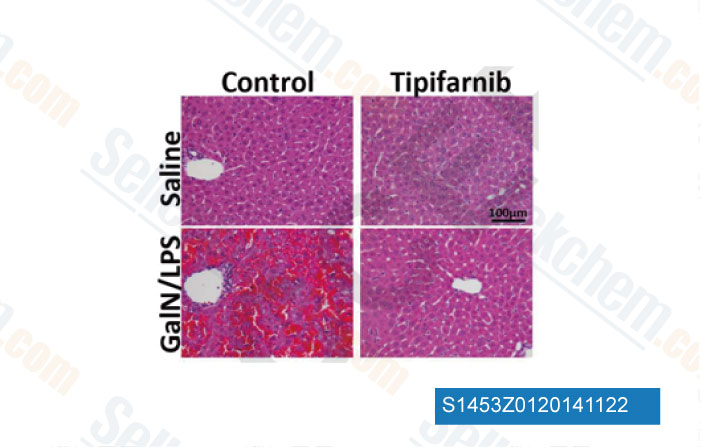
-
Datos de [ Shock , 2014 , 42(6), 570-7 ]
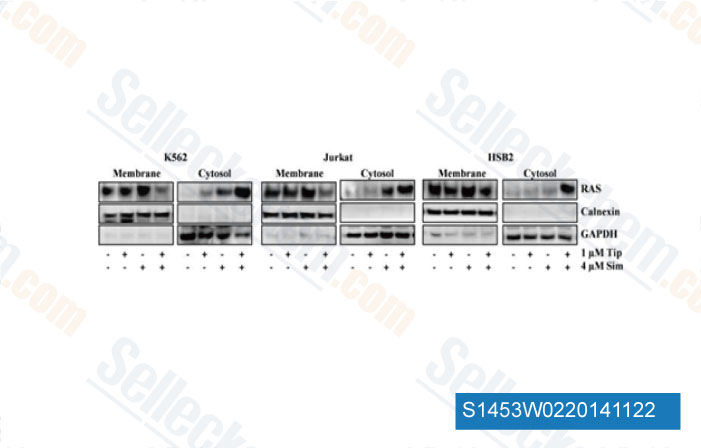
-
Datos de [ Leuk Res , 2014 , 10.1016/j.leukres.2014.09.002 ]
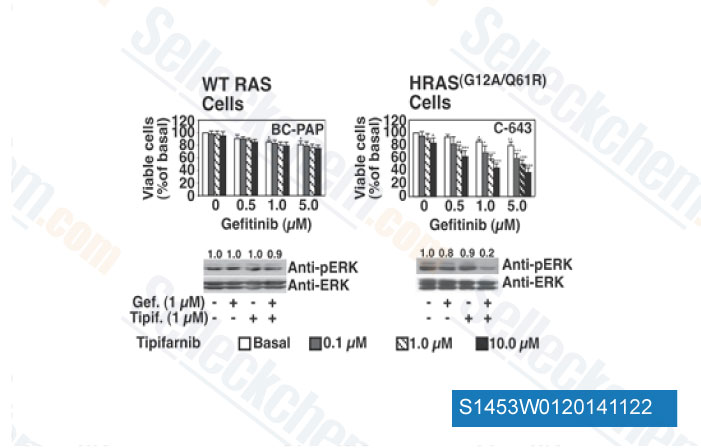
-
Datos de [ J Clin Endocrinol Metab , 2013 , 98(6), 2502-12 ]
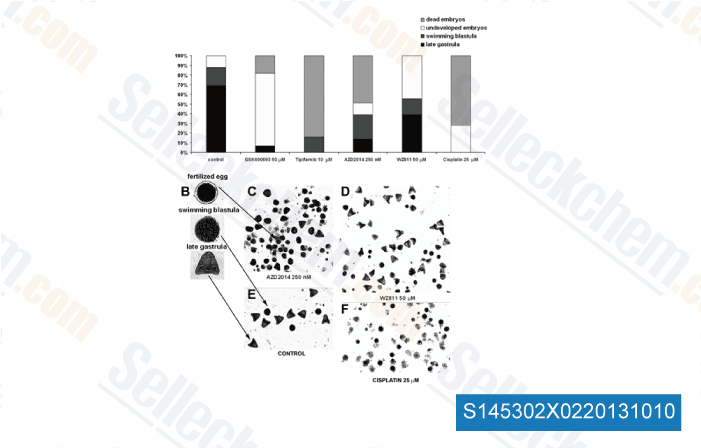
-
, , Dr. Milica Pesic from Institute for Biological Research
Sellecks Tipifarnib (IND 58359) Ha sido citado por 38 Publicaciones
| Impaired MC3T3-E1 osteoblast differentiation triggered by oncogenic HRAS is rescued by the farnesyltransferase inhibitor Tipifarnib [ Sci Rep, 2025, 15(1):6832] | PubMed: 40000861 |
| In Vitro synergy of Farnesyltransferase inhibitors in combination with colistin against ESKAPE bacteria [ PLoS One, 2025, 20(9):e0331440] | PubMed: 40911556 |
| Mitotic perturbation is a key mechanism of action of decitabine in myeloid tumor treatment [ Cell Rep, 2023, 42(9):113098] | PubMed: 37714156 |
| Salivary gland cancer organoids are valid for preclinical genotype-oriented medical precision trials [ iScience, 2023, 26(5):106695] | PubMed: 37207275 |
| Suppression of NASH-Related HCC by Farnesyltransferase Inhibitor through Inhibition of Inflammation and Hypoxia-Inducible Factor-1α Expression [ Int J Mol Sci, 2023, 24(14)11546] | PubMed: 37511305 |
| Cooperative Genomic Lesions in HRAS-Mutant Cancers Predict Resistance to Farnesyltransferase Inhibitors [ Res Sq, 2023, rs.3.rs-3154719] | PubMed: 37503077 |
| BRAF activation by metabolic stress promotes glycolysis sensitizing NRASQ61-mutated melanomas to targeted therapy [ Nat Commun, 2022, 13(1):7113] | PubMed: 36402789 |
| Impact of a conserved N-terminal proline-rich region of the α-subunit of CAAX-prenyltransferases on their enzyme properties [ Cell Commun Signal, 2022, 20(1):118] | PubMed: 35941619 |
| Combination of Tipifarnib and Sunitinib Overcomes Renal Cell Carcinoma Resistance to Tyrosine Kinase Inhibitors via Tumor-Derived Exosome and T Cell Modulation [ Cancers (Basel), 2022, 14(4)903] | PubMed: 35205655 |
| Bacteria Are New Targets for Inhibitors of Human Farnesyltransferase [ Front Microbiol, 2021, 12:628283] | PubMed: 34917041 |
POLÍTICA DE DEVOLUCIÓN
La Política de Devolución Incondicional de Selleck Chemical garantiza una experiencia de compra en línea fluida para nuestros clientes. Si no está satisfecho con su compra de alguna manera, puede devolver cualquier artículo(s) dentro de los 7 días posteriores a su recepción. En caso de problemas de calidad del producto, ya sean problemas relacionados con el protocolo o con el producto, puede devolver cualquier artículo(s) dentro de los 365 días a partir de la fecha de compra original. Siga las instrucciones a continuación al devolver productos.
ENVÍO Y ALMACENAMIENTO
Los productos Selleck se transportan a temperatura ambiente. Si recibe el producto a temperatura ambiente, tenga la seguridad de que el Departamento de Inspección de Calidad de Selleck ha realizado experimentos para verificar que la colocación a temperatura normal durante un mes no afectará la actividad biológica de los productos en polvo. Después de la recogida, guarde el producto de acuerdo con los requisitos descritos en la hoja de datos. La mayoría de los productos Selleck son estables en las condiciones recomendadas.
NO PARA USO HUMANO, DIAGNÓSTICO VETERINARIO O TERAPÉUTICO.