
Datos técnicos
| Fórmula | C26H26F3N3O3 |
||||||
| Peso molecular | 485.5 | Número CAS | 956697-53-3 | ||||
| Solubilidad (25°C)* | In vitro | DMSO | 97 mg/mL (199.79 mM) | ||||
| Ethanol | 16 mg/mL (32.95 mM) | ||||||
| Water | Insoluble | ||||||
| In vivo (Agregue los solventes al producto individualmente y en orden.) |
|
||||||
|
* <1 mg/ml significa ligeramente soluble o insoluble. * Tenga en cuenta que Selleck prueba la solubilidad de todos los compuestos internamente, y la solubilidad real puede diferir ligeramente de los valores publicados. Esto es normal y se debe a ligeras variaciones entre lotes. * Envío a temperatura ambiente (Las pruebas de estabilidad demuestran que este producto se puede enviar sin medidas de refrigeración.) |
|||||||
Preparación de soluciones madre
Actividad biológica
| Descripción | Sonidegib es un antagonista de Smoothened (Smo), que inhibe la señalización Hedgehog (Hh) con una IC50 de 1,3 nM (ratón) y 2,5 nM (humano) en ensayos sin células, respectivamente. Fase 3. | ||||
|---|---|---|---|---|---|
| Objetivos |
|
||||
| In vitro | Sonidegib (Erismodegib, NVP-LDE225) inhibe la línea celular luciferizada TM3 con 0,6 nM y 8 nM, en presencia de un agonista de Hh Ag1.5 de 1 nM y 25 nM, respectivamente. | ||||
| In vivo | Sonidegib (Erismodegib, NVP-LDE225) se une fuertemente a las proteínas plasmáticas de ratón, rata y humanas (>99%) y moderadamente a las proteínas plasmáticas de perro y mono (77 y 85%, respectivamente). LDE225 tiene una alta permeabilidad (90,8% en humanos) en el ensayo PAMPA. LDE225 muestra una buena biodisponibilidad oral que oscila entre 69 y 102% en especies preclínicas cuando se administra en solución. LDE225 es una base débil con un pKa medido de 4,20 y exhibe una solubilidad acuosa relativamente pobre. LDE225 demuestra actividad antitumoral relacionada con la dosis. A una dosis de 5 mg/kg/día qd, LDE225 inhibe significativamente el crecimiento tumoral, correspondiendo a un valor T/C del 33%. Cuando se administra a 10 y 20 mg/kg/día qd, LDE225 produce una regresión del 51 y 83%, respectivamente. La inhibición del ARNm de Gli1 se correlaciona con la exposición tumoral y plasmática de LDE225. LDE225 penetra con éxito la barrera hematoencefálica en animales portadores de tumores y resulta en la inhibición del crecimiento tumoral después de 4 días de tratamiento. LDE225 reduce significativamente el volumen tumoral en un 95,7% en ratones Rip1-Tag2. LDE225 prolonga la supervivencia en ratones Rip1Tag2. LDE225 disminuye la expresión de marcadores estromales en los ratones tratados con LDE225. |
Protocolo (de referencia)
| Ensayo celular: |
|
|---|---|
| Estudio en animales: |
|
Referencias
|
Validación de productos por parte del cliente
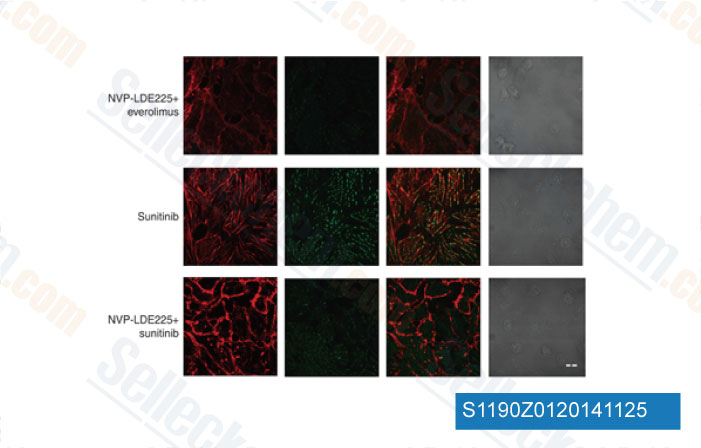
-
Datos de [ Br J Cancer , 2014 , 111(6), 1168-79 ]
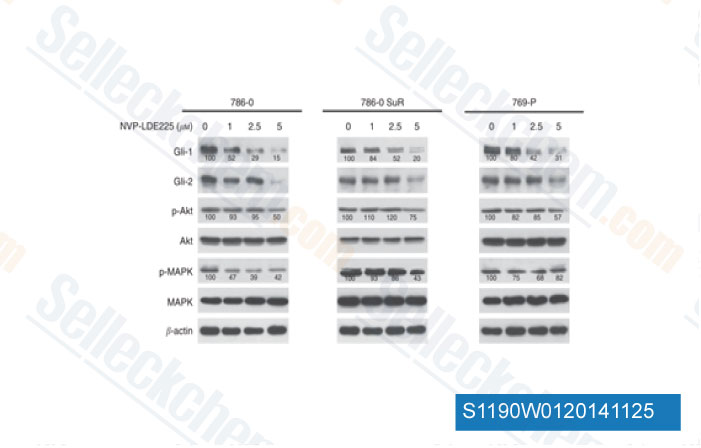
-
Datos de [ Br J Cancer , 2014 , 111(6), 1168-79 ]
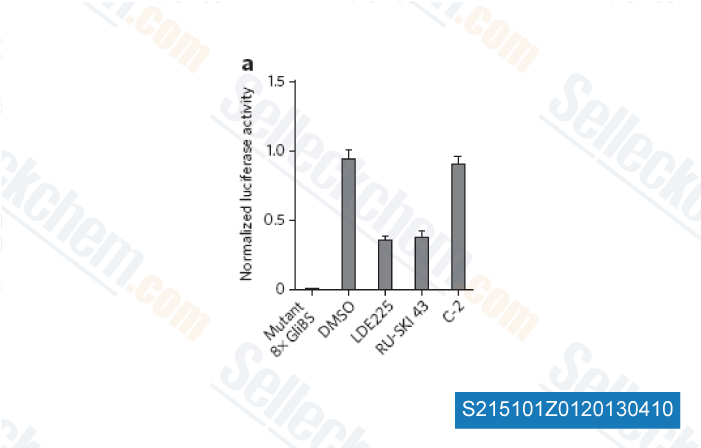
-
Datos de [ Nat Chem Biol , 2013 , 9, 247-9 ]
Sellecks Sonidegib (NVP-LDE225, Erismodegib) Ha sido citado por 72 Publicaciones
| Sonic hedgehog medulloblastomas are dependent on Netrin-1 for survival [ Nat Commun, 2025, 16(1):5137] | PubMed: 40461501 |
| The O-glycosyltransferase C1GALT1 promotes EWSR1::FLI1 expression and is a therapeutic target for Ewing sarcoma [ Nat Commun, 2025, 16(1):1267] | PubMed: 39894896 |
| Determination of the Minimum Cell-to-Cell Adhesion Time Using Optical Tweezers in Leukemia and Lymphoma Research [ Method Protocol, 2025, 8(3)59] | PubMed: 40559447 |
| Identification of a distal enhancer regulating hedgehog interacting protein gene in human lung epithelial cells [ EBioMedicine, 2024, 101:105026] | PubMed: 38417378 |
| Inhibition of primary cilia-hedgehog signaling axis triggers autophagic cell death and suppresses malignant progression of VHL wild-type ccRCC [ Cell Death Dis, 2024, 15(10):739] | PubMed: 39389955 |
| Hedgehog signalling is involved in acquired resistance to KRASG12C inhibitors in lung cancer cells [ Cell Death Dis, 2024, 15(1):56] | PubMed: 38225225 |
| Alterations of ceramide synthesis induce PD-L1 internalization and signaling to regulate tumor metastasis and immunotherapy response [ Cell Rep, 2024, 43(8):114532] | PubMed: 39046874 |
| Genome-wide CRISPR-Cas9 knockout screens identify DNMT1 as a druggable dependency in sonic hedgehog medulloblastoma [ Acta Neuropathol Commun, 2024, 12(1):125] | PubMed: 39107797 |
| Patient-derived rhabdomyosarcoma cells recapitulate the genetic and transcriptomic landscapes of primary tumors [ iScience, 2024, 27(10):110862] | PubMed: 39319271 |
| Multiplatform molecular profiling uncovers two subgroups of malignant peripheral nerve sheath tumors with distinct therapeutic vulnerabilities [ Nat Commun, 2023, 14(1):2696] | PubMed: 37164978 |
POLÍTICA DE DEVOLUCIÓN
La Política de Devolución Incondicional de Selleck Chemical garantiza una experiencia de compra en línea fluida para nuestros clientes. Si no está satisfecho con su compra de alguna manera, puede devolver cualquier artículo(s) dentro de los 7 días posteriores a su recepción. En caso de problemas de calidad del producto, ya sean problemas relacionados con el protocolo o con el producto, puede devolver cualquier artículo(s) dentro de los 365 días a partir de la fecha de compra original. Siga las instrucciones a continuación al devolver productos.
ENVÍO Y ALMACENAMIENTO
Los productos Selleck se transportan a temperatura ambiente. Si recibe el producto a temperatura ambiente, tenga la seguridad de que el Departamento de Inspección de Calidad de Selleck ha realizado experimentos para verificar que la colocación a temperatura normal durante un mes no afectará la actividad biológica de los productos en polvo. Después de la recogida, guarde el producto de acuerdo con los requisitos descritos en la hoja de datos. La mayoría de los productos Selleck son estables en las condiciones recomendadas.
NO PARA USO HUMANO, DIAGNÓSTICO VETERINARIO O TERAPÉUTICO.