
Datos técnicos
| Fórmula | C28H27N3O3.HCl |
||||||||||||||
| Peso molecular | 489.99 | Número CAS | 521984-48-5 | ||||||||||||
| Solubilidad (25°C)* | In vitro | DMSO | 49 mg/mL (100.0 mM) | ||||||||||||
| Ethanol | 3 mg/mL (6.12 mM) | ||||||||||||||
| Water | Insoluble | ||||||||||||||
| In vivo (Agregue los solventes al producto individualmente y en orden.) |
|
||||||||||||||
|
* <1 mg/ml significa ligeramente soluble o insoluble. * Tenga en cuenta que Selleck prueba la solubilidad de todos los compuestos internamente, y la solubilidad real puede diferir ligeramente de los valores publicados. Esto es normal y se debe a ligeras variaciones entre lotes. * Envío a temperatura ambiente (Las pruebas de estabilidad demuestran que este producto se puede enviar sin medidas de refrigeración.) |
|||||||||||||||
Preparación de soluciones madre
Actividad biológica
| Descripción | SIS3, un nuevo inhibidor específico de Smad3, inhibe la señalización de TGF-β y activina al suprimir la fosforilación de Smad3 sin afectar las vías de señalización MAPK/p38, ERK o PI3-quinasa. | |
|---|---|---|
| Objetivos |
|
|
| In vitro | Addition of SIS3 attenuates the effects of TGF-β1 by reducing the transcriptional activity. SIS3 also inhibits the myofibroblast differentiation of fibroblasts by TGF-β1. SIS3 completely diminishes the constitutive phosphorylation of Smad3 as well as the up-regulated type I collagen expression in scleroderma fibroblasts, thus abolishes the ECM overexpression in the TGF-β1-treated normal dermal fibroblasts and scleroderma fibroblasts in vitro. | |
| In vivo | SIS3 inhibits Smad3 activation in streptozotocin(STZ)-induced diabetic nephropathy in Tie2-Cre;Loxp-EGFP mice. It also reduces AGE-induced EndoMT and decreases EndoMT in STZ-induced diabetic nephropathy in Tie2-Cre;Loxp-EGFP mice. SIS3 significantly reduces collagen IV and fibronectin expression in the glomeruli and tubulointerstitium of STZ-injected Tie2-Cre;Loxp-EGFP mice, suggesting that SIS3 retards the early development of STZ-induced diabetic glomerulosclerosis and tubulointerstitial fibrosis. However, SIS3 administration does not reduce proteinuria. |
Protocolo (de referencia)
| Ensayo celular: |
|
|---|---|
| Estudio en animales: |
|
Referencias
|
Validación de productos por parte del cliente
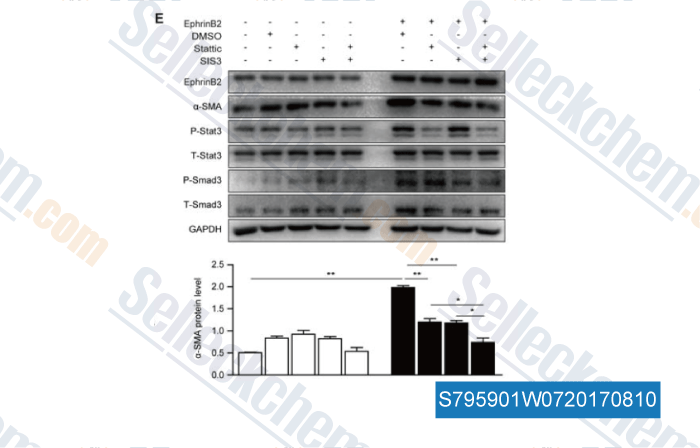
-
, , Circ Res, 2017, 121(6):617-627
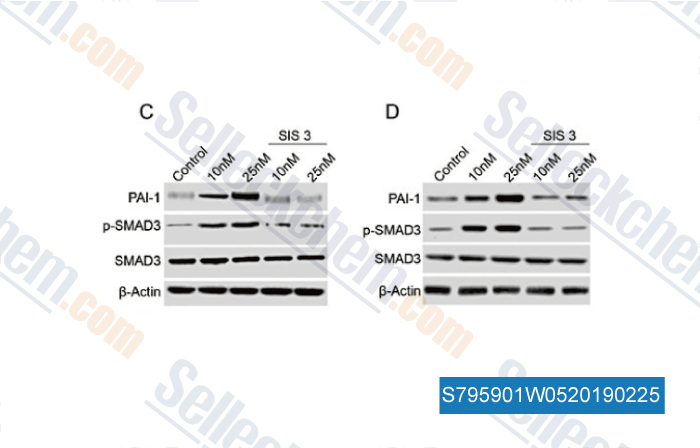
-
Datos de [ , , Cell Physiol Biochem, 2017, 44(6):2201-2211 ]
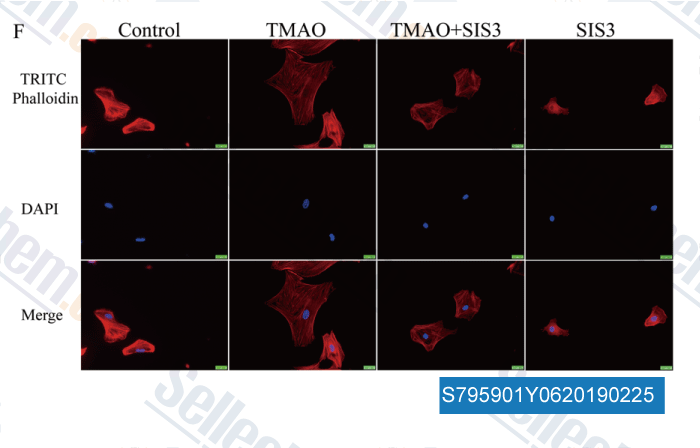
-
Datos de [ , , Lab Invest, 2018, doi: 10.1038/s41374-018-0091-y ]
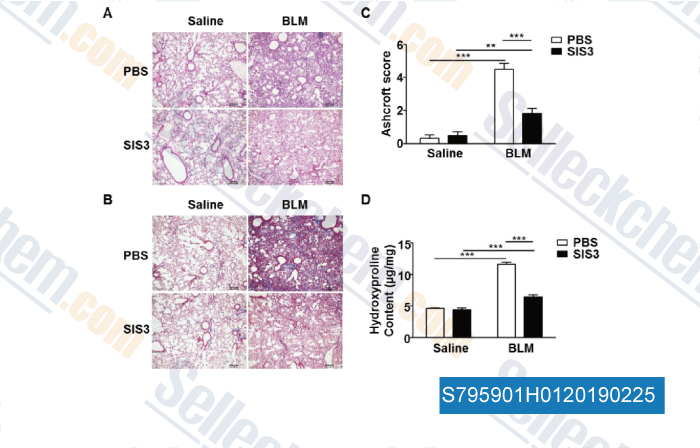
-
Datos de [ , , Biochem Biophys Res Commun, 2018, 503(2):757-762 ]
Selleck's SIS3 Hydrochloride Ha sido citado por 88 Publicaciones
| An SPP1-SOCS1 pathway constrains interferon responses in tumor-associated macrophages and shapes an immunosuppressive tumor microenvironment [ Immunity, 2026, S1074-7613(26)00141-X] | PubMed: 42049035 |
| Smad3 Mediates Renal Fibrosis via GPX4-Dependent Ferroptosis [ Int J Biol Sci, 2025, 21(13):5922-5935] | PubMed: 41079940 |
| Elevated TGF-β1 impairs synaptic and cognitive function through activation of Smad2/3-Sp1 pathway in AngII-related hypertension [ EMBO Rep, 2025, 26(12):3162-3186] | PubMed: 40425782 |
| KLHL25-ACLY module functions as a switch in the fate determination of the differentiation of iTreg/Th17 [ Commun Biol, 2025, 8(1):471] | PubMed: 40119138 |
| Inhibition of XPO1 by selinexor enhances terminal erythroid maturation through modulation of HSP70 trafficking in severe β0-thalassemia/HbE [ PLoS One, 2025, 20(9):e0333127] | PubMed: 40997022 |
| UBR5 mediates colorectal cancer chemoresistance by attenuating ferroptosis via Lys 11 ubiquitin-dependent stabilization of Smad3-SLC7A11 signaling [ Redox Biol, 2024, 76:103349] | PubMed: 39260061 |
| Vulnerability to APOBEC3G linked to the pathogenicity of deltaretroviruses [ Proc Natl Acad Sci U S A, 2024, 121(13):e2309925121] | PubMed: 38502701 |
| Therapeutic targeting of PLK1 in TERT promoter-mutant hepatocellular carcinoma [ Clin Transl Med, 2024, 14(5):e1703] | PubMed: 38769666 |
| Treatment for type 2 diabetes and diabetic nephropathy by targeting Smad3 signaling [ Int J Biol Sci, 2024, 20(1):200-217] | PubMed: 38164169 |
| Sleeve gastrectomy links the attenuation of diabetic kidney disease to the inhibition of renal tubular ferroptosis through down-regulating TGF-β1/Smad3 signaling pathway [ J Endocrinol Invest, 2024, 10.1007/s40618-023-02267-1] | PubMed: 38512446 |
POLÍTICA DE DEVOLUCIÓN
La Política de Devolución Incondicional de Selleck Chemical garantiza una experiencia de compra en línea fluida para nuestros clientes. Si no está satisfecho con su compra de alguna manera, puede devolver cualquier artículo(s) dentro de los 7 días posteriores a su recepción. En caso de problemas de calidad del producto, ya sean problemas relacionados con el protocolo o con el producto, puede devolver cualquier artículo(s) dentro de los 365 días a partir de la fecha de compra original. Siga las instrucciones a continuación al devolver productos.
ENVÍO Y ALMACENAMIENTO
Los productos Selleck se transportan a temperatura ambiente. Si recibe el producto a temperatura ambiente, tenga la seguridad de que el Departamento de Inspección de Calidad de Selleck ha realizado experimentos para verificar que la colocación a temperatura normal durante un mes no afectará la actividad biológica de los productos en polvo. Después de la recogida, guarde el producto de acuerdo con los requisitos descritos en la hoja de datos. La mayoría de los productos Selleck son estables en las condiciones recomendadas.
NO PARA USO HUMANO, DIAGNÓSTICO VETERINARIO O TERAPÉUTICO.