
Datos técnicos
| Fórmula | C15H14N2O |
||||||||||||||
| Peso molecular | 238.28 | Número CAS | 204005-46-9 | ||||||||||||
| Solubilidad (25°C)* | In vitro | DMF | 100 mg/mL (419.67 mM) | ||||||||||||
| DMSO | 20 mg/mL (83.93 mM) | ||||||||||||||
| Ethanol | 4 mg/mL (16.78 mM) | ||||||||||||||
| In vivo (Agregue los solventes al producto individualmente y en orden.) |
|
||||||||||||||
|
* <1 mg/ml significa ligeramente soluble o insoluble. * Tenga en cuenta que Selleck prueba la solubilidad de todos los compuestos internamente, y la solubilidad real puede diferir ligeramente de los valores publicados. Esto es normal y se debe a ligeras variaciones entre lotes. * Envío a temperatura ambiente (Las pruebas de estabilidad demuestran que este producto se puede enviar sin medidas de refrigeración.) |
|||||||||||||||
Preparación de soluciones madre
Actividad biológica
| Descripción | Semaxanib (SU5416, semaxinib) es un potente y selectivo inhibidor de VEGFR (Flk-1/KDR) con una IC50 de 1,23 M, 20 veces m s selectivo para VEGFR que PDGFR , y carece de actividad contra EGFR, InsR y FGFR. Fase 3. Puede utilizarse para inducir modelos animales de hipoxia intermitente cr nica. | ||
|---|---|---|---|
| Objetivos |
|
||
| In vitro | Semaxanib (SU5416) inhibe la fosforilaci n dependiente de VEGF del receptor Flk-1 en c lulas NIH 3T3 que sobreexpresan Flk-1 con una IC50 de 1,04 M, y la autofosforilaci n dependiente de PDGF en c lulas NIH 3T3 con una IC50 de 20,3 M. Tambi n inhibe la mitog nesis impulsada por VEGF y FGF de manera dependiente de la dosis con una IC50 de 0,04 y 50 M, respectivamente. El tratamiento con este compuesto no tiene efecto sobre el crecimiento in vitro de c lulas de glioma C6, carcinoma de pulm n Calu 6, melanoma A375, carcinoma epidermoide A431 y glioma SF767T (todas las IC50 > 20 M). | ||
| In vivo | Semaxanib (SU5416) inhibe el crecimiento del tumor A375 in vivo de forma dosis-dependiente. Se observa una inhibici n >85% del crecimiento tumoral subcut neo con la administraci n diaria i.p. de este compuesto en DMSO, sin toxicidad medible. Muestra una actividad antitumoral de amplio espectro, inhibiendo significativamente el crecimiento subcut neo de 8 de 10 l neas tumorales probadas (c lulas A431, Calu-6, C6, LNCAP, EPH4-VEGF, 3T3HER2, 488G2M2 y SF763T) con una tasa de mortalidad promedio del 2,5%. A 25 mg/kg/d a, muestra una potente actividad antiangiog nica, lo que resulta en una reducci n significativa tanto de la densidad vascular total como funcional de la microvasculatura tumoral. |
Protocolo (de referencia)
| Ensayo de quinasa:[1] |
|
|---|---|
| Ensayo celular:[1] |
|
| Estudio en animales:[1] |
|
Referencias
|
Validación de productos por parte del cliente
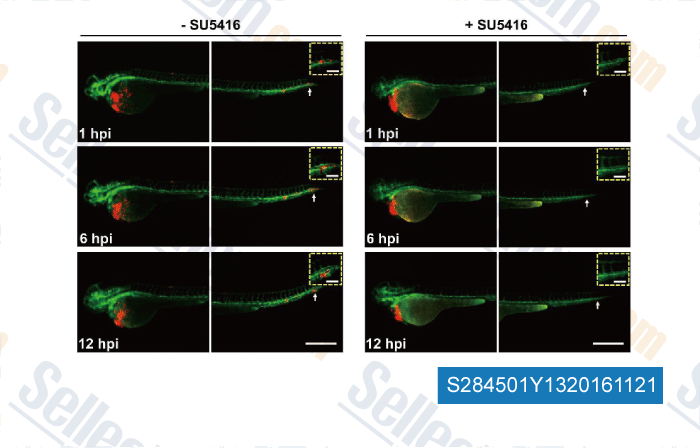
-
Datos de [ , , Sci Rep, 2016, 6:19304. ]
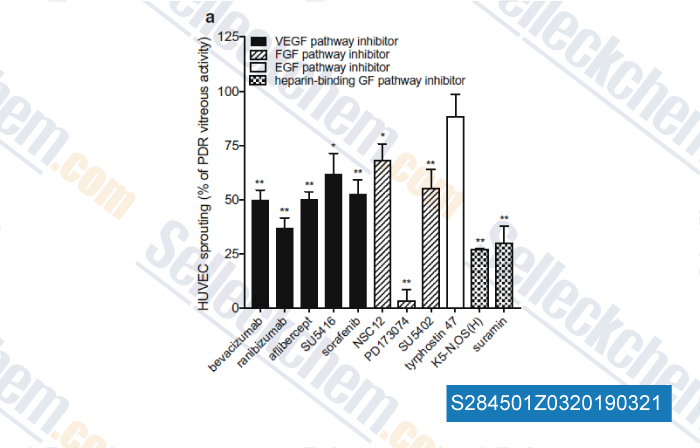
-
Datos de [ , , Angiogenesis, 2017, 20(4):629-640 ]
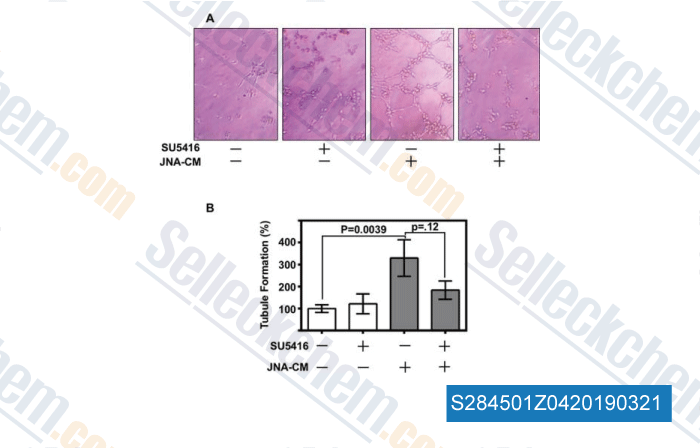
-
Datos de [ , , Int Forum Allergy Rhinol, 2017, 7(10):973-979 ]
Sellecks Semaxanib (SU5416) Ha sido citado por 21 Publicaciones
| LONP1 facilitates pulmonary artery smooth muscle cell glycolytic reprogramming by degrading MPC1 in pulmonary hypertension [ Clin Sci (Lond), 2025, 139(10)CS20255922] | PubMed: 40332105 |
| APOE- ε4-induced Fibronectin at the blood-brain barrier is a conserved pathological mediator of disrupted astrocyte-endothelia interaction in Alzheimer's disease [ bioRxiv, 2025, 2025.01.24.634732] | PubMed: 39975303 |
| Gliovascular transcriptional perturbations in Alzheimer's disease reveal molecular mechanisms of blood brain barrier dysfunction [ Nat Commun, 2024, 15(1):4758] | PubMed: 38902234 |
| Endothelial Slc35a1 Deficiency Causes Loss of LSEC Identity and Exacerbates Neonatal Lipid Deposition in the Liver in Mice [ Cell Mol Gastroenterol Hepatol, 2024, 17(6):1039-1061] | PubMed: 38467191 |
| A novel twelve-gene signature to predict neoadjuvant chemotherapy response and prognosis in breast cancer [ Front Immunol, 2022, 13:1035667] | PubMed: 36341435 |
| VEGF Modulates Neurogenesis and Microvascular Remodeling in Epileptogenesis After Status Epilepticus in Immature Rats [ Front Neurol, 2021, 12:808568] | PubMed: 35002944 |
| PKR deficiency alleviates pulmonary hypertension via inducing inflammasome adaptor ASC inactivation [ Pulm Circ, 2021, 11(4):20458940211046156] | PubMed: 34540200 |
| Uncovering mutation-specific morphogenic phenotypes and paracrine-mediated vessel dysfunction in a biomimetic vascularized mammary duct platform [ Nat Commun, 2020, 11(1):3377] | PubMed: 32632100 |
| RhoJ integrates attractive and repulsive cues in directional migration of endothelial cells [ EMBO J, 2020, 39(12):e102930] | PubMed: 32347571 |
| Activation of inflammasomes by tyrosine kinase inhibitors of vascular endothelial growth factor receptor: Implications for VEGFR TKIs-induced immune related adverse events [ Toxicol In Vitro, 2020, 71:105063] | PubMed: 33271325 |
POLÍTICA DE DEVOLUCIÓN
La Política de Devolución Incondicional de Selleck Chemical garantiza una experiencia de compra en línea fluida para nuestros clientes. Si no está satisfecho con su compra de alguna manera, puede devolver cualquier artículo(s) dentro de los 7 días posteriores a su recepción. En caso de problemas de calidad del producto, ya sean problemas relacionados con el protocolo o con el producto, puede devolver cualquier artículo(s) dentro de los 365 días a partir de la fecha de compra original. Siga las instrucciones a continuación al devolver productos.
ENVÍO Y ALMACENAMIENTO
Los productos Selleck se transportan a temperatura ambiente. Si recibe el producto a temperatura ambiente, tenga la seguridad de que el Departamento de Inspección de Calidad de Selleck ha realizado experimentos para verificar que la colocación a temperatura normal durante un mes no afectará la actividad biológica de los productos en polvo. Después de la recogida, guarde el producto de acuerdo con los requisitos descritos en la hoja de datos. La mayoría de los productos Selleck son estables en las condiciones recomendadas.
NO PARA USO HUMANO, DIAGNÓSTICO VETERINARIO O TERAPÉUTICO.