
Datos técnicos
| Fórmula | C17H11F6N7O |
||||||||||
| Peso molecular | 443.31 | Número CAS | 1393477-72-9 | ||||||||
| Solubilidad (25°C)* | In vitro | DMSO | 89 mg/mL (200.76 mM) | ||||||||
| Ethanol | 89 mg/mL (200.76 mM) | ||||||||||
| Water | Insoluble | ||||||||||
| In vivo (Agregue los solventes al producto individualmente y en orden.) |
|
||||||||||
|
* <1 mg/ml significa ligeramente soluble o insoluble. * Tenga en cuenta que Selleck prueba la solubilidad de todos los compuestos internamente, y la solubilidad real puede diferir ligeramente de los valores publicados. Esto es normal y se debe a ligeras variaciones entre lotes. * Envío a temperatura ambiente (Las pruebas de estabilidad demuestran que este producto se puede enviar sin medidas de refrigeración.) |
|||||||||||
Preparación de soluciones madre
Actividad biológica
| Descripción | Selinexor (KPT-330, ATG-010) es un inhibidor selectivo de CRM1 biodisponible por vía oral. Este compuesto se encuentra en Fase 2. | |
|---|---|---|
| Objetivos |
|
|
| In vitro | Como análogo candidato clínico de KPT-185, Selinexor (KPT-330) exhibe efectos similares sobre la viabilidad de las células T-ALL y provoca una respuesta apoptótica rápida. También reduce el crecimiento celular en las líneas celulares MOLT-4, Jurkat, HBP-ALL, KOPTK-1, SKW-3 y DND-41, con valores de IC50 de 34-203 nM. | |
| In vivo | Selinexor (KPT-330) suprime drásticamente el crecimiento de células T-ALL (MOLT-4) y células AML (MV4–11) in vivo, con poca toxicidad para las células hematopoyéticas normales. En ratones SCID con lesiones óseas difusas de mieloma múltiple humano, este compuesto inhibe la lisis ósea inducida por el mieloma múltiple y prolonga la supervivencia. Además, altera directamente la osteoclastogénesis y la reabsorción ósea al bloquear NF-κB y NFATc1 inducidos por RANKL, con un impacto mínimo en osteoblastos y BMSCs. |
Protocolo (de referencia)
| Ensayo celular:[1] |
|
|---|---|
| Estudio en animales:[1] |
|
Referencias
|
Validación de productos por parte del cliente

-
, , Mol Cancer Ther, 2017, 16(4):717-728
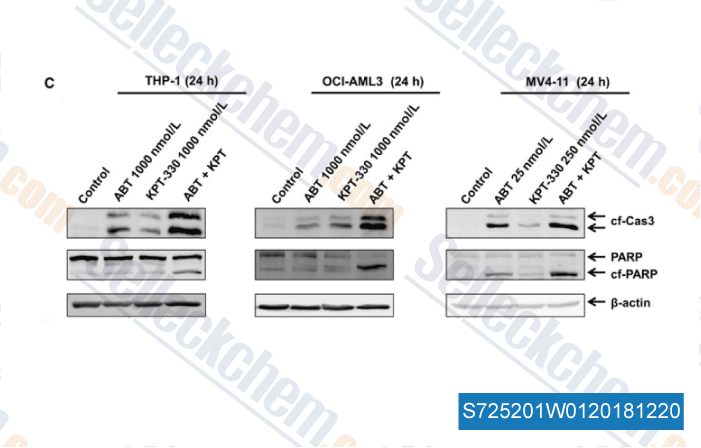
-
Datos de [ , , J Cell Mol Med, 2018, doi:10.1111/jcmm.13886 ]
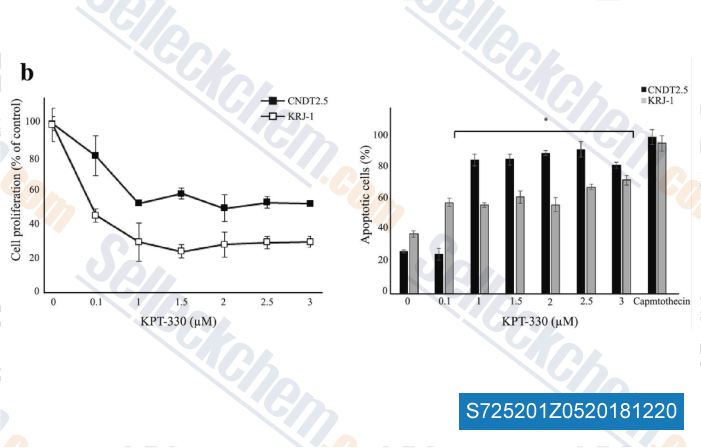
-
Datos de [ , , BMC Cancer, 2018, 18(1):764 ]
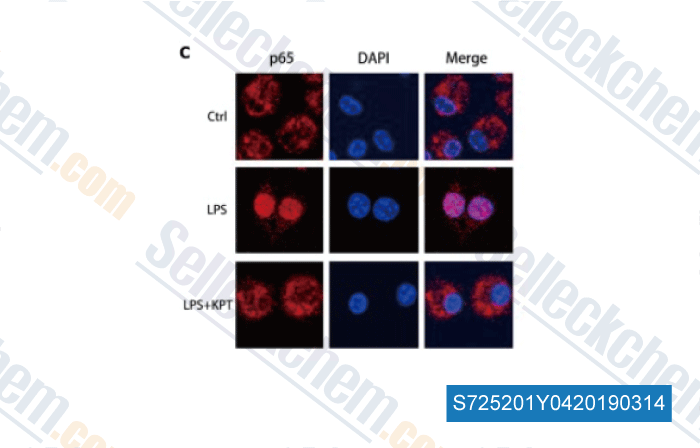
-
Datos de [ , , Biochem Biophys Res Commun, 2018, 503(3):1773-1779 ]
Sellecks Selinexor (KPT-330) Ha sido citado por 130 Publicaciones
| Disparate leukemia mutations converge on nuclear phase-separated condensates [ Cell, 2025, S0092-8674(25)01149-3] | PubMed: 41192422 |
| Human iPSC-derived nephron progenitor cells treat acute kidney injury and chronic kidney disease in mouse models [ Sci Transl Med, 2025, 17(792):eadt5553] | PubMed: 40173262 |
| The macrophage-intrinsic MDA5/IRF5 axis drives HIV-1 intron-containing RNA-induced inflammatory responses [ J Clin Invest, 2025, 135(16)e187663] | PubMed: 40493408 |
| Nuclear to Cytoplasmic Transport Is a Druggable Dependency in HDAC7-driven Small Cell Lung Cancer [ Adv Sci (Weinh), 2025, 12(14):e2413445] | PubMed: 39887933 |
| A patient-derived T cell lymphoma biorepository uncovers pathogenetic mechanisms and host-related therapeutic vulnerabilities [ Cell Rep Med, 2025, S2666-3791(25)00102-8] | PubMed: 40147445 |
| Nuclear paxillin functions as a molecular switch for alternative splicing in neurons during a critical period of brain development [ EMBO J, 2025, 44(21):5965-5992] | PubMed: 40926123 |
| NPM1-fusion proteins promote myeloid leukemogenesis through XPO1-dependent HOX activation [ Leukemia, 2025, 39(1):75-86] | PubMed: 39443736 |
| Atovaquone and selinexor as a novel combination treatment option in acute myeloid leukemia [ Cancer Lett, 2025, 613:217501] | PubMed: 39864539 |
| Targeting fucosyltransferase FUT8 as a prospective therapeutic approach for DLBCL [ Oncogenesis, 2025, 14(1):1] | PubMed: 39881135 |
| Regulation of chromatin modifications through coordination of nucleus size and epithelial cell morphology heterogeneity [ Commun Biol, 2025, 8(1):269] | PubMed: 39979587 |
POLÍTICA DE DEVOLUCIÓN
La Política de Devolución Incondicional de Selleck Chemical garantiza una experiencia de compra en línea fluida para nuestros clientes. Si no está satisfecho con su compra de alguna manera, puede devolver cualquier artículo(s) dentro de los 7 días posteriores a su recepción. En caso de problemas de calidad del producto, ya sean problemas relacionados con el protocolo o con el producto, puede devolver cualquier artículo(s) dentro de los 365 días a partir de la fecha de compra original. Siga las instrucciones a continuación al devolver productos.
ENVÍO Y ALMACENAMIENTO
Los productos Selleck se transportan a temperatura ambiente. Si recibe el producto a temperatura ambiente, tenga la seguridad de que el Departamento de Inspección de Calidad de Selleck ha realizado experimentos para verificar que la colocación a temperatura normal durante un mes no afectará la actividad biológica de los productos en polvo. Después de la recogida, guarde el producto de acuerdo con los requisitos descritos en la hoja de datos. La mayoría de los productos Selleck son estables en las condiciones recomendadas.
NO PARA USO HUMANO, DIAGNÓSTICO VETERINARIO O TERAPÉUTICO.