
Datos técnicos
| Fórmula | C13H10BrN3O4 |
||||||
| Peso molecular | 352.14 | Número CAS | 182498-32-4 | ||||
| Solubilidad (25°C)* | In vitro | DMSO | 70 mg/mL (198.78 mM) | ||||
| Ethanol | 3 mg/mL (8.51 mM) | ||||||
| Water | Insoluble | ||||||
| In vivo (Agregue los solventes al producto individualmente y en orden.) |
|
||||||
|
* <1 mg/ml significa ligeramente soluble o insoluble. * Tenga en cuenta que Selleck prueba la solubilidad de todos los compuestos internamente, y la solubilidad real puede diferir ligeramente de los valores publicados. Esto es normal y se debe a ligeras variaciones entre lotes. * Envío a temperatura ambiente (Las pruebas de estabilidad demuestran que este producto se puede enviar sin medidas de refrigeración.) |
|||||||
Preparación de soluciones madre
Actividad biológica
| Descripción | SB225002 es un antagonista potente y selectivo de CXCR2 con una IC50 de 22 nM para inhibir la unión de la interleucina IL-8 a CXCR2, con una selectividad > 150 veces mayor que otros 7-TMR probados. | ||
|---|---|---|---|
| Objetivos |
|
||
| In vitro | In vitro, SB225002 inhibe la movilización de calcio estimulada por GROα e inhibe potentemente la quimiotaxis de neutrófilos humanos y de conejo inducida tanto por IL-8 como por GROalpha. Este compuesto reduce sustancialmente los niveles de ERK1/2 fosforilado y disminuye la proliferación celular en células WHCO1. También muestra actividad antitumoral como inhibidor de microtúbulos. | ||
| In vivo | En conejos, SB225002 bloquea selectivamente la marginación de neutrófilos inducida por IL-8. En el modelo de carcinoma colangiocelular intrahepático de ratón, este compuesto (1 mg/kg i.p.) suprime el crecimiento de tumores subcutáneos trasplantados. Además, también muestra efectos antinociceptivos de larga duración y reduce la colitis inducida por TNBS en modelos de ratón. |
Protocolo (de referencia)
| Ensayo de quinasa:[1] |
|
|---|---|
| Ensayo celular:[2] |
|
| Estudio en animales:[1] |
|
Referencias
|
Validación de productos por parte del cliente
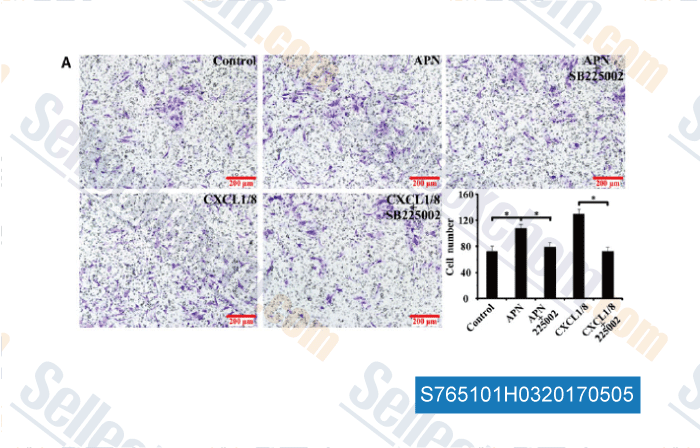
-
, , J Cell Mol Med, 2017, 21(7):1411-1419
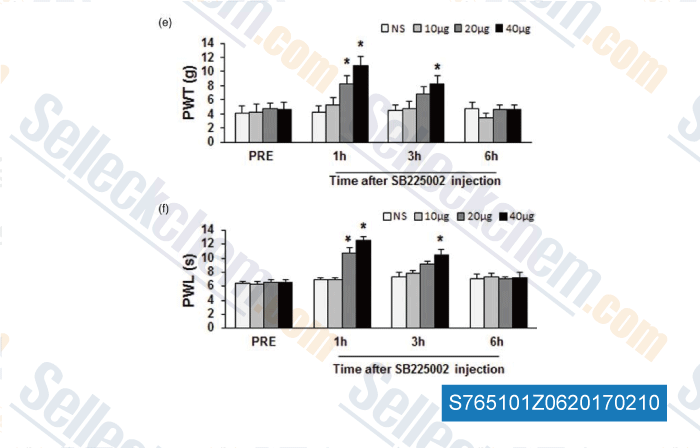
-
, , Mol Pain, 2016, doi: 10.1177/1744806916646381
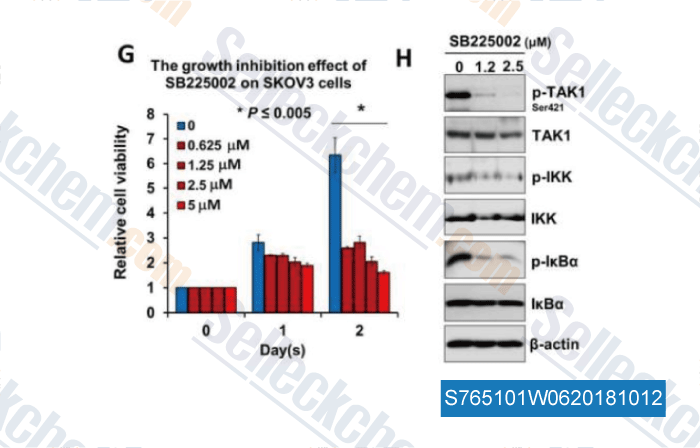
-
Datos de [ , , Theranostics, 2018, 8(5):1270-1285 ]
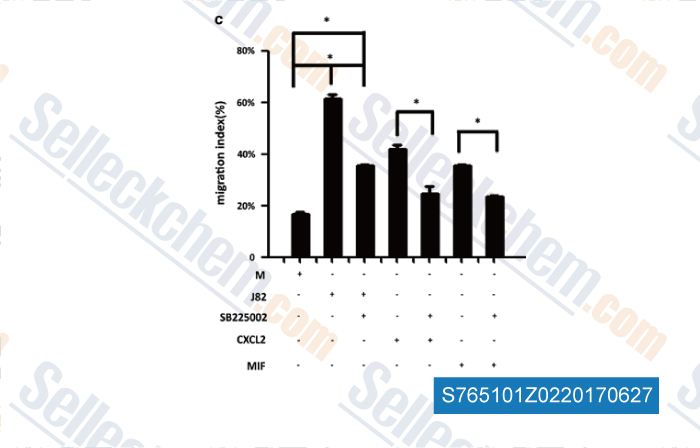
-
Datos de [ , , Oncogene, 2017, 36(15):2095-2104 ]
Sellecks SB 225002 Ha sido citado por 91 Publicaciones
| Myeloid-Derived Suppressor Cell Accumulation Drives Intestinal Fibrosis through mCCL6/hCCL15 Chemokine-Mediated Fibroblast Activation [ Adv Sci (Weinh), 2025, 12(8):e2411711] | PubMed: 39739231 |
| Tumor-derived exosomes induce neutrophil infiltration and reprogramming to promote T-cell exhaustion in hepatocellular carcinoma [ Theranostics, 2025, 15(7):2852-2869] | PubMed: 40083930 |
| USP15 Facilitates Colorectal Cancer Immune Evasion through SMYD3/CCL2-Dependent Myeloid-Derived Suppressor Cell Recruitment [ Cancer Immunol Res, 2025, 10.1158/2326-6066.CIR-24-1194] | PubMed: 40323348 |
| Cholesterol 25-Hydroxylase Enhances Myeloid-Derived Suppressor Cell (MDSC) Immunosuppression via the Stimulator of Interferon Genes (STING)-Tank-Binding Kinase 1 (TBK1)-Receptor-Interacting Protein Kinase 3 (RIPK3) Pathway in Colorectal Cancer [ MedComm (2020), 2025, 6(10):e70411] | PubMed: 41020041 |
| CXCR2 mediates rotenone-induced neuroinflammation and neurodegeneration through neurotrophil infiltration and extracellular traps formation in mice [ Int J Biol Macromol, 2025, 330(Pt 4):148305] | PubMed: 41093199 |
| KRASG12D drives immunosuppression in lung adenocarcinoma through paracrine signaling [ JCI Insight, 2025, 10(1)e182228] | PubMed: 39782689 |
| Induction of cell death by the CXCR2 antagonist SB225002 in colorectal cancer and stromal cells [ Biomed Pharmacother, 2025, 188:118203] | PubMed: 40412356 |
| The crosstalk of monocyte-neutrophil in hair follicles regulates neutrophil transepidermal migration in contact dermatitis [ Commun Biol, 2025, 8(1):564] | PubMed: 40185981 |
| IDO1 promotes Echinococcus multilocularis infection by regulating the formation of neutrophil extracellular traps [ Vet Res, 2025, 56(1):131] | PubMed: 40597301 |
| Extracellular-vesicle-packaged S100A11 from osteosarcoma cells mediates lung premetastatic niche formation by recruiting gMDSCs [ Cell Rep, 2024, 43(2):113751] | PubMed: 38341855 |
POLÍTICA DE DEVOLUCIÓN
La Política de Devolución Incondicional de Selleck Chemical garantiza una experiencia de compra en línea fluida para nuestros clientes. Si no está satisfecho con su compra de alguna manera, puede devolver cualquier artículo(s) dentro de los 7 días posteriores a su recepción. En caso de problemas de calidad del producto, ya sean problemas relacionados con el protocolo o con el producto, puede devolver cualquier artículo(s) dentro de los 365 días a partir de la fecha de compra original. Siga las instrucciones a continuación al devolver productos.
ENVÍO Y ALMACENAMIENTO
Los productos Selleck se transportan a temperatura ambiente. Si recibe el producto a temperatura ambiente, tenga la seguridad de que el Departamento de Inspección de Calidad de Selleck ha realizado experimentos para verificar que la colocación a temperatura normal durante un mes no afectará la actividad biológica de los productos en polvo. Después de la recogida, guarde el producto de acuerdo con los requisitos descritos en la hoja de datos. La mayoría de los productos Selleck son estables en las condiciones recomendadas.
NO PARA USO HUMANO, DIAGNÓSTICO VETERINARIO O TERAPÉUTICO.