
Datos técnicos
| Fórmula | C18H22N4O4 |
||||||
| Peso molecular | 358.39 | Número CAS | 1433953-83-3 | ||||
| Solubilidad (25°C)* | In vitro | DMSO | 72 mg/mL (200.89 mM) | ||||
| Ethanol | 3 mg/mL (8.37 mM) | ||||||
| Water | Insoluble | ||||||
| In vivo (Agregue los solventes al producto individualmente y en orden.) |
|
||||||
|
* <1 mg/ml significa ligeramente soluble o insoluble. * Tenga en cuenta que Selleck prueba la solubilidad de todos los compuestos internamente, y la solubilidad real puede diferir ligeramente de los valores publicados. Esto es normal y se debe a ligeras variaciones entre lotes. * Envío a temperatura ambiente (Las pruebas de estabilidad demuestran que este producto se puede enviar sin medidas de refrigeración.) |
|||||||
Preparación de soluciones madre
Actividad biológica
| Descripción | SAR131675 es un inhibidor de VEGFR3 con una IC50/Ki de 23 nM/12 nM en ensayos libres de células, aproximadamente 50 y 10 veces más selectivo para VEGFR3 que VEGFR1/2, con poca actividad contra Akt1, CDKs, PLK1, EGFR, IGF-1R, c-Met, Flt2, etc. | ||
|---|---|---|---|
| Objetivos |
|
||
| In vitro | SAR131675 inhibe de forma dosis dependiente la proliferación de células linfáticas humanas primarias, inducida por los ligandos de VEGFR-3 VEGFC y VEGFD, con una IC50 de aproximadamente 20 nM. Este compuesto inhibe de forma dosis dependiente la actividad de rh-VEGFR-3–TK con una IC50 de 23 nM. Inhibe la actividad de VEGR-3–TK con una Ki de aproximadamente 12 nM. Inhibe la actividad de VEGFR-1–TK con una IC50 de > 3 μM y la actividad de VEGFR-2–TK con una IC50 de 235 nM. Inhibe la autofosforilación de VEGFR-1 con una IC50 de aproximadamente 1 μM y la de VEGFR-2 con una IC50 de aproximadamente 280 nM. Inhibe moderadamente VEGFR-2 y tiene muy poco efecto sobre VEGFR-1, mostrando una buena selectividad por VEGFR-3. Inhibe la fosforilación de VEGFR-2 inducida por VEGFA de forma dosis dependiente, con una IC50 de 239 nM. Inhibe potentemente la supervivencia de células linfáticas inducida por VEGFC y VEGFD con IC50 de 14 nM y 17 nM, respectivamente. Inhibe la supervivencia inducida por VEGFA con una IC50 de 664 nM. Inhibe significativa y dosis dependentemente la fosforilación de Erk inducida por VEGFC, con una IC50 de aproximadamente 30 nM. |
||
| In vivo | En la angiogénesis embrionaria utilizando el modelo de pez cebra, SAR131675 altera eficientemente la vasculogénesis embrionaria. Este compuesto a 100 mg/kg/día ha reducido significativamente los niveles de VEGFR-3 y el contenido de hemoglobina en aproximadamente un 50 %. Abroga eficientemente la linfangiogénesis y la angiogénesis inducidas in vivo por FGF2. Este químico a una dosis de 300 mg/kg es capaz de inhibir tanto la señalización de VEGFR-2 como la de VEGFR-3. En el estudio de prevención, el tratamiento de 5 semanas con este compuesto es bien tolerado y el número de islotes angiogénicos en el páncreas de ratones tratados con SAR131675 disminuye significativamente en un 42 %, en comparación con el grupo tratado con vehículo. En el estudio de intervención, la administración oral diaria de este químico desde la semana 10 hasta la semana 12,5 provoca una disminución significativa de la carga tumoral en un 62 %. El tratamiento con él reduce significativamente el volumen tumoral en un 24 % y un 50 % a 30 mg/kg/día y 100 mg/kg/día, respectivamente. |
||
| Características | Un potente y selectivo inhibidor de la tirosina quinasa de VEGFR-3. |
Protocolo (de referencia)
| Ensayo de quinasa: |
|
|---|---|
| Ensayo celular: |
|
| Estudio en animales: |
|
Referencias
|
Validación de productos por parte del cliente

-
, , Neuroscience, 2015, 290C:90-102.
-
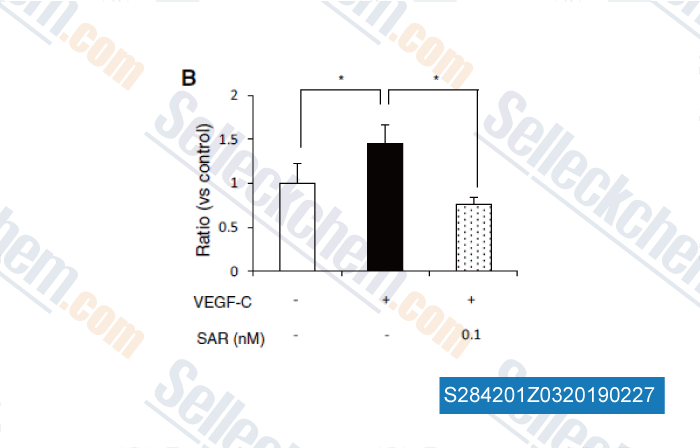
Datos de [ , , Clin Exp Metastasis, 2015, 32(8):789-98 ]
-
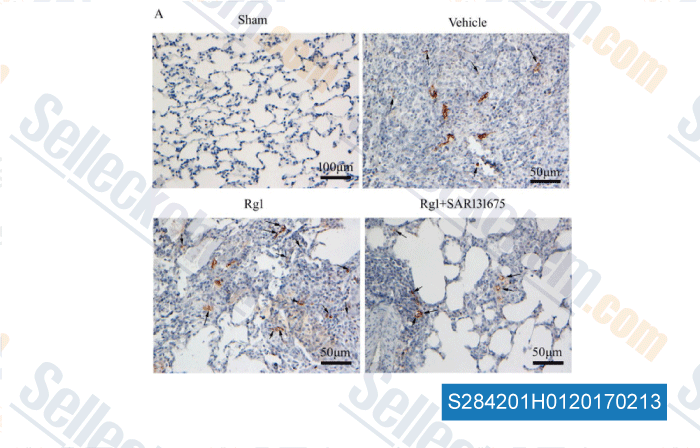
Datos de [ , , Biochem Biophys Res Commun, 2016, 472(1):182-8. ]
Sellecks SAR131675 Ha sido citado por 34 Publicaciones
| Inhibition of VEGFR-3 by SAR131675 decreases renal inflammation and lymphangiogenesis in the murine lupus nephritis model [ Cell Death Discov, 2025, 11(1):320] | PubMed: 40651955 |
| VEGFR-3 deficiency in astrocytes exacerbates Japanese encephalitis virus-induced neuroinflammation in mouse brains [ Zool Res, 2025, 46(6):1317-1325] | PubMed: 41224673 |
| Vegfr3 activation of Pkd2l1+ CSF-cNs triggers the neural stem cell response in spinal cord injury [ Cell Signal, 2025, 130:111675] | PubMed: 39986360 |
| Compensatory lymphangiogenesis is required for edema resolution in zebrafish [ Sci Rep, 2025, 15(1):8177] | PubMed: 40065081 |
| Piezo1 regulates meningeal lymphatic vessel drainage and alleviates excessive CSF accumulation [ Nat Neurosci, 2024, 10.1038/s41593-024-01604-8] | PubMed: 38528202 |
| Fibroblasts facilitate lymphatic vessel formation in transplanted heart [ Theranostics, 2024, 14(5):1886-1908] | PubMed: 38505621 |
| VEGFD signaling balances stability and activity-dependent structural plasticity of dendrites [ Cell Mol Life Sci, 2024, 81(1):354] | PubMed: 39158743 |
| Lack of RAMP1 Signaling Suppresses Liver Regeneration and Angiogenesis Following Partial Hepatectomy in Mice [ In Vivo, 2024, 38(5):2261-2270] | PubMed: 39187322 |
| VEGFR-3 signaling restrains the neuron-macrophage crosstalk during neurotropic viral infection [ Cell Rep, 2023, 42(5):112489] | PubMed: 37167063 |
| Rotator cuff healing is regulated by the lymphatic vasculature [ J Orthop Translat, 2023, 38:65-75] | PubMed: 36313978 |
POLÍTICA DE DEVOLUCIÓN
La Política de Devolución Incondicional de Selleck Chemical garantiza una experiencia de compra en línea fluida para nuestros clientes. Si no está satisfecho con su compra de alguna manera, puede devolver cualquier artículo(s) dentro de los 7 días posteriores a su recepción. En caso de problemas de calidad del producto, ya sean problemas relacionados con el protocolo o con el producto, puede devolver cualquier artículo(s) dentro de los 365 días a partir de la fecha de compra original. Siga las instrucciones a continuación al devolver productos.
ENVÍO Y ALMACENAMIENTO
Los productos Selleck se transportan a temperatura ambiente. Si recibe el producto a temperatura ambiente, tenga la seguridad de que el Departamento de Inspección de Calidad de Selleck ha realizado experimentos para verificar que la colocación a temperatura normal durante un mes no afectará la actividad biológica de los productos en polvo. Después de la recogida, guarde el producto de acuerdo con los requisitos descritos en la hoja de datos. La mayoría de los productos Selleck son estables en las condiciones recomendadas.
NO PARA USO HUMANO, DIAGNÓSTICO VETERINARIO O TERAPÉUTICO.