
Datos técnicos
| Fórmula | C23H30N8O |
||||||
| Peso molecular | 434.54 | Número CAS | 1211441-98-3 | ||||
| Solubilidad (25°C)* | In vitro | DMSO | 8 mg/mL (18.41 mM) | ||||
| Water | Insoluble | ||||||
| Ethanol | Insoluble | ||||||
| In vivo (Agregue los solventes al producto individualmente y en orden.) |
|
||||||
|
* <1 mg/ml significa ligeramente soluble o insoluble. * Tenga en cuenta que Selleck prueba la solubilidad de todos los compuestos internamente, y la solubilidad real puede diferir ligeramente de los valores publicados. Esto es normal y se debe a ligeras variaciones entre lotes. * Envío a temperatura ambiente (Las pruebas de estabilidad demuestran que este producto se puede enviar sin medidas de refrigeración.) |
|||||||
Preparación de soluciones madre
Actividad biológica
| Descripción | Ribociclib es un inhibidor oralmente disponible y altamente específico de CDK4 y CDK6 con una IC50 de 10 nM y 39 nM. Fase 3. | ||||
|---|---|---|---|---|---|
| Objetivos |
|
||||
| In vitro | LEE011, como inhibidor dual de CDK4/CDK6, inhibe significativamente el crecimiento de 12 de 17 líneas celulares de neuroblastoma con una IC50 media de 307 nM. La inhibición del crecimiento de las líneas celulares de neuroblastoma es principalmente citostática y está mediada por una detención del Cell Cycle en G1 y la senescencia celular. |
||||
| In vivo | LEE011 (200 mg/kg diarios, p.o.) causa un retraso significativo en el crecimiento tumoral en ratones portadores de xenoinjertos BE2C o 1643 sin pérdida de peso u otros signos de toxicidad. |
||||
| Características | Inhibidor selectivo de CDK4/6 biodisponible por vía oral que ha sido probado en ensayos clínicos de fase III para el tratamiento del cáncer de mama avanzado. |
Protocolo (de referencia)
| Ensayo celular: |
|
|---|---|
| Estudio en animales: |
|
Referencias
|
Validación de productos por parte del cliente
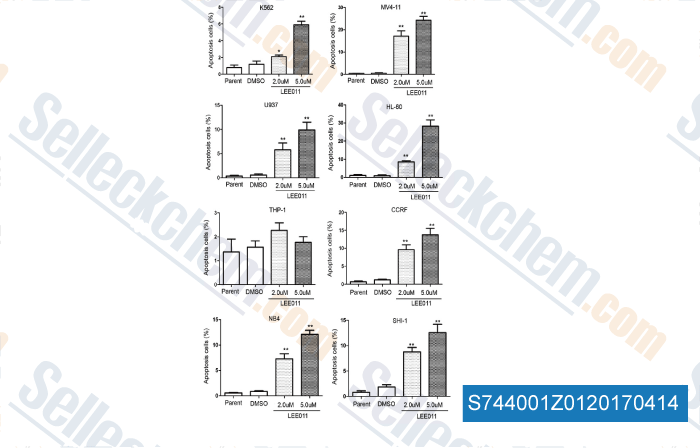
-
, , Cancer Cell Int, 2017, 17:35
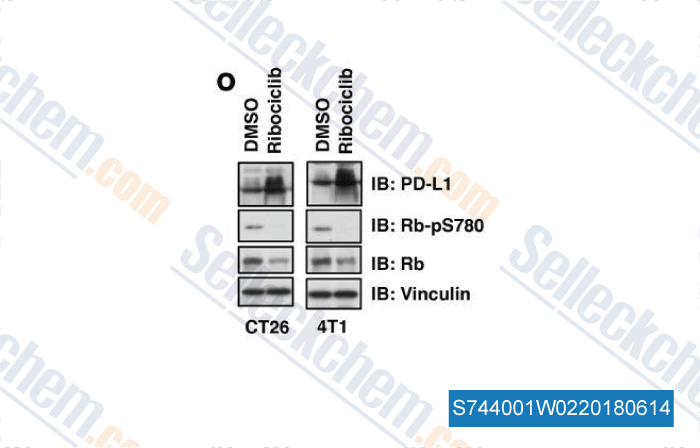
-
Datos de [ , , Nature, 2017, 553(7686):91-95 ]

-
Datos de [ , , Clin Cancer Res, 2017, 23(22):6958-6968 ]
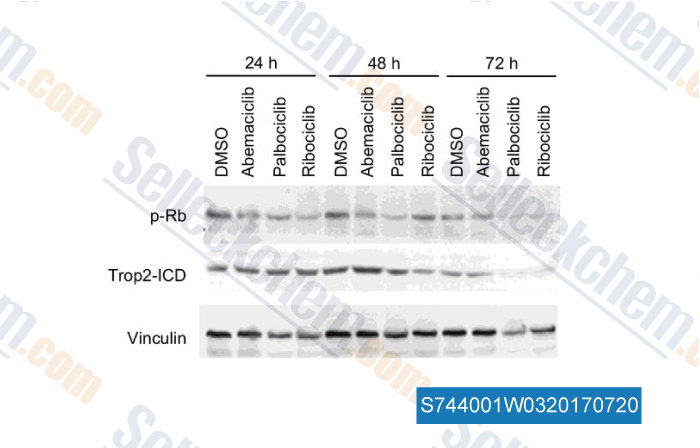
-
Datos de [ , , Cancer Res, 2016, 76(22):6723-6734 ]
Sellecks LEE011 (Ribociclib) Ha sido citado por 116 Publicaciones
| Cellular interactions within the immune microenvironment underpins resistance to cell cycle inhibition in breast cancers [ Nat Commun, 2025, 16(1):2132] | PubMed: 40032842 |
| Combined therapy with DR5-targeting antibody-drug conjugate and CDK inhibitors as a strategy for advanced colorectal cancer [ Cell Rep Med, 2025, S2666-3791(25)00231-9] | PubMed: 40449480 |
| Resistance to CDK7 inhibitors directed by acquired mutation of a conserved residue in cancer cells [ EMBO J, 2025, 10.1038/s44318-025-00554-6] | PubMed: 40921851 |
| Blocking cancer-fibroblast mutualism inhibits proliferation of endocrine therapy resistant breast cancer [ Mol Syst Biol, 2025, 10.1038/s44320-025-00104-6] | PubMed: 40341770 |
| Gene expression analysis in circulating tumour cells to determine resistance to CDK4/6 inhibitors plus endocrine therapy in HR + /HER2- metastatic breast cancer patients [ J Transl Med, 2025, 23(1):400] | PubMed: 40186268 |
| Efficacy of CDK4/6 Inhibition in colorectal cancer and the role of p16 expression in predicting drug resistance [ Cell Oncol (Dordr), 2025, 10.1007/s13402-025-01080-7] | PubMed: 40522623 |
| FLT4 activation promotes acute lymphoid leukemia survival through stabilization of MDM2/MDMX and inactivation of p53 [ Oncogenesis, 2025, 14(1):14] | PubMed: 40316529 |
| Preclinical Evaluation of the Efficacy of a Cyclin-dependent Kinase Inhibitor Ribociclib in Combination with Letrozole Against Patient-Derived Glioblastoma Cells [ Mol Cancer Ther, 2025, 10.1158/1535-7163.MCT-25-0277] | PubMed: 40994426 |
| Investigation of ribociclib, abemaciclib and palbociclib resistance in ER+ breast cancer cells reveal potential therapeutic opportunities` [ Sci Rep, 2025, 15(1):28579] | PubMed: 40764324 |
| Bacterial ubiquitin ligase engineered for small molecule and protein target identification [ bioRxiv, 2025, 2025.03.20.644192] | PubMed: 40166235 |
POLÍTICA DE DEVOLUCIÓN
La Política de Devolución Incondicional de Selleck Chemical garantiza una experiencia de compra en línea fluida para nuestros clientes. Si no está satisfecho con su compra de alguna manera, puede devolver cualquier artículo(s) dentro de los 7 días posteriores a su recepción. En caso de problemas de calidad del producto, ya sean problemas relacionados con el protocolo o con el producto, puede devolver cualquier artículo(s) dentro de los 365 días a partir de la fecha de compra original. Siga las instrucciones a continuación al devolver productos.
ENVÍO Y ALMACENAMIENTO
Los productos Selleck se transportan a temperatura ambiente. Si recibe el producto a temperatura ambiente, tenga la seguridad de que el Departamento de Inspección de Calidad de Selleck ha realizado experimentos para verificar que la colocación a temperatura normal durante un mes no afectará la actividad biológica de los productos en polvo. Después de la recogida, guarde el producto de acuerdo con los requisitos descritos en la hoja de datos. La mayoría de los productos Selleck son estables en las condiciones recomendadas.
NO PARA USO HUMANO, DIAGNÓSTICO VETERINARIO O TERAPÉUTICO.