
Datos técnicos
| Fórmula | C19H20F3IN2O5S |
||||||||||||||
| Peso molecular | 572.34 | Número CAS | 923032-37-5 | ||||||||||||
| Solubilidad (25°C)* | In vitro | DMSO | 100 mg/mL (174.72 mM) | ||||||||||||
| Ethanol | 100 mg/mL (174.72 mM) | ||||||||||||||
| Water | Insoluble | ||||||||||||||
| In vivo (Agregue los solventes al producto individualmente y en orden.) |
|
||||||||||||||
|
* <1 mg/ml significa ligeramente soluble o insoluble. * Tenga en cuenta que Selleck prueba la solubilidad de todos los compuestos internamente, y la solubilidad real puede diferir ligeramente de los valores publicados. Esto es normal y se debe a ligeras variaciones entre lotes. * Envío a temperatura ambiente (Las pruebas de estabilidad demuestran que este producto se puede enviar sin medidas de refrigeración.) |
|||||||||||||||
Preparación de soluciones madre
Actividad biológica
| Descripción | Refametinib (RDEA119, Bay 86-9766) es un inhibidor potente, no competitivo de ATP y altamente selectivo de MEK1 y MEK2 con IC50 de 19 nM y 47 nM, respectivamente. | ||||
|---|---|---|---|---|---|
| Objetivos |
|
||||
| In vitro | Refametinib (RDEA119) se une selectivamente y directamente a un bolsillo alostérico en las enzimas MEK1/2, y es altamente eficaz para inhibir la proliferación celular en varias líneas de células tumorales, incluyendo A375, SK-MEI-28, Colo205, HT-29 y BxPC3. Inhibe el crecimiento dependiente del anclaje de líneas celulares de cáncer humano que albergan la mutación BRAF V600E con ganancia de función, con valores de GI50 que van de 67 a 89 nM. En condiciones independientes del anclaje, los valores de GI50 para todas las líneas celulares probadas son similares (40-84 nM). Este compuesto muestra una selectividad tisular que reduce su potencial de efectos secundarios relacionados con el sistema nervioso central. Inhibe potentemente la proliferación de las 4 líneas celulares que albergaban la mutación BRAF, pero tiene efectos nulos o modestos en las otras 4 células que albergaban BRAF de tipo salvaje (IC50 de 0,034-0,217 μM frente a 1,413-34,120 μM). El efecto inhibidor de Refametinib en las líneas celulares seleccionadas OCUT1 (BRAF V600E(+), PIK3CA H1047R(+)) y SW1376 (BRAF V600E(+)) se potencia mediante la combinación con el inhibidor de mTOR, temsirolimus. Tanto Refametinib como temsirolimus también muestran efectos sinérgicos sobre la muerte autofágica de las células OCUT1 y KAT18 probadas selectivamente. | ||||
| In vivo | La administración oral de RDEA119 a 50 mg/kg en un esquema de una vez al día durante 14 días conduce a una inhibición del 68 % del crecimiento tumoral (TGI) en el modelo tumoral de melanoma humano A375. Este compuesto a 25 mg/kg en un esquema de una vez al día durante 14 días da como resultado una TGI del 123 % en el modelo tumoral de carcinoma de colon humano Colo205 (una TGI > 100 % ocurre cuando el tumor se reduce por debajo de su volumen inicial). Una dosis de 25 mg/kg una vez al día durante 14 días produce una TGI del 56 % y 67 % para los tumores HT-29 y A431, respectivamente. |
Protocolo (de referencia)
| Ensayo de quinasa: |
|
|---|---|
| Ensayo celular: |
|
| Estudio en animales: |
|
Referencias
|
Validación de productos por parte del cliente
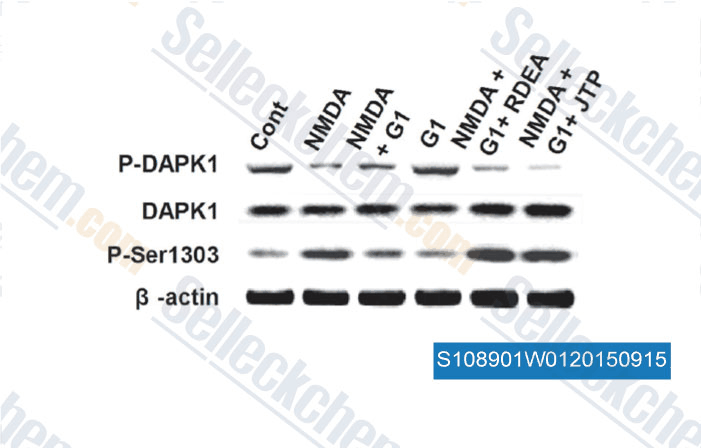
-
Datos de [ , , J Neurosci, 2012, 32(14): 4887-900 ]
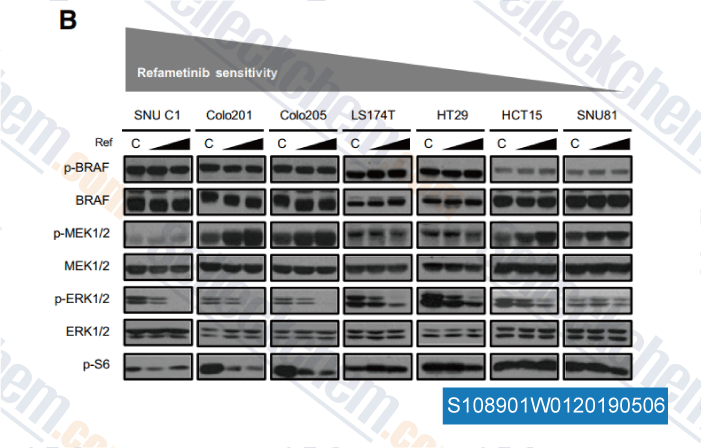
-
Datos de [ , , Mol Oncol, 2018, 12(8):1398-1409 ]
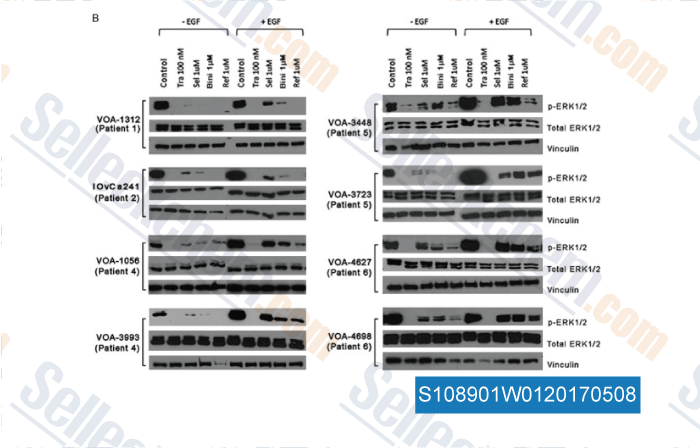
-
Datos de [ , , Am J Cancer Res, 2016, 6(10):2235-2251 ]
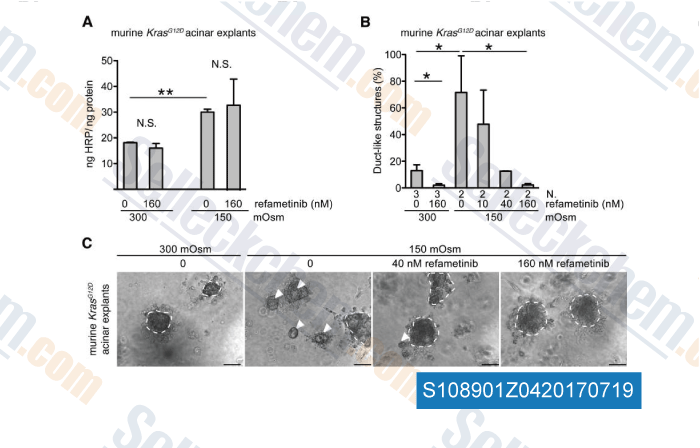
-
Datos de [ , , EBioMedicine, 2017, 15:90-99 ]
Sellecks Refametinib (RDEA119) Ha sido citado por 29 Publicaciones
| System analysis links SMARCD3 regulons to growth signaling and MEK inhibitor response in everolimus-resistant ER+ breast cancer cells [ Cell Rep Med, 2025, 6(11):102425] | PubMed: 41260207 |
| Histone deacetylase inhibitors promote breast cancer metastasis by elevating NEDD9 expression [ Signal Transduct Target Ther, 2023, 8(1):11] | PubMed: 36604412 |
| Salmonella effector SopB reorganizes cytoskeletal vimentin to maintain replication vacuoles for efficient infection [ Nat Commun, 2023, 14(1):478] | PubMed: 36717589 |
| Signaling-induced systematic repression of miRNAs uncovers cancer vulnerabilities and targeted therapy sensitivity [ Cell Rep Med, 2023, S2666-3791(23)00367-1] | PubMed: 37734378 |
| Signaling-induced systematic repression of miRNAs uncovers cancer vulnerabilities and targeted therapy sensitivity [ Cell Rep Med, 2023, 4(10):101200] | PubMed: 37734378 |
| Protein Tyrosine Phosphatase Non-Receptor 11 (PTPN11/Shp2) as a Driver Oncogene and a Novel Therapeutic Target in Non-Small Cell Lung Cancer (NSCLC) [ Int J Mol Sci, 2023, 24(13)10545] | PubMed: 37445722 |
| Anatomic position determines oncogenic specificity in melanoma [ Nature, 2022, 604(7905):354-361] | PubMed: 35355015 |
| NOTCH signaling limits the response of Low Grade Serous Ovarian Cancers to MEK inhibition [ Mol Cancer Ther, 2022, MCT-22-0004] | PubMed: 36198031 |
| Secondary resistance to anti-EGFR therapy by transcriptional reprogramming in patient-derived colorectal cancer models [ Genome Med, 2021, 13(1):116] | PubMed: 34271981 |
| Targeting the PI3K and MAPK pathways to improve response to HER2-targeted therapies in HER2-positive gastric cancer [ J Transl Med, 2021, 19(1):184] | PubMed: 33933113 |
POLÍTICA DE DEVOLUCIÓN
La Política de Devolución Incondicional de Selleck Chemical garantiza una experiencia de compra en línea fluida para nuestros clientes. Si no está satisfecho con su compra de alguna manera, puede devolver cualquier artículo(s) dentro de los 7 días posteriores a su recepción. En caso de problemas de calidad del producto, ya sean problemas relacionados con el protocolo o con el producto, puede devolver cualquier artículo(s) dentro de los 365 días a partir de la fecha de compra original. Siga las instrucciones a continuación al devolver productos.
ENVÍO Y ALMACENAMIENTO
Los productos Selleck se transportan a temperatura ambiente. Si recibe el producto a temperatura ambiente, tenga la seguridad de que el Departamento de Inspección de Calidad de Selleck ha realizado experimentos para verificar que la colocación a temperatura normal durante un mes no afectará la actividad biológica de los productos en polvo. Después de la recogida, guarde el producto de acuerdo con los requisitos descritos en la hoja de datos. La mayoría de los productos Selleck son estables en las condiciones recomendadas.
NO PARA USO HUMANO, DIAGNÓSTICO VETERINARIO O TERAPÉUTICO.