
Datos técnicos
| Fórmula | C17H13N3O7 |
||||||||||
| Peso molecular | 371.3 | Número CAS | 418805-02-4 | ||||||||
| Solubilidad (25°C)* | In vitro | DMSO | 74 mg/mL (199.29 mM) | ||||||||
| Water | Insoluble | ||||||||||
| Ethanol | Insoluble | ||||||||||
| In vivo (Agregue los solventes al producto individualmente y en orden.) |
|
||||||||||
|
* <1 mg/ml significa ligeramente soluble o insoluble. * Tenga en cuenta que Selleck prueba la solubilidad de todos los compuestos internamente, y la solubilidad real puede diferir ligeramente de los valores publicados. Esto es normal y se debe a ligeras variaciones entre lotes. * Envío a temperatura ambiente (Las pruebas de estabilidad demuestran que este producto se puede enviar sin medidas de refrigeración.) |
|||||||||||
Preparación de soluciones madre
Actividad biológica
| Descripción | PYR-41 es el primer inhibidor celular permeable de la enzima activadora de ubiquitina E1, sin actividad en E2. Este compuesto induce la apoptosis. | ||
|---|---|---|---|
| Objetivos |
|
||
| In vitro | PYR-41 (50 μM) inhibe la actividad de la enzima activadora de ubiquitina E1 en más del 90%. Este compuesto podría ser un objetivo para el ataque nucleofílico y potencialmente reaccionar con la cisteína del sitio activo de E1. Bloquea eficientemente la degradación de la ciclina E. Este químico disminuye el nivel de tioésteres E1fUb en células con una IC50 entre 10 y 25 μM, y previene la acumulación de proteínas ubiquitiniladas inducida por inhibidores del proteasoma. Aumenta la sumoilación total en células y en células que albergan E1 termosensible. Es capaz de inhibir tanto las actividades de ubiquitinación dependientes del proteasoma como las independientes del proteasoma. Este compuesto (50 μM) atenúa la activación del factor nuclear-κB mediada por 1 ng/mL de IL-1α en más del 60% al prevenir la ubiquitinación descendente y la degradación proteasomal de IκBα. Inhibe la degradación de p53 y activa la actividad transcripcional de p53, lo que le permite matar diferencialmente las células transformadas que expresan p53. Bloquea las reacciones de ubiquitinación pero paradójicamente conduce a la acumulación de proteínas ubiquitinadas de alto peso molecular. Este compuesto también tiene una actividad inhibidora igual o mayor contra varias desubiquitinasas (DUBs) en células intactas y USP5 purificada in vitro. También media la reticulación de quinasas de proteínas específicas (Bcr-Abl, Jak2) para inhibir su actividad de señalización. |
Protocolo (de referencia)
Referencias
|
Validación de productos por parte del cliente
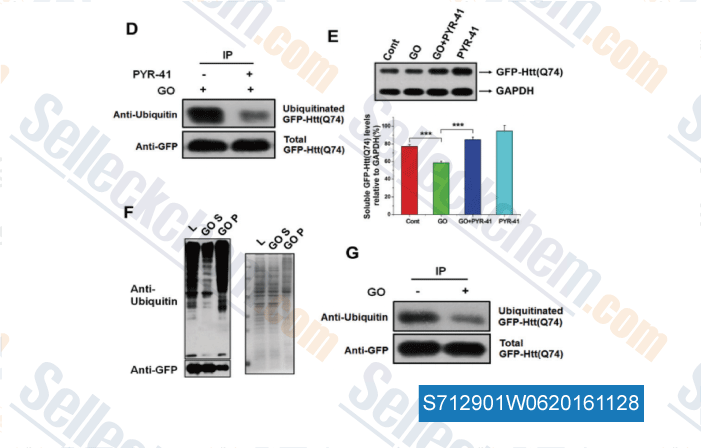
-
Datos de [ , , Nanoscale, 2016, 8: 18740-18750 ]
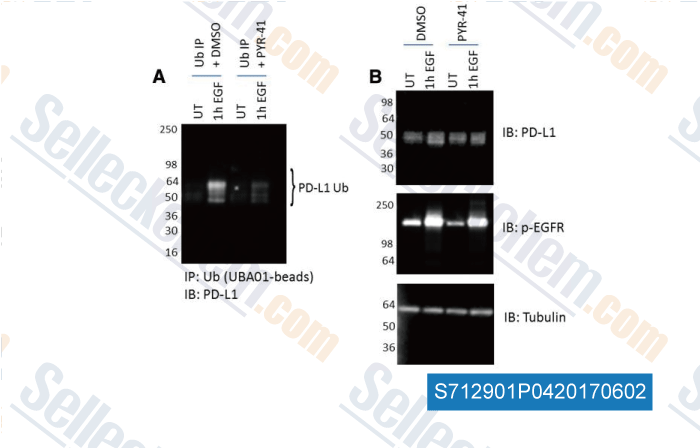
-
Datos de [ , , Neoplasia, 2017, 19(4):346-353 ]
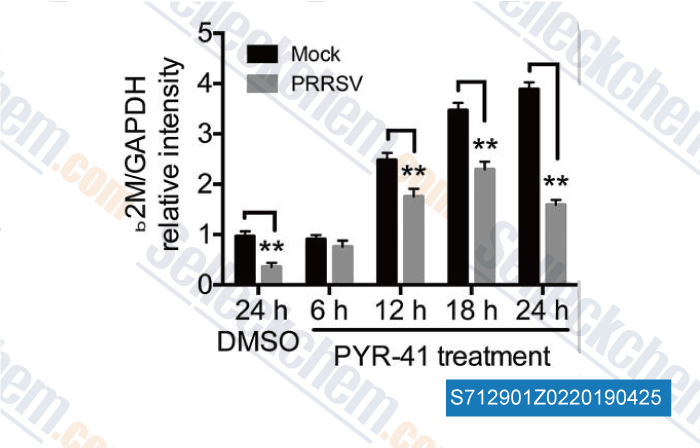
-
Datos de [ , , J Virol, 2017, 91(5) ]
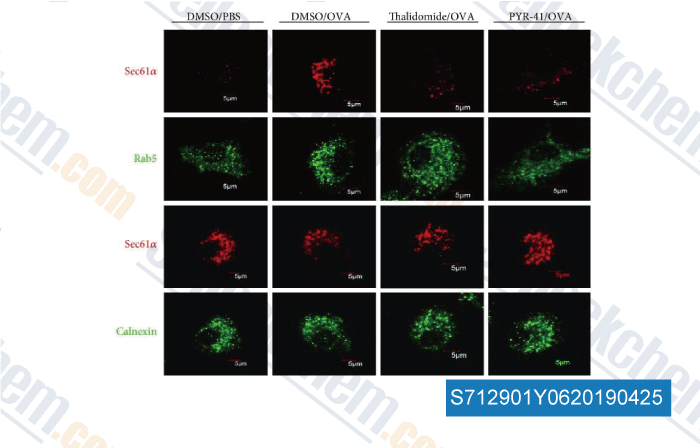
-
Datos de [ , , J Immunol Res, 2018, 2018:5070573 ]
Sellecks PYR-41 Ha sido citado por 35 Publicaciones
| SAMD9 senses cytosolic double-stranded nucleic acids in epithelial and mesenchymal cells to induce antiviral immunity [ Nat Commun, 2025, 16(1):3756] | PubMed: 40263291 |
| Glutathione reductase underlies the stability of mutant p53 by antagonizing protein glutathionylation [ Redox Biol, 2025, 81:103522] | PubMed: 39983342 |
| TLR4 endocytosis and endosomal TLR4 signaling are distinct and independent outcomes of TLR4 activation [ EMBO Rep, 2025, 10.1038/s44319-025-00444-2] | PubMed: 40204912 |
| Engineered a dual-targeting HA-TPP/A nanoparticle for combination therapy against KRAS-TP53 co-mutation in gastrointestinal cancers [ Bioact Mater, 2024, 32:277-291] | PubMed: 37876556 |
| ER Stress-Activated HSF1 Governs Cancer Cell Resistance to USP7 Inhibitor-Based Chemotherapy through the PERK Pathway [ Int J Mol Sci, 2024, 25(5)2768] | PubMed: 38474017 |
| IE1 of Human Cytomegalovirus Inhibits Necroptotic Cell Death via Direct and Indirect Modulation of the Necrosome Complex [ Viruses, 2024, 16(2)290] | PubMed: 38400065 |
| Precise pancreatic cancer therapy through targeted degradation of mutant p53 protein by cerium oxide nanoparticles [ J Nanobiotechnology, 2023, 21(1):117] | PubMed: 37005668 |
| The Ubiquitin-Proteasome System Facilitates Membrane Fusion and Uncoating during Coronavirus Entry [ Viruses, 2023, 15(10)2001] | PubMed: 37896778 |
| Proteasomal and autophagy-mediated degradation of mutp53 proteins through mitochondria-targeting aggregation-induced-emission materials [ Acta Biomater, 2022, S1742-7061(22)00458-5] | PubMed: 35931280 |
| Small Molecules Promote Selective Denaturation and Degradation of Tubulin Heterodimers through a Low-Barrier Hydrogen Bond [ J Med Chem, 2022, 65(13):9159-9173] | PubMed: 35762925 |
POLÍTICA DE DEVOLUCIÓN
La Política de Devolución Incondicional de Selleck Chemical garantiza una experiencia de compra en línea fluida para nuestros clientes. Si no está satisfecho con su compra de alguna manera, puede devolver cualquier artículo(s) dentro de los 7 días posteriores a su recepción. En caso de problemas de calidad del producto, ya sean problemas relacionados con el protocolo o con el producto, puede devolver cualquier artículo(s) dentro de los 365 días a partir de la fecha de compra original. Siga las instrucciones a continuación al devolver productos.
ENVÍO Y ALMACENAMIENTO
Los productos Selleck se transportan a temperatura ambiente. Si recibe el producto a temperatura ambiente, tenga la seguridad de que el Departamento de Inspección de Calidad de Selleck ha realizado experimentos para verificar que la colocación a temperatura normal durante un mes no afectará la actividad biológica de los productos en polvo. Después de la recogida, guarde el producto de acuerdo con los requisitos descritos en la hoja de datos. La mayoría de los productos Selleck son estables en las condiciones recomendadas.
NO PARA USO HUMANO, DIAGNÓSTICO VETERINARIO O TERAPÉUTICO.