
Datos técnicos
| Fórmula | C7H5N5S2 |
||||||
| Peso molecular | 223.28 | Número CAS | 2645-32-1 | ||||
| Solubilidad (25°C)* | In vitro | DMSO | 45 mg/mL (201.54 mM) | ||||
| Water | Insoluble | ||||||
| Ethanol | Insoluble | ||||||
| In vivo (Agregue los solventes al producto individualmente y en orden.) |
|
||||||
|
* <1 mg/ml significa ligeramente soluble o insoluble. * Tenga en cuenta que Selleck prueba la solubilidad de todos los compuestos internamente, y la solubilidad real puede diferir ligeramente de los valores publicados. Esto es normal y se debe a ligeras variaciones entre lotes. * Envío a temperatura ambiente (Las pruebas de estabilidad demuestran que este producto se puede enviar sin medidas de refrigeración.) |
|||||||
Preparación de soluciones madre
Actividad biológica
| Descripción | PR-619 es un inhibidor no selectivo y reversible de las enzimas desubiquitinilantes (DUBs) con un EC50 de 1-20 μM en un ensayo sin células. Este compuesto activa la autophagy. | |||||||||||
|---|---|---|---|---|---|---|---|---|---|---|---|---|
| Objetivos |
|
|||||||||||
| In vitro | PR-619 es un inhibidor de DUB de amplio espectro de la clase piridinamina, permeable a las células, cuyos objetivos conocidos incluyen ATXN3, BAP1, JOSD2, OTUD5, UCH-L1, UCH-L3, UCH-L5/UCH37, USP1, 2, 4, 5, 7, 8, 9X, 10, 14, 15, 16, 19, 20, 22, 24, 28, 47, 48, VCIP135, YOD1, así como la deISGylase PLpro, la deNEDDylase DEN1 y la deSUMOlyase SENP6. Se ha demostrado que este compuesto aumenta la poliubiquitinación proteica global en células HEK293T de manera dependiente de la dosis y el tiempo (20 a 150 μM, 0,5 a 20 h). El tratamiento con este químico resulta en la regulación al alza de las cadenas de poliUb unidas a K48 y a K63. Induce la muerte celular HCT116 con valores de EC50 de 6,3 μM. |
|||||||||||
| In vivo | PR-619 mejora el efecto antitumoral sobre el xenoinjerto de UC en ratones nude. |
Protocolo (de referencia)
| Ensayo de quinasa: |
|
|---|---|
| Ensayo celular: |
|
Referencias
|
Validación de productos por parte del cliente
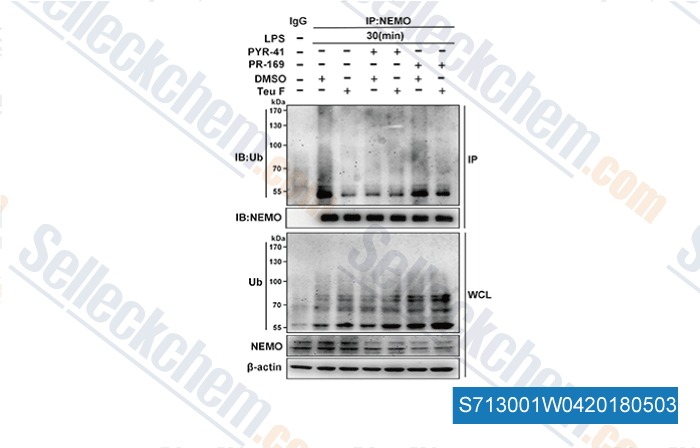
-
Datos de [ , , Front Pharmacol, 2017, https://doi.org/10.3389/fphar.2017.00565 ]
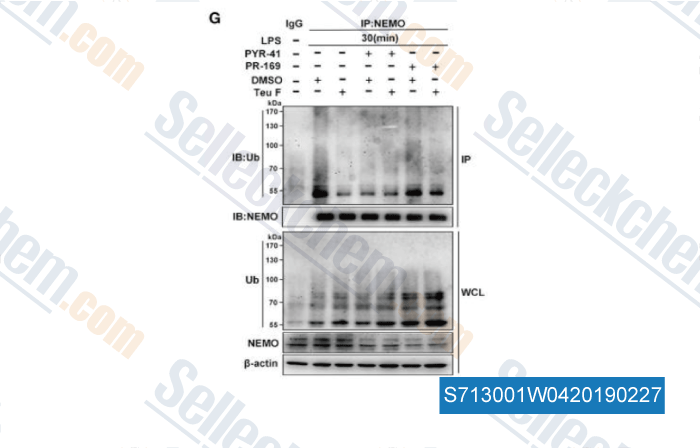
-
Datos de [ , , Front Pharmacol, 2018, 8:565 ]
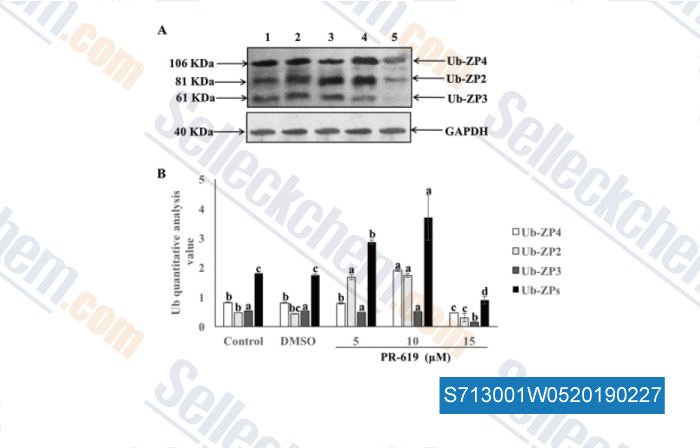
-
Datos de [ , , Anim Reprod Sci, 2017, 187:64-73 ]
Sellecks PR-619 Ha sido citado por 65 Publicaciones
| USP15 Facilitates Colorectal Cancer Immune Evasion through SMYD3/CCL2-Dependent Myeloid-Derived Suppressor Cell Recruitment [ Cancer Immunol Res, 2025, 10.1158/2326-6066.CIR-24-1194] | PubMed: 40323348 |
| A novel mechanism in regulating drug sensitivity, growth, and apoptosis of bortezomib-resistant multiple myeloma cells: the USP4/KLF2/HMGA2 cascade [ J Orthop Surg Res, 2025, 20(1):220] | PubMed: 40022160 |
| Linear ubiquitination prevents lipodystrophy and obesity-associated metabolic syndrome [ Sci Adv, 2025, 11(38):eadw2539] | PubMed: 40961178 |
| Noncanonical function of folate through folate receptor 1 during neural tube formation [ Nat Commun, 2024, 15(1):1642] | PubMed: 38388461 |
| Sugar-mediated non-canonical ubiquitination impairs Nrf1/NFE2L1 activation [ Mol Cell, 2024, 84(16):3115-3127.e11] | PubMed: 39116872 |
| Increased CSN5 expression enhances the sensitivity to lenalidomide in multiple myeloma cells [ iScience, 2024, 27(12):111399] | PubMed: 39687025 |
| MAPK-dependent control of mitotic progression in S. pombe [ BMC Biol, 2024, 22(1):71] | PubMed: 38523261 |
| DNA polymerase η is regulated by mutually exclusive mono-ubiquitination and mono-NEDDylation [ bioRxiv, 2024, 2024.10.12.618026] | PubMed: 39416117 |
| Precise pancreatic cancer therapy through targeted degradation of mutant p53 protein by cerium oxide nanoparticles [ J Nanobiotechnology, 2023, 21(1):117] | PubMed: 37005668 |
| Comparative proteomic and phosphoproteomic analysis reveals differential heat response mechanism in two congeneric oyster species [ Ecotoxicol Environ Saf, 2023, 263:115197] | PubMed: 37451098 |
POLÍTICA DE DEVOLUCIÓN
La Política de Devolución Incondicional de Selleck Chemical garantiza una experiencia de compra en línea fluida para nuestros clientes. Si no está satisfecho con su compra de alguna manera, puede devolver cualquier artículo(s) dentro de los 7 días posteriores a su recepción. En caso de problemas de calidad del producto, ya sean problemas relacionados con el protocolo o con el producto, puede devolver cualquier artículo(s) dentro de los 365 días a partir de la fecha de compra original. Siga las instrucciones a continuación al devolver productos.
ENVÍO Y ALMACENAMIENTO
Los productos Selleck se transportan a temperatura ambiente. Si recibe el producto a temperatura ambiente, tenga la seguridad de que el Departamento de Inspección de Calidad de Selleck ha realizado experimentos para verificar que la colocación a temperatura normal durante un mes no afectará la actividad biológica de los productos en polvo. Después de la recogida, guarde el producto de acuerdo con los requisitos descritos en la hoja de datos. La mayoría de los productos Selleck son estables en las condiciones recomendadas.
NO PARA USO HUMANO, DIAGNÓSTICO VETERINARIO O TERAPÉUTICO.