
|
Cómo citar 1. Para citas en el texto (Materiales y métodos): 2. Para la tabla de recursos clave: |
||
|
Llamada gratuita: (877) 796-6397 -- Solo EE. UU. y Canadá -- |
Fax: +1-832-582-8590 Pedidos: +1-832-582-8158 |
Soporte técnico: +1-832-582-8158 Ext:3 Por favor, indique su número de pedido en el correo electrónico. Nos esforzamos por responder a todas las consultas por correo electrónico en el plazo de un día hábil. |
Descripción biológica
| Especificidad | POLG Antibody [M21J18] detecta niveles endógenos de proteína POLG total. |
|---|---|
| Antecedentes | El ADN mitocondrial (ADNmt) reside en nucleoides discretos dentro de la matriz interna de la mitocondria, con cada nucleoide conteniendo típicamente una o dos copias de ADNmt. La replicación del ADNmt es llevada a cabo por un replisoma especializado compuesto por proteínas de replicación centrales, incluyendo la ADN polimerasa γ (pol γ), la proteína de unión a ADN de cadena sencilla mitocondrial, la helicasa Twinkle mtDNA, así como topoisomerasas y RNasa H. La pol γ humana es un heterodímero que consta de dos subunidades: POLG, la subunidad catalítica de 140 kDa codificada por el gen POLG en el locus cromosómico 15q25, posee actividades de ADN polimerasa, exonucleasa 3′→5′ y liasa de 5′-desoxirribosafosfato (5′-dRP). Tiene un dominio exonucleasa amino-terminal conectado por un enlazador al dominio polimerasa carboxi-terminal. POLG2, la subunidad accesoria de 55 kDa codificada por POLG2 en el locus cromosómico 17q24, forma un dímero y mejora la procesividad de la polimerasa al aumentar la afinidad de la subunidad catalítica por el ADN. Las mutaciones en POLG son una causa principal de trastornos mitocondriales heredados, con hasta un 2% de la población portando variantes patogénicas. Estas mutaciones pueden conducir a síndromes de agotamiento de ADNmt en la primera infancia o a afecciones de aparición más tardía resultantes de deleciones de ADNmt. Los trastornos relacionados con POLG forman un continuo de fenotipos superpuestos, con un inicio que va desde la infancia hasta la edad adulta tardía. Los seis síndromes clínicos primarios vinculados a mutaciones de POLG son: síndrome de Alpers–Huttenlocher (uno de los fenotipos más graves), espectro de miocerebrohepatopatía infantil, ataxia sensorial por miopatía de epilepsia mioclónica, espectro de neuropatía por ataxia, oftalmoplejía externa progresiva autosómica recesiva, oftalmoplejía externa progresiva autosómica dominante. |
Información de uso
| Aplicación | WB | Dilución |
|
||
|---|---|---|---|---|---|
| Reactividad | Mouse, Rat, Human | ||||
| Fuente | Rabbit Monoclonal Antibody | MW | 140 kDa | ||
| Tampón de almacenamiento | PBS, pH 7.2+50% Glycerol+0.05% BSA+0.01% NaN3 | Almacenamiento (Desde la fecha de recepción) |
-20°C (avoid freeze-thaw cycles), 2 years | ||
| WB |
Experimental Protocol:
Sample preparation
1. Tissue: Lyse the tissue sample by adding an appropriate volume of ice-cold RIPA Lysis Buffer (containing Protease Inhibitor Cocktail),and homogenize the tissue at a low temperature. 2. Adherent cell: Aspirate the culture medium and wash the cells with ice-cold PBS twice. Lyse the cells by adding an appropriate volume of RIPA Lysis Buffer (containing Protease Inhibitor Cocktail) and put the sample on ice for 5 min. 3. Suspension cell: Transfer the culture medium to a pre-cooled centrifuge tube. Centrifuge and aspirate the supernatant. Wash the cells with ice-cold PBS twice. Lyse the cells by adding an appropriate volume of RIPA Lysis Buffer (containing Protease Inhibitor Cocktail) and put the sample on ice for 5 min. 4. Place the lysate into a pre-cooled microcentrifuge tube. Centrifuge at 4°C for 15 min. Collect the supernatant;
5. Remove a small volume of lysate to determine the protein concentration;
6. Combine the lysate with protein loading buffer. Boil 20 µL sample under 95-100°C for 5 min. Centrifuge for 5 min after cool down on ice.
Electrophoretic separation
1. According to the concentration of extracted protein, load appropriate amount of protein sample and marker onto SDS-PAGE gels for electrophoresis. Recommended separating gel (lower gel) concentration: 5%. Reference Table for Selecting SDS-PAGE Separation Gel Concentrations 2. Power up 80V for 30 minutes. Then the power supply is adjusted (110 V~150 V), the Marker is observed, and the electrophoresis can be stopped when the indicator band of the predyed protein Marker where the protein is located is properly separated. (Note that the current should not be too large when electrophoresis, too large current (more than 150 mA) will cause the temperature to rise, affecting the result of running glue. If high currents cannot be avoided, an ice bath can be used to cool the bath.)
Transfer membrane
1. Take out the converter, soak the clip and consumables in the pre-cooled converter;
2. Activate PVDF membrane with methanol for 1 min and rinse with transfer buffer;
3. Install it in the order of "black edge of clip - sponge - filter paper - filter paper - glue -PVDF membrane - filter paper - filter paper - sponge - white edge of clip"; 4. The protein was electrotransferred to PVDF membrane. ( 0.45 µm PVDF membrane is recommended ) Reference Table for Selecting PVDF Membrane Pore Size Specifications Recommended conditions for wet transfer: 200 mA, 120 min. ( Note that the transfer conditions can be adjusted according to the protein size. For high-molecular-weight proteins, a higher current and longer transfer time are recommended. However, ensure that the transfer tank remains at a low temperature to prevent gel melting.)
Block
1. After electrotransfer, wash the film with TBST at room temperature for 5 minutes;
2. Incubate the film in the blocking solution for 1 hour at room temperature;
3. Wash the film with TBST for 3 times, 5 minutes each time.
Antibody incubation
1. Use 5% skim milk powder to prepare the primary antibody working liquid (recommended dilution ratio for primary antibody 1:1000), gently shake and incubate with the film at 4°C overnight; 2. Wash the film with TBST 3 times, 5 minutes each time;
3. Add the secondary antibody to the blocking solution and incubate with the film gently at room temperature for 1 hour;
4. After incubation, wash the film with TBST 3 times for 5 minutes each time.
Antibody staining
1. Add the prepared ECL luminescent substrate (or select other color developing substrate according to the second antibody) and mix evenly;
2. Incubate with the film for 1 minute, remove excess substrate (keep the film moist), wrap with plastic film, and expose in the imaging system. (Exposure time of at least 120s is recommended)
|
Referencias
|
Datos de aplicación
WB
Validado por Selleck
-
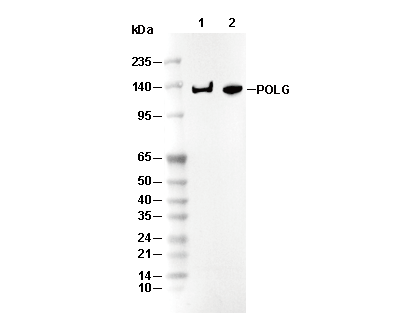 Lane 1: HEK-293T, Lane 2: HepG2