
Datos técnicos
| Fórmula | C31H32N4O3 |
||||||
| Peso molecular | 508.61 | Número CAS | 130663-39-7 | ||||
| Solubilidad (25°C)* | In vitro | DMSO | 100 mg/mL (196.61 mM) | ||||
| Water | 100 mg/mL (196.61 mM) | ||||||
| Ethanol | 100 mg/mL (196.61 mM) | ||||||
| In vivo (Agregue los solventes al producto individualmente y en orden.) |
|
||||||
|
* <1 mg/ml significa ligeramente soluble o insoluble. * Tenga en cuenta que Selleck prueba la solubilidad de todos los compuestos internamente, y la solubilidad real puede diferir ligeramente de los valores publicados. Esto es normal y se debe a ligeras variaciones entre lotes. * Envío a temperatura ambiente (Las pruebas de estabilidad demuestran que este producto se puede enviar sin medidas de refrigeración.) |
|||||||
Preparación de soluciones madre
Actividad biológica
| Descripción | PD 123319 es un antagonista potente y selectivo del receptor AT2 de angiotensina II con una IC50 de 34 nM. | ||
|---|---|---|---|
| Objetivos |
|
||
| In vitro | Se ha demostrado que PD 123319 discrimina entre dos subclases de receptores de AII en muchos tejidos diferentes. El 125I-AII marcó específicamente dos clases de sitios de unión para AII en una preparación de membrana de células glomerulares suprarrenales bovinas. La primera clase (sensible a DuP-753) representa aproximadamente el 85% de los sitios de unión totales para AII y posee una alta afinidad (IC50 de 92,9 nM) por DuP-753. PD-123319 no tiene ningún efecto sobre la unión de 125I-AII a este sitio. La segunda clase de sitios de unión es más sensible a PD-123319, con una IC50 de 6,9 nM, y tiene una afinidad mucho menor por DuP-753 (IC50 de alrededor de 10 μM). | ||
| In vivo | PD 123319 no tiene efecto sobre la autorregulación del flujo sanguíneo cerebral. El bloqueo agudo del receptor AT2 no influye en la autorregulación del CBF. La administración intravenosa de PD 123319 a ratas hipertensas conscientes provoca un aumento inmediato dependiente de la dosis en la MAP que se mantiene durante aproximadamente 7,4 minutos con 3 mg/kg de PD 123319. |
Protocolo (de referencia)
| Estudio en animales:[3] |
|
|---|
Referencias
|
Validación de productos por parte del cliente
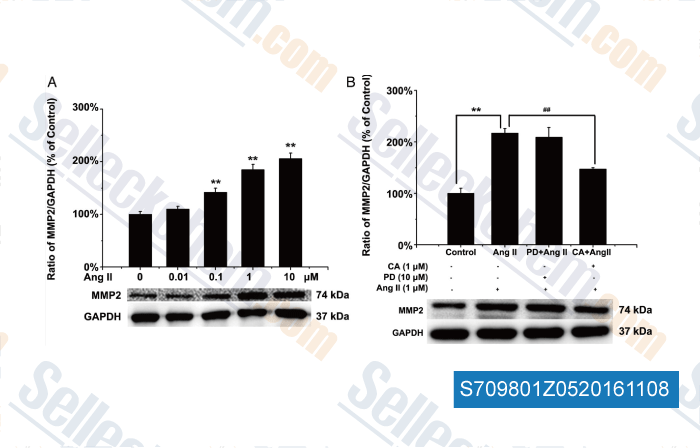
-
, , Acta Biochim Biophys Sin (Shanghai), 2015, 47(7):539-47.
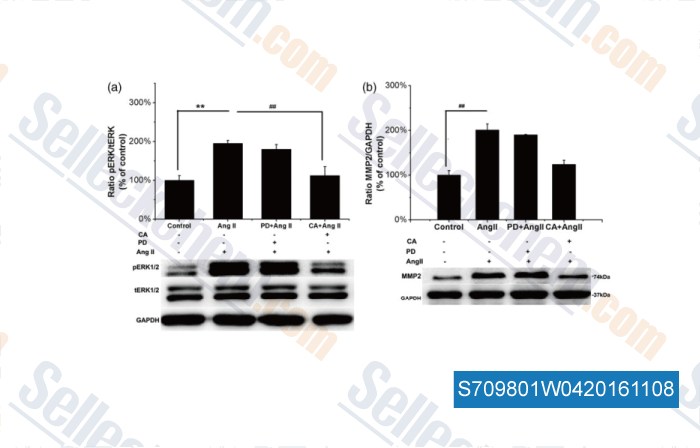
-
, , Exp Biol Med (Maywood), 2015, 240(12):1564-71.
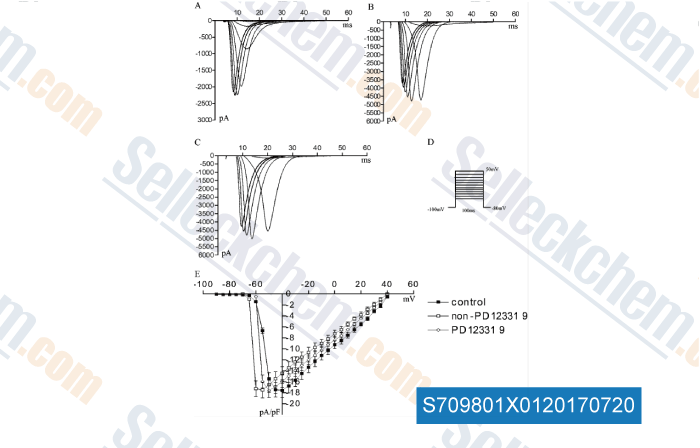
-
Datos de [ , , Naunyn Schmiedebergs Arch Pharmacol, 2016, 389(12):1333-1340 ]
Sellecks PD123319 Ha sido citado por 12 Publicaciones
| Cartilage oligomeric matrix protein is an endogenous β-arrestin-2-selective allosteric modulator of AT1 receptor counteracting vascular injury [ Cell Res, 2021, 10.1038/s41422-020-00464-8] | PubMed: 33510386 |
| Angiotensin II inhibits osteogenic differentiation of isolated synoviocytes by increasing DKK-1 expression. [ Int J Biochem Cell Biol, 2020, 121:105703] | PubMed: 32014499 |
| Angiotensin II down-regulates transferrin receptor 1 and ferroportin 1 expression in Neuro-2a cells via activation of type-1 receptor. [ Neurosci Lett, 2020, 716:134684] | PubMed: 31830506 |
| (Pro)renin receptor contributes to hypoxia/reoxygenation-induced apoptosis and autophagy in myocardial cells via the beta-catenin signaling pathway [ Physiol Res, 2020, 69(3):427-438] | PubMed: 32469229 |
| Alamandine attenuates long‑term hypertension‑induced cardiac fibrosis independent of blood pressure. [ Mol Med Rep, 2019, 19(6):4553-4560] | PubMed: 31059021 |
| [ J Immunother Cancer, 2018, ] | PubMed: 30208943 |
| Role of angiotensin II type 2 receptor during electrophysiological remodeling of left ventricular hypertrophic myocardium in spontaneously hypertensive rats [Xiao Y, et al. J Am Soc Hypertens, 2018, 12(1):58-65] | PubMed: 29100861 |
| Angiotensin II induces connective tissue growth factor expression in human hepatic stellate cells by a transforming growth factor β-independent mechanism. [ Sci Rep, 2017, 7(1):7841] | PubMed: 28798388 |
| Long-term treatment of spontaneously hypertensive rats with PD123319 and electrophysiological remodeling of left ventricular myocardium. [Ying X, et al. Naunyn Schmiedebergs Arch Pharmacol, 2016, 389(12):1333-1340] | PubMed: 27629578 |
| Angiotensin II induces an increase in MMP-2 expresison in idiopathic ascending aortic aneurysm via AT1 receptor and JNK pathway. [Wang C, et al. Acta Biochim Biophys Sin, 2015, 47(7), 1–9] | PubMed: 26071572 |
POLÍTICA DE DEVOLUCIÓN
La Política de Devolución Incondicional de Selleck Chemical garantiza una experiencia de compra en línea fluida para nuestros clientes. Si no está satisfecho con su compra de alguna manera, puede devolver cualquier artículo(s) dentro de los 7 días posteriores a su recepción. En caso de problemas de calidad del producto, ya sean problemas relacionados con el protocolo o con el producto, puede devolver cualquier artículo(s) dentro de los 365 días a partir de la fecha de compra original. Siga las instrucciones a continuación al devolver productos.
ENVÍO Y ALMACENAMIENTO
Los productos Selleck se transportan a temperatura ambiente. Si recibe el producto a temperatura ambiente, tenga la seguridad de que el Departamento de Inspección de Calidad de Selleck ha realizado experimentos para verificar que la colocación a temperatura normal durante un mes no afectará la actividad biológica de los productos en polvo. Después de la recogida, guarde el producto de acuerdo con los requisitos descritos en la hoja de datos. La mayoría de los productos Selleck son estables en las condiciones recomendadas.
NO PARA USO HUMANO, DIAGNÓSTICO VETERINARIO O TERAPÉUTICO.