
Datos técnicos
| Fórmula | C12H7Cl2NO3S2 |
||||||
| Peso molecular | 348.22 | Número CAS | 882257-11-6 | ||||
| Solubilidad (25°C)* | In vitro | DMSO | 28 mg/mL (80.4 mM) | ||||
| Water | Insoluble | ||||||
| Ethanol | Insoluble | ||||||
| In vivo (Agregue los solventes al producto individualmente y en orden.) |
|
||||||
|
* <1 mg/ml significa ligeramente soluble o insoluble. * Tenga en cuenta que Selleck prueba la solubilidad de todos los compuestos internamente, y la solubilidad real puede diferir ligeramente de los valores publicados. Esto es normal y se debe a ligeras variaciones entre lotes. * Envío a temperatura ambiente (Las pruebas de estabilidad demuestran que este producto se puede enviar sin medidas de refrigeración.) |
|||||||
Preparación de soluciones madre
Actividad biológica
| Descripción | P5091 es un inhibidor selectivo y potente de la ubiquitin-specific protease 7 (USP7) con una EC50 de 4,2 μM y de la estrechamente relacionada USP47. | ||||
|---|---|---|---|---|---|
| Objetivos |
|
||||
| In vitro | P5091 es un tiofeno trisustituido con sustituyentes diclorofeniltio, nitro y acetilo que median la actividad anti-USP7. Este compuesto exhibe una actividad desubiquitinante potente, específica y selectiva contra USP7. En contraste, no inhibe otras DUBs u otras familias de cisteín proteasas probadas (EC50 > 100 mM). Este químico inhibe el marcaje de USP7 con HA-UbVME de manera dependiente de la concentración. La escisión de cadenas de poliubiquitina de alto peso molecular mediada por USP7 es inhibida de manera dosis-dependiente por este compuesto. Además, inhibe la escisión de cadenas de ubiquitina unidas a poli-K48 mediada por USP7, pero no por USP2 o USP8. La inhibición de USP7 por este compuesto induce la poliubiquitinación de HDM2 y acelera la degradación de HDM2. Inhibe la actividad desubiquitinante de USP7, sin bloquear la actividad del proteasoma en células MM. Este químico induce una disminución dosis-dependiente en la viabilidad de varias líneas celulares MM. Supera el crecimiento de células MM inducido por células estromales de médula ósea. Este compuesto disminuyó los niveles de HDM2 y HDMX, así como aumentó los niveles de p53 y p21. En general, la citotoxicidad inducida por este compuesto está mediada en parte a través del eje de señalización HDM2-p21 y, aunque p53 se regula al alza en respuesta a este tratamiento químico, la actividad citotóxica del mismo no depende de p53. |
||||
| In vivo | En estudios de modelos tumorales en animales, P5091 es bien tolerado, inhibe el crecimiento tumoral y prolonga la supervivencia. La combinación de este compuesto con el inhibidor de HDAC SAHA desencadena una actividad anti-MM sinérgica. |
Protocolo (de referencia)
| Ensayo de quinasa: |
|
|---|---|
| Ensayo celular: |
|
| Estudio en animales: |
|
Referencias
|
Validación de productos por parte del cliente
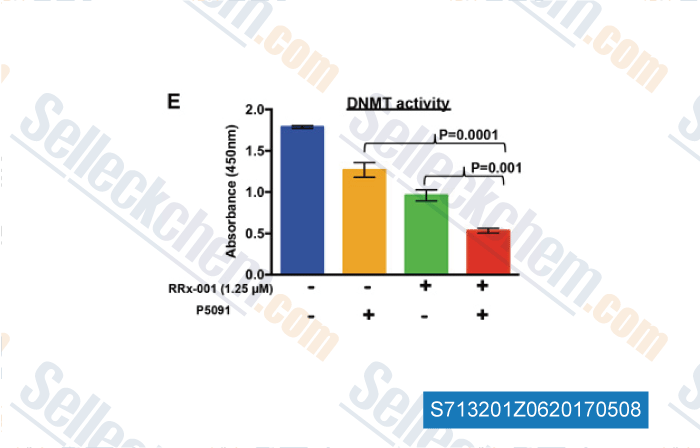
-
Datos de [ , , Leukemia, 2016, 30(11):2187-2197 ]
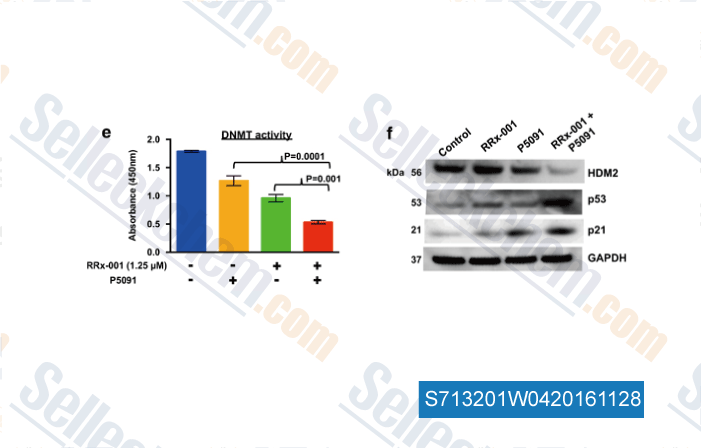
-
Datos de [ , , Leukemia, 2016, 30(11):2187-2197. ]

-
Datos de [ , , Cell Physiol Biochem, 2017, 43(5):1755-1766 ]
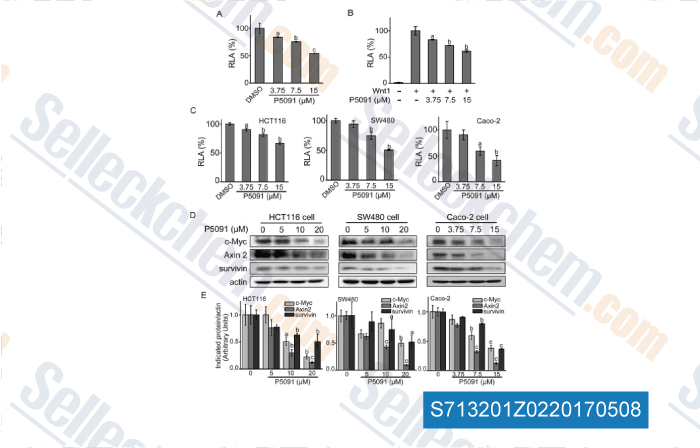
-
Datos de [ , , Biochem Pharmacol, 2017, 131:29-39 ]
Sellecks P5091 Ha sido citado por 57 Publicaciones
| ACC1 is a dual metabolic-epigenetic regulator of Treg stability and immune tolerance [ Mol Metab, 2025, 94:102111] | PubMed: 39929287 |
| The deubiquitinase USP7 stabilizes HER2 expression and promotes breast cancer progression [ Neoplasia, 2025, 66:101192] | PubMed: 40472738 |
| Stabilization of KPNB1 by deubiquitinase USP7 promotes glioblastoma progression through the YBX1-NLGN3 axis [ J Exp Clin Cancer Res, 2024, 43(1):28] | PubMed: 38254206 |
| ER Stress-Activated HSF1 Governs Cancer Cell Resistance to USP7 Inhibitor-Based Chemotherapy through the PERK Pathway [ Int J Mol Sci, 2024, 25(5)2768] | PubMed: 38474017 |
| USP7/Maged1-mediated H2A monoubiquitination in the paraventricular thalamus: an epigenetic mechanism involved in cocaine use disorder [ Nat Commun, 2023, 14(1):8481] | PubMed: 38123574 |
| Engineered Microparticles for Treatment of Murine Brain Metastasis by Reprograming Tumor Microenvironment and Inhibiting MAPK Pathway [ Adv Sci (Weinh), 2023, 10(8):e2206212] | PubMed: 36698296 |
| USP7 promotes non-small-cell lung cancer cell glycolysis and survival by stabilizing and activating c-Abl [ Clin Transl Med, 2023, 13(12):e1509] | PubMed: 38082439 |
| De-ubiquitination of SAMHD1 by USP7 promotes DNA damage repair to overcome oncogenic stress and affect chemotherapy sensitivity [ Oncogene, 2023, 42(22):1843-1856] | PubMed: 37081042 |
| Suppression of USP7 negatively regulates the stability of ETS proto-oncogene 2 protein [ Biomed Pharmacother, 2023, 162:114700] | PubMed: 37062218 |
| USP7 Inhibits Osteoclastogenesis via Dual Effects of Attenuating TRAF6/TAK1 Axis and Stimulating STING Signaling [ Aging Dis, 2023, 14(6):2267-2283] | PubMed: 37199589 |
POLÍTICA DE DEVOLUCIÓN
La Política de Devolución Incondicional de Selleck Chemical garantiza una experiencia de compra en línea fluida para nuestros clientes. Si no está satisfecho con su compra de alguna manera, puede devolver cualquier artículo(s) dentro de los 7 días posteriores a su recepción. En caso de problemas de calidad del producto, ya sean problemas relacionados con el protocolo o con el producto, puede devolver cualquier artículo(s) dentro de los 365 días a partir de la fecha de compra original. Siga las instrucciones a continuación al devolver productos.
ENVÍO Y ALMACENAMIENTO
Los productos Selleck se transportan a temperatura ambiente. Si recibe el producto a temperatura ambiente, tenga la seguridad de que el Departamento de Inspección de Calidad de Selleck ha realizado experimentos para verificar que la colocación a temperatura normal durante un mes no afectará la actividad biológica de los productos en polvo. Después de la recogida, guarde el producto de acuerdo con los requisitos descritos en la hoja de datos. La mayoría de los productos Selleck son estables en las condiciones recomendadas.
NO PARA USO HUMANO, DIAGNÓSTICO VETERINARIO O TERAPÉUTICO.