
Datos técnicos
| Fórmula | C16H28N2O4.H3PO4 |
||||||
| Peso molecular | 410.4 | Número CAS | 204255-11-8 | ||||
| Solubilidad (25°C)* | In vitro | DMSO | 82 mg/mL (199.8 mM) | ||||
| Water | 82 mg/mL (199.8 mM) | ||||||
| Ethanol | Insoluble | ||||||
| In vivo (Agregue los solventes al producto individualmente y en orden.) |
|
||||||
|
* <1 mg/ml significa ligeramente soluble o insoluble. * Tenga en cuenta que Selleck prueba la solubilidad de todos los compuestos internamente, y la solubilidad real puede diferir ligeramente de los valores publicados. Esto es normal y se debe a ligeras variaciones entre lotes. * Envío a temperatura ambiente (Las pruebas de estabilidad demuestran que este producto se puede enviar sin medidas de refrigeración.) |
|||||||
Preparación de soluciones madre
Actividad biológica
| Descripción | Oseltamivir Phosphate (Tamiflu) es un inhibidor potente y selectivo de la Neuraminidase, esencial para la replicación de los virus Influenza A y B, utilizado para prevenir la influenza. | |
|---|---|---|
| Objetivos |
|
|
| In vitro | Oseltamivir Phosphate, los anticuerpos anti-Neu1 y el inhibidor específico de la metaloproteinasa de matriz-9 bloquean la actividad de Neu1 asociada con las células MDA-MB-231 de TNBC estimuladas por EGF. Oseltamivir ralentiza la propagación del Influenza Virus entre las células del cuerpo al impedir que el virus rompa químicamente los lazos con su célula huésped. |
|
| In vivo | La monoterapia con Oseltamivir Phosphate puede ser la terapia de tratamiento eficaz para los TNBC (cánceres de mama triple negativos). Es eficaz en el tratamiento de infecciones causadas por los virus Influenza H5N1 y H9N2 en ratones. Después de la dosificación, el profármaco (Oseltamivir Phosphate) se absorbe fácilmente del tracto gastrointestinal y se convierte rápidamente en el metabolito activo, OC. En todos los grupos de pacientes, el OC tiene una alta biodisponibilidad y se distribuye sistémicamente a los sitios de infección en concentraciones suficientes para inhibir una variedad de Neuraminidases del Influenza Virus. |
Protocolo (de referencia)
| Ensayo celular: |
|
|---|---|
| Estudio en animales: |
|
Referencias
|
Validación de productos por parte del cliente
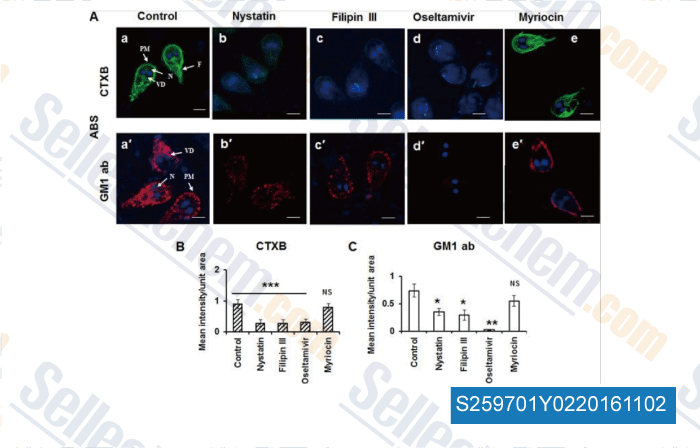
-
, , Infect Immun, 2015, 83(5):2030-42.
Sellecks Oseltamivir Phosphate Ha sido citado por 11 Publicaciones
| Rab27a regulates the transport of influenza virus membrane proteins to the plasma membrane [ Nat Commun, 2025, 16(1):6271] | PubMed: 40623997 |
| CD26 acts as a host restriction factor to inhibit Influenza A virus (H1N1) infection [ Int J Biol Macromol, 2025, 330(Pt 3):148150] | PubMed: 41067348 |
| The critical role of RAGE in severe influenza infection: A target for control of inflammatory response in the disease [ Clin Immunol, 2024, 262:110178] | PubMed: 38460892 |
| H3N2 influenza hemagglutination inhibition method qualification with data driven statistical methods for human clinical trials [ Front Immunol, 2023, 14:1155880] | PubMed: 37090729 |
| Differential Production of Type I IFN Determines the Reciprocal Levels of IL-10 and Proinflammatory Cytokines Produced by C57BL/6 and BALB/c Macrophages [ iScience, 2022, 25(4):104088] | PubMed: 35402869 |
| Giardial lipid rafts share virulence factors with secreted vesicles and participate in parasitic infection in mice [ Front Cell Infect Microbiol, 2022, 12:974200] | PubMed: 36081774 |
| Elevated N-Glycosylation Contributes to the Cisplatin Resistance of Non-Small Cell Lung Cancer Cells Revealed by Membrane Proteomic and Glycoproteomic Analysis [ Front Pharmacol, 2021, 12:805499] | PubMed: 35002739 |
| Antiviral effect of fufang yinhua jiedu (FFYH) granules against influenza A virus through regulating the inflammatory responses by TLR7/MyD88 signaling pathway [ J Ethnopharmacol, 2021, S0378-8741(21)00290-7] | PubMed: 33813013 |
| Identification of a novel compound targeting the nuclear export of influenza A virus nucleoprotein. [ J Cell Mol Med, 2018, 22(3):1826-1839] | PubMed: 29193684 |
| The Assembly of GM1 Glycolipid and Cholesterol-Enriched Raft-Like Membrane Microdomains is Important for Giardial Encystation. [De Chatterjee A, et al. Infect Immun, 2015, 10.1128/IAI.03118-14] | PubMed: 25733521 |
POLÍTICA DE DEVOLUCIÓN
La Política de Devolución Incondicional de Selleck Chemical garantiza una experiencia de compra en línea fluida para nuestros clientes. Si no está satisfecho con su compra de alguna manera, puede devolver cualquier artículo(s) dentro de los 7 días posteriores a su recepción. En caso de problemas de calidad del producto, ya sean problemas relacionados con el protocolo o con el producto, puede devolver cualquier artículo(s) dentro de los 365 días a partir de la fecha de compra original. Siga las instrucciones a continuación al devolver productos.
ENVÍO Y ALMACENAMIENTO
Los productos Selleck se transportan a temperatura ambiente. Si recibe el producto a temperatura ambiente, tenga la seguridad de que el Departamento de Inspección de Calidad de Selleck ha realizado experimentos para verificar que la colocación a temperatura normal durante un mes no afectará la actividad biológica de los productos en polvo. Después de la recogida, guarde el producto de acuerdo con los requisitos descritos en la hoja de datos. La mayoría de los productos Selleck son estables en las condiciones recomendadas.
NO PARA USO HUMANO, DIAGNÓSTICO VETERINARIO O TERAPÉUTICO.