
Datos técnicos
| Fórmula | C28H25F3N6O2.C4H4O |
||||||||||
| Peso molecular | 650.6 | Número CAS | 1245537-68-1 | ||||||||
| Solubilidad (25°C)* | In vitro | DMSO | 30 mg/mL (46.11 mM) | ||||||||
| Water | Insoluble | ||||||||||
| Ethanol | Insoluble | ||||||||||
| In vivo (Agregue los solventes al producto individualmente y en orden.) |
|
||||||||||
|
* <1 mg/ml significa ligeramente soluble o insoluble. * Tenga en cuenta que Selleck prueba la solubilidad de todos los compuestos internamente, y la solubilidad real puede diferir ligeramente de los valores publicados. Esto es normal y se debe a ligeras variaciones entre lotes. * Envío a temperatura ambiente (Las pruebas de estabilidad demuestran que este producto se puede enviar sin medidas de refrigeración.) |
|||||||||||
Preparación de soluciones madre
Actividad biológica
| Descripción | El maleato de BGT226 (NVP-BGT226) es un novedoso inhibidor de clase I de PI3K/mTOR para PI3Kα/β/γ con IC50 de 4 nM/63 nM/38 nM. Fase 1/2. | ||||||||
|---|---|---|---|---|---|---|---|---|---|
| Objetivos |
|
||||||||
| In vitro | Los efectos antiproliferativos y proapoptóticos de NVP-BGT226 son independientes del estado bcr-abl. La activación de la cascada de señalización AKT/mTOR es suprimida por NVP-BGT226 de manera dependiente de la concentración y el tiempo. El análisis por citometría de flujo exhibe una acumulación de células en la fase G(0)-G(1) con una pérdida concomitante en la fase S. NVP-BGT226 muestra una potente actividad inhibidora del crecimiento contra todas las líneas celulares probadas, incluyendo las líneas celulares SCC4, TU183 y KB, con una IC50 que oscila entre 7,4 y 30,1 nM. En particular, tanto las células Detroit 562 como las HONE-1, que expresan la mutación PIK3CA H1047R, siguen siendo sensibles al efecto inhibidor del crecimiento del tratamiento con NVP-BGT226. Además, la sensibilidad a NVP-BGT226 entre las células HONE-1. Los resultados del ensayo de marcaje de extremos de rotura de dUTP mediado por desoxinucleotidil transferasa terminal (TUNEL) y el análisis de caspasa 3/7 y PARP indican que NVP-BGT226 induce la muerte de células cancerosas a través de una vía independiente de la apoptosis. NVP-BGT226 induce la autofagia, como lo indican la agregación y la regulación al alza de la cadena ligera 3B-II de la proteína asociada a microtúbulos, y la degradación de p62. El silenciamiento génico de Beclin1 o el cotratamiento del inhibidor del autofagosoma, 3-metiladenina, inhibe la autofagia inducida por NVP-BGT226 y conduce a la recuperación de la supervivencia de la colonia. NVP-BGT226 inhibe el crecimiento en líneas celulares de mieloma comunes y células primarias de mieloma (como las líneas celulares NCI-H929, U266, RPMI-8226 y OPM2 MM) a concentraciones nanomolares de manera dependiente del tiempo y la dosis. NVP-BGT226 inhibe la fosforilación de la proteína quinasa B (Akt), P70S6k y 4E-BP-1 de manera dependiente del tiempo y la dosis. El efecto estimulante del factor de crecimiento similar a la insulina 1, la interleucina-6 y el medio condicionado de las células estromales HS-5 sobre el crecimiento de las células de mieloma es completamente abrogado por NVP-BGT226. La inhibición de la fosfoinositol-3-quinasa/diana de rapamicina en mamíferos por NVP-BGT226 es altamente efectiva, y NVP-BGT226 representa un nuevo candidato potencial para la terapia dirigida en el mieloma múltiple. La inhibición combinada de PI3K y la diana de rapamicina en mamíferos (mTOR) por NVP-BGT226 ha demostrado ser muy efectiva en términos de inducción de apoptosis e inhibición de la proliferación. En otro estudio, después de 24 horas, el 86,9% de las células MiaPaCa-2 tratadas con 100 nM de NVP-BGT226 se detienen en la fase G0/G1 en comparación con el 55,6% de las células de control. |
||||||||
| In vivo | En un modelo animal de xenoinjerto, NVP-BGT226 retrasa significativamente el crecimiento tumoral de manera dosis-dependiente, junto con una expresión citoplasmática suprimida de p-p70 S6 quinasa y la presencia de formación de autofagosomas. NVP-BGT226 inhibe el crecimiento tumoral de manera dosis-dependiente en un modelo de ratón con xenoinjerto de células FaDu. La administración oral de NVP-BGT226 a 2,5 y 5 mg/kg durante 3 semanas provoca una reducción del 34,7% y 76,1% del crecimiento tumoral el día 21, respectivamente (en comparación con el control). NVP-BGT226 muestra una inhibición comparable contra el crecimiento tumoral a la de la rapamicina. El volumen final de ambos grupos es significativamente menor que el de los tratados con LY294002 (un inhibidor de PI3K) o el control. |
Protocolo (de referencia)
| Ensayo celular: |
|
|---|---|
| Estudio en animales: |
|
Referencias
|
Validación de productos por parte del cliente
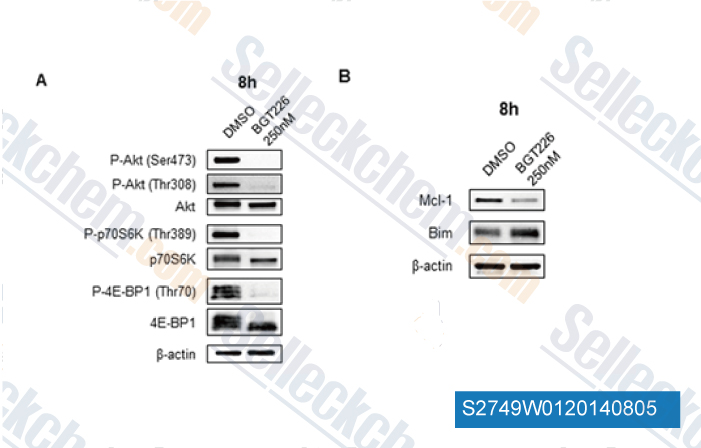
-
Datos de [ Cancer Lett , 2014 , 348(1-2), 38-49 ]
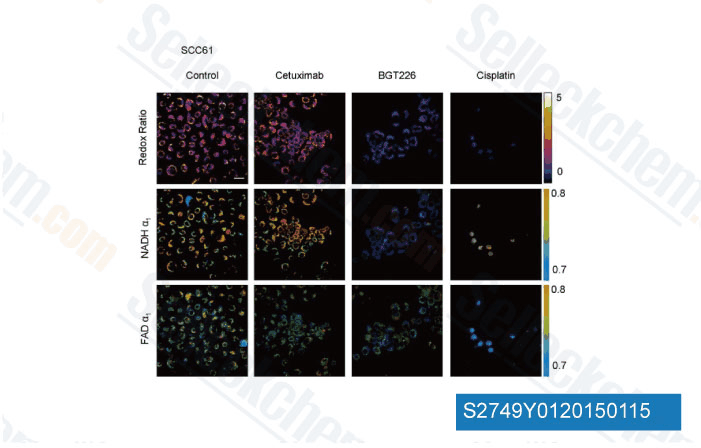
-
Datos de [ PLoS One , 2014 , 9(3), e90746 ]
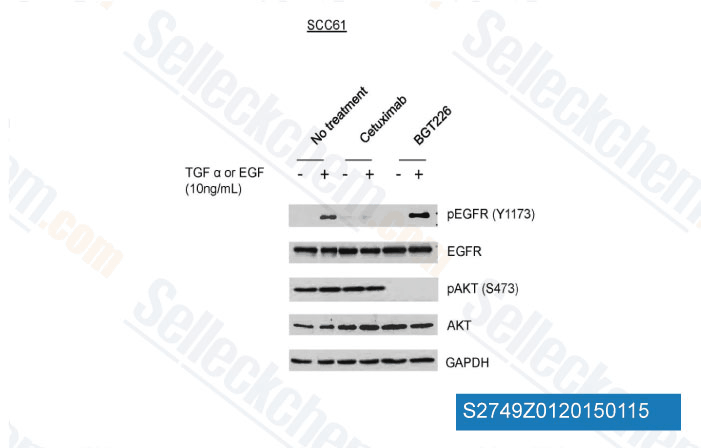
-
Datos de [ PLoS One , 2014 , 9(3), e90746 ]
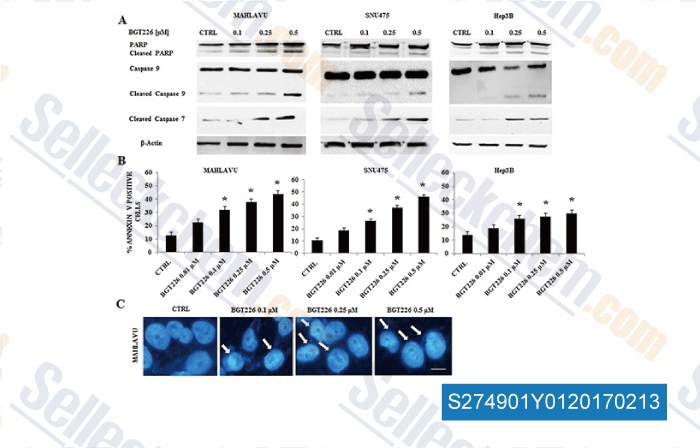
-
Datos de [ , , Oncotarget, 2015, 6(19):17147-60. ]
Sellecks BGT226 (NVP-BGT226) maleate Ha sido citado por 12 Publicaciones
| Heterogeneous Activation of Signaling Pathways and Therapeutic Vulnerabilities in KSHV-Associated Primary Effusion Lymphoma Cell Lines [ J Med Virol, 2025, 97(8):e70534] | PubMed: 40751690 |
| Role of the PI3K/AKT signaling pathway in the cellular response to Tumor Treating Fields (TTFields) [ Cell Death Dis, 2025, 16(1):210] | PubMed: 40148314 |
| PIK Your Poison: The Effects of Combining PI3K and CDK Inhibitors against Metastatic Cutaneous Squamous Cell Carcinoma In Vitro [ Cancers (Basel), 2024, 16(2)370] | PubMed: 38254859 |
| High-throughput and targeted drug screens identify pharmacological candidates against MiT-translocation renal cell carcinoma [ J Exp Clin Cancer Res, 2023, 42(1):99] | PubMed: 37095531 |
| A high-throughput screening platform identifies novel combination treatments for Malignant Peripheral Nerve Sheath Tumors [ Mol Cancer Ther, 2022, molcanther.MCT-21-0947-A.2021] | PubMed: 35511749 |
| Co-targeting PI3K, mTOR, and IGF1R with small molecule inhibitors for treating undifferentiated pleomorphic sarcoma. [ Cancer Biol Ther, 2017, 18(10):816-826] | PubMed: 29099264 |
| Healthy CD4+ T lymphocytes are not affected by targeted therapies against the PI3K/Akt/mTOR pathway in T-cell acute lymphoblastic leukemia. [ Oncotarget, 2016, 7(34):55690-55703] | PubMed: 27494886 |
| Synergistic effects of selective inhibitors targeting the PI3K/AKT/mTOR pathway or NUP214-ABL1 fusion protein in human Acute Lymphoblastic Leukemia. [Simioni C, et al. Oncotarget, 2016, 7(48):79842-79853] | PubMed: 27821800 |
| The PI3K/Akt Pathway Regulates Oxygen Metabolism via Pyruvate Dehydrogenase (PDH)-E1α Phosphorylation [Cerniglia GJ, et al. Mol Cancer Ther, 2015, 14(8):1928-38] | PubMed: 25995437 |
| The novel dual PI3K/mTOR inhibitor NVP-BGT226 displays cytotoxic activity in both normoxic and hypoxic hepatocarcinoma cells. [Simioni C, et al. Oncotarget, 2015, 6(19):17147-60] | PubMed: 26003166 |
POLÍTICA DE DEVOLUCIÓN
La Política de Devolución Incondicional de Selleck Chemical garantiza una experiencia de compra en línea fluida para nuestros clientes. Si no está satisfecho con su compra de alguna manera, puede devolver cualquier artículo(s) dentro de los 7 días posteriores a su recepción. En caso de problemas de calidad del producto, ya sean problemas relacionados con el protocolo o con el producto, puede devolver cualquier artículo(s) dentro de los 365 días a partir de la fecha de compra original. Siga las instrucciones a continuación al devolver productos.
ENVÍO Y ALMACENAMIENTO
Los productos Selleck se transportan a temperatura ambiente. Si recibe el producto a temperatura ambiente, tenga la seguridad de que el Departamento de Inspección de Calidad de Selleck ha realizado experimentos para verificar que la colocación a temperatura normal durante un mes no afectará la actividad biológica de los productos en polvo. Después de la recogida, guarde el producto de acuerdo con los requisitos descritos en la hoja de datos. La mayoría de los productos Selleck son estables en las condiciones recomendadas.
NO PARA USO HUMANO, DIAGNÓSTICO VETERINARIO O TERAPÉUTICO.