
Datos técnicos
| Fórmula | C25H19NO3S |
||||||
| Peso molecular | 413.49 | Número CAS | 503468-95-9 | ||||
| Solubilidad (25°C)* | In vitro | DMSO | 3 mg/mL (7.25 mM) | ||||
| Water | Insoluble | ||||||
| Ethanol | Insoluble | ||||||
| In vivo (Agregue los solventes al producto individualmente y en orden.) |
|
||||||
|
* <1 mg/ml significa ligeramente soluble o insoluble. * Tenga en cuenta que Selleck prueba la solubilidad de todos los compuestos internamente, y la solubilidad real puede diferir ligeramente de los valores publicados. Esto es normal y se debe a ligeras variaciones entre lotes. * Envío a temperatura ambiente (Las pruebas de estabilidad demuestran que este producto se puede enviar sin medidas de refrigeración.) |
|||||||
Preparación de soluciones madre
Actividad biológica
| Descripción | NU7441 (KU-57788) es un inhibidor muy potente y selectivo de DNA-PK con IC50 de 14 nM. También inhibe mTOR y PI3K con IC50 de 1,7 μM y 5 μM en ensayos libres de células, respectivamente, y reduce la frecuencia de NHEJ mientras aumenta la tasa de HDR después de la escisión de ADN mediada por Cas9. | ||||||
|---|---|---|---|---|---|---|---|
| Objetivos |
|
||||||
| In vitro | NU7441 (KU-57788) aumenta la persistencia de los focos γH2AX después del daño al ADN inducido por radiación ionizante. (0,5 μM o 1 μM) aumenta apreciablemente la acumulación de G2-M inducida por radiación ionizante y doxorrubicina tanto en células SW620 como LoVo. Este compuesto provoca la persistencia de las roturas de doble cadena de ADN inducidas por doxorrubicina y radiación ionizante y también disminuye ligeramente la actividad de recombinación homóloga en células tumorales humanas M059-Fus-1 competentes en DNA-PK y M059 J deficientes en DNA-PK. Inhibe la hiperfosforilación de RPA p34 inducida por UV de manera dependiente de la dosis tanto en células que carecen como en células que expresan la polimerasa η. NU7441 aumenta los niveles de focos γH2AX inducidos por y disminuye correspondientemente la muerte celular inducida por en células de leucemia linfocítica crónica. También inhibe la autofosforilación y reparación de DNA-PKcs inducidas por en células de leucemia linfocítica crónica. Este compuesto reduce la frecuencia de NHEJ mientras aumenta la tasa de HDR después de la escisión de ADN mediada por Cas9. |
||||||
| In vivo | NU7441 (KU-57788) administrado intraperitonealmente a una dosis de 10 mg/kg se mantiene durante al menos 4 horas, no muestra toxicidad y aumenta el retraso del crecimiento tumoral inducido por 2 veces en ratones con xenoinjertos SW620. |
Protocolo (de referencia)
| Ensayo celular: |
|
|---|---|
| Estudio en animales: |
|
Referencias
|
Validación de productos por parte del cliente
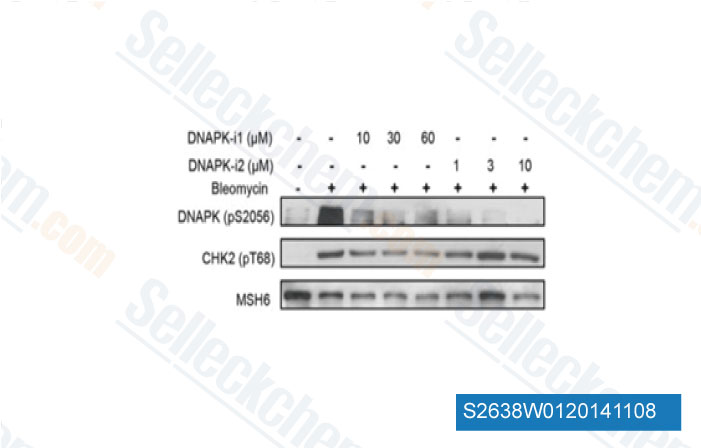
-
Datos de [ Toxicol Sci , 2014 , 10.1093/toxsci/kfu207 ]
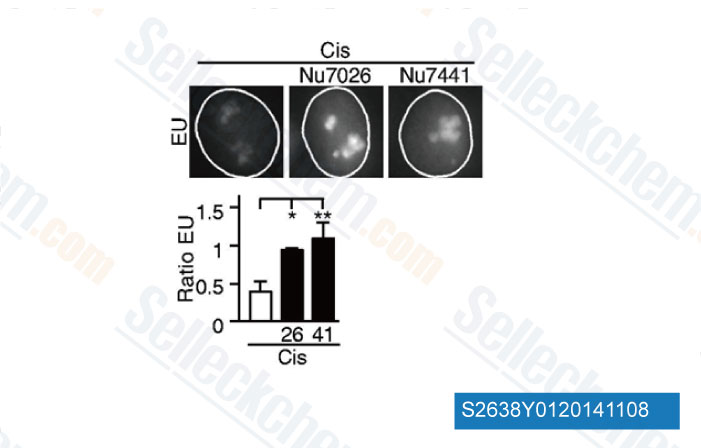
-
Datos de [ Nucleic Acids Res , 2013 , 41(15), 7378-86 ]
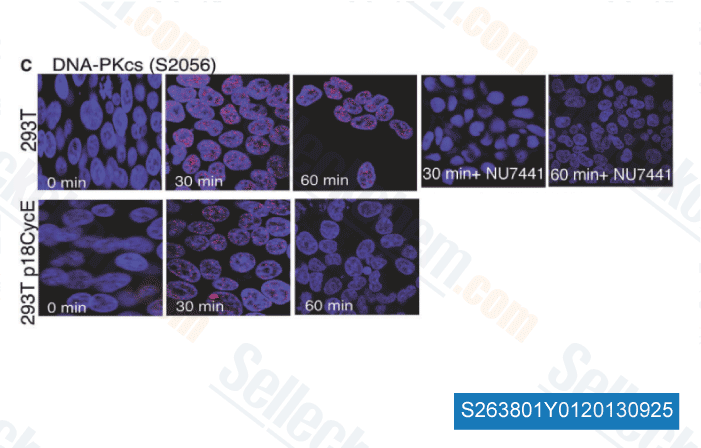
-
Datos de [ Nucleic Acids Res , 2013 , 41, 10157-69 ]
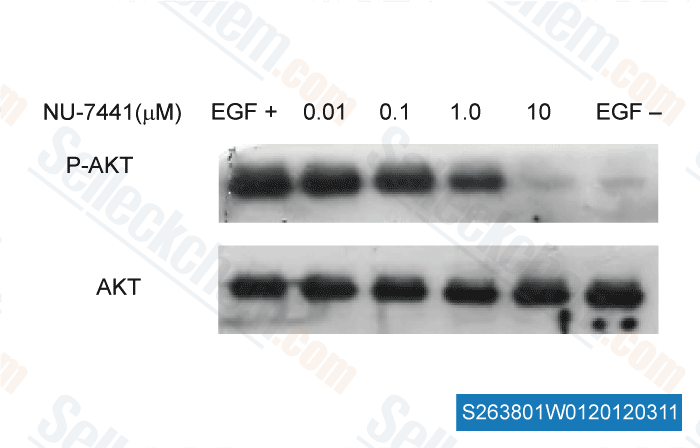
-
, , Dr. Zhang of Tianjin Medical University
Sellecks NU7441 (KU-57788) Ha sido citado por 309 Publicaciones
| Homologous recombination promotes non-immunogenic mitotic cell death upon DNA damage [ Nat Cell Biol, 2025, 27(1):59-72] | PubMed: 39805921 |
| Highly efficient prime editors for mammalian genome editing based on porcine retrovirus reverse transcriptase [ Trends Biotechnol, 2025, S0167-7799(25)00314-2] | PubMed: 40885667 |
| Phosphorylation-dependent WRN-RPA interaction promotes recovery of stalled forks at secondary DNA structure [ Nat Commun, 2025, 16(1):997] | PubMed: 39870632 |
| Autophosphorylation of the Tousled-like kinases TLK1 and TLK2 regulates recruitment to damaged chromatin via PCNA interaction [ Nucleic Acids Res, 2025, 53(4)gkae1279] | PubMed: 39727191 |
| Homeodomain protein PRRX1 anchors the Ku heterodimers at DNA double-strand breaks to promote nonhomologous end-joining [ Nucleic Acids Res, 2025, 53(6)gkaf200] | PubMed: 40114375 |
| ONE-STEP tagging: a versatile method for rapid site-specific integration by simultaneous reagent delivery [ Nucleic Acids Res, 2025, 53(15)gkaf809] | PubMed: 40823809 |
| The inflammasome sensor NLRP3 interacts with REV7 to maintain genome integrity through homologous recombination [ Nucleic Acids Res, 2025, 53(12)gkaf554] | PubMed: 40613708 |
| Nuclear damage-induced DNA damage response coupled with IFI16-driven ECM remodeling underlies dilated cardiomyopathy [ Theranostics, 2025, 15(12):5998-6021] | PubMed: 40365289 |
| Cross-species analysis of the nuclease Artemis highlights its evolving function in domesticating RAG-like transposons and residues that are crucial for activity [ PLoS Biol, 2025, 23(4):e3003056] | PubMed: 40245028 |
| DSCC1 restrains 53BP1/RIF1 signaling at DNA double-strand breaks to promote homologous recombination repair [ Cell Rep, 2025, 44(4):115452] | PubMed: 40117291 |
POLÍTICA DE DEVOLUCIÓN
La Política de Devolución Incondicional de Selleck Chemical garantiza una experiencia de compra en línea fluida para nuestros clientes. Si no está satisfecho con su compra de alguna manera, puede devolver cualquier artículo(s) dentro de los 7 días posteriores a su recepción. En caso de problemas de calidad del producto, ya sean problemas relacionados con el protocolo o con el producto, puede devolver cualquier artículo(s) dentro de los 365 días a partir de la fecha de compra original. Siga las instrucciones a continuación al devolver productos.
ENVÍO Y ALMACENAMIENTO
Los productos Selleck se transportan a temperatura ambiente. Si recibe el producto a temperatura ambiente, tenga la seguridad de que el Departamento de Inspección de Calidad de Selleck ha realizado experimentos para verificar que la colocación a temperatura normal durante un mes no afectará la actividad biológica de los productos en polvo. Después de la recogida, guarde el producto de acuerdo con los requisitos descritos en la hoja de datos. La mayoría de los productos Selleck son estables en las condiciones recomendadas.
NO PARA USO HUMANO, DIAGNÓSTICO VETERINARIO O TERAPÉUTICO.