
Datos técnicos
| Fórmula | C25H34N6O·xHCl |
||||||
| Peso molecular | 434.58 (free base) | Número CAS | 2070014-87-6 | ||||
| Solubilidad (25°C)* | In vitro | DMSO | 5 mg/mL | ||||
| Water | Insoluble | ||||||
| Ethanol | Insoluble | ||||||
| In vivo (Agregue los solventes al producto individualmente y en orden.) |
|
||||||
|
* <1 mg/ml significa ligeramente soluble o insoluble. * Tenga en cuenta que Selleck prueba la solubilidad de todos los compuestos internamente, y la solubilidad real puede diferir ligeramente de los valores publicados. Esto es normal y se debe a ligeras variaciones entre lotes. * Envío a temperatura ambiente (Las pruebas de estabilidad demuestran que este producto se puede enviar sin medidas de refrigeración.) |
|||||||
Preparación de soluciones madre
Actividad biológica
| Descripción | MRT68921 es un potente y doble inhibidor de la quinasa Autophagy ULK1/2 con IC50 de 2,9 nM y 1,1 nM, respectivamente. | ||||
|---|---|---|---|---|---|
| Objetivos |
|
||||
| In vitro | MRT68921 interrumpe específicamente la maduración del autofagosoma y, por lo tanto, bloquea el flujo autofágico a través de la inhibición de ULK1. |
||||
| In vivo | MRT68921 es un potente y doble inhibidor de la quinasa Autophagy ULK1/2. |
Protocolo (de referencia)
| Ensayo de quinasa: |
|
|---|---|
| Ensayo celular: |
|
| Estudio en animales: |
|
Referencias
|
Validación de productos por parte del cliente

-
, , Methods Enzymol. 2017, 587:391-404
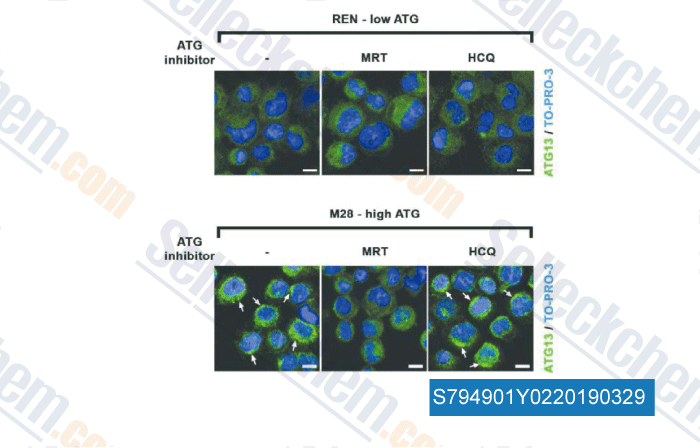
-
Datos de [ , , Mol Carcinog, 2018, 57(3):319-332 ]
Sellecks MRT68921 HCl Ha sido citado por 46 Publicaciones
| Excessive autophagic degradation of MYLK3 causes sunitinib-induced cardiotoxicity [ Autophagy, 2025, 1-20.] | PubMed: 40568844 |
| Inhibiting autophagy selectively prunes dysfunctional tumor vessels and optimizes the tumor immune microenvironment [ Theranostics, 2025, 15(1):258-276] | PubMed: 39744218 |
| Defective chaperone-mediated autophagy in the retinal pigment epithelium of age-related macular degeneration patients [ EMBO Mol Med, 2025, 17(12):3472-3495] | PubMed: 41168502 |
| Image-based temporal profiling of autophagy-related phenotypes [ Autophagy Rep, 2025, 4(1)2484835] | PubMed: 40291494 |
| Exposure of the inner mitochondrial membrane triggers apoptotic mitophagy [ Cell Death Differ, 2024, 10.1038/s41418-024-01260-2] | PubMed: 38396150 |
| Synthetic lethality of combined ULK1 defection and p53 restoration induce pyroptosis by directly upregulating GSDME transcription and cleavage activation through ROS/NLRP3 signaling [ J Exp Clin Cancer Res, 2024, 43(1):248] | PubMed: 39215364 |
| Starvation-induced phosphorylation activates gasdermin A to initiate pyroptosis [ Cell Rep, 2024, 43(9):114728] | PubMed: 39264808 |
| Chronic hypoxia stabilizes 3βHSD1 via autophagy suppression [ Cell Rep, 2024, 43(1):113575] | PubMed: 38181788 |
| ATG7/GAPLINC/IRF3 axis plays a critical role in regulating pathogenesis of influenza A virus [ PLoS Pathog, 2024, 20(1):e1011958] | PubMed: 38227600 |
| ULK2 Is a Key Pro-Autophagy Protein That Contributes to the High Chemoresistance and Disease Relapse in FLT3-Mutated Acute Myeloid Leukemia [ Int J Mol Sci, 2024, 25(1)646] | PubMed: 38203816 |
POLÍTICA DE DEVOLUCIÓN
La Política de Devolución Incondicional de Selleck Chemical garantiza una experiencia de compra en línea fluida para nuestros clientes. Si no está satisfecho con su compra de alguna manera, puede devolver cualquier artículo(s) dentro de los 7 días posteriores a su recepción. En caso de problemas de calidad del producto, ya sean problemas relacionados con el protocolo o con el producto, puede devolver cualquier artículo(s) dentro de los 365 días a partir de la fecha de compra original. Siga las instrucciones a continuación al devolver productos.
ENVÍO Y ALMACENAMIENTO
Los productos Selleck se transportan a temperatura ambiente. Si recibe el producto a temperatura ambiente, tenga la seguridad de que el Departamento de Inspección de Calidad de Selleck ha realizado experimentos para verificar que la colocación a temperatura normal durante un mes no afectará la actividad biológica de los productos en polvo. Después de la recogida, guarde el producto de acuerdo con los requisitos descritos en la hoja de datos. La mayoría de los productos Selleck son estables en las condiciones recomendadas.
NO PARA USO HUMANO, DIAGNÓSTICO VETERINARIO O TERAPÉUTICO.