
Datos técnicos
| Fórmula | C35H49F2N7O4 |
||||||||||||||
| Peso molecular | 669.8 | Número CAS | 1417329-24-8 | ||||||||||||
| Solubilidad (25°C)* | In vitro | DMSO | 100 mg/mL (149.29 mM) | ||||||||||||
| Ethanol | 100 mg/mL (149.29 mM) | ||||||||||||||
| Water | 50 mg/mL (74.64 mM) | ||||||||||||||
| In vivo (Agregue los solventes al producto individualmente y en orden.) |
|
||||||||||||||
|
* <1 mg/ml significa ligeramente soluble o insoluble. * Tenga en cuenta que Selleck prueba la solubilidad de todos los compuestos internamente, y la solubilidad real puede diferir ligeramente de los valores publicados. Esto es normal y se debe a ligeras variaciones entre lotes. * Envío a temperatura ambiente (Las pruebas de estabilidad demuestran que este producto se puede enviar sin medidas de refrigeración.) |
|||||||||||||||
Preparación de soluciones madre
Actividad biológica
| Descripción | MM-102 (HMTase Inhibitor IX) es un inhibidor peptidomimético de alta afinidad de la interacción proteína-proteína WDR5/MLL1, que se une a WDR5 con Ki < 1 nM e IC50 = 2,4 nM.Este producto puede precipitar cuando se disuelve en solución salina o solución PBS. Se recomienda preparar la solución madre en solución DMSO. | ||
|---|---|---|---|
| Objetivos |
|
||
| In vitro | MM-102, como mimético de MLL1, muestra altas afinidades de unión a WDR5 con un IC50 de 2,9 nM y un Ki de < 1 nM. En las células murinas transducidas con MLL1-AF9, este compuesto reduce específicamente la expresión de dos genes diana críticos de MLL1 (HoxA9 y Meis-1), que son necesarios para la leucemogénesis mediada por MLL1. Además, inhibe eficaz y selectivamente el crecimiento celular e induce la apoptosis en células leucémicas que albergan proteínas de fusión MLL1. |
Protocolo (de referencia)
| Ensayo de quinasa: |
|
|---|---|
| Ensayo celular: |
|
Referencias
|
Validación de productos por parte del cliente
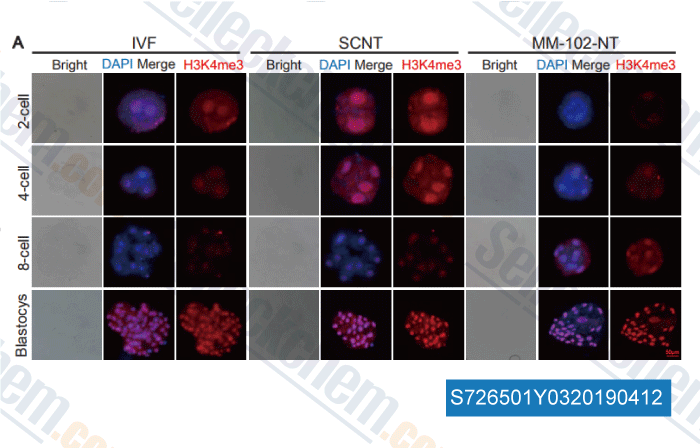
-
Datos de [ , , Cell Physiol Biochem, 2018, 45(4):1529-1540 ]
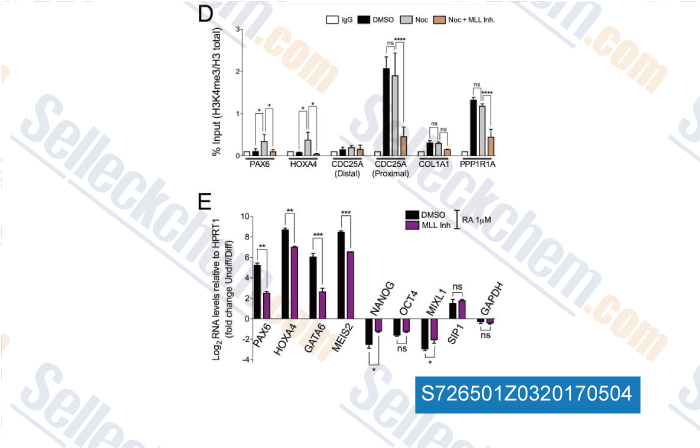 −2; ****, P < 10−5; ns, not significant. (E) Reverse transcription-qPCR analysis of RNA expression levels for bivalent genes after induction of differentiation in unsynchronized H9 ES cells pretreated with MLL inhibitors. Differentiation was induced using E6 medium containing 1 μM RA per 24 h. DMSO, cells pretreated with DMSO only; MLL Inh, cells pretreated with Mi-2 and MM-102 (20 μM each) for 24 h. Unpaired parametric t test with Welch's corrections was performed. Two-tailed P values were calculated. *, P < 10−2; **, P < 10−3; ***, P < 10−4; ns, not significant. Log2 RNA levels were normalized against HPRT1 RNA levels and expressed as fold change between undifferentiated and differentiated cells.'/>
-
Datos de [ , , Mol Cell Biol, 2015, 36(4):615-27 ]
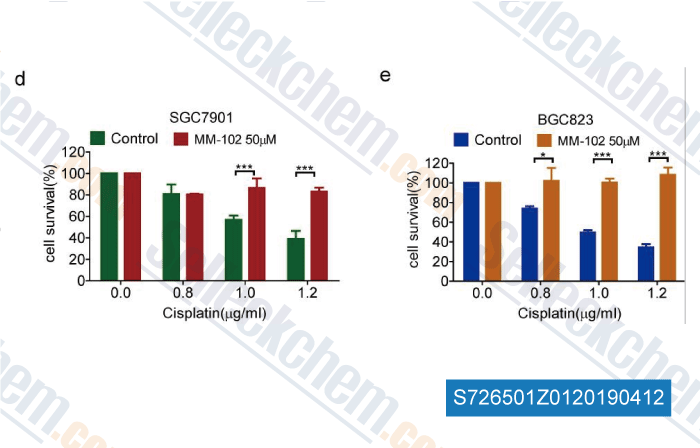
-
Datos de [ , , Int J Biol Sci, 2018, 14(9):1122-1132 ]
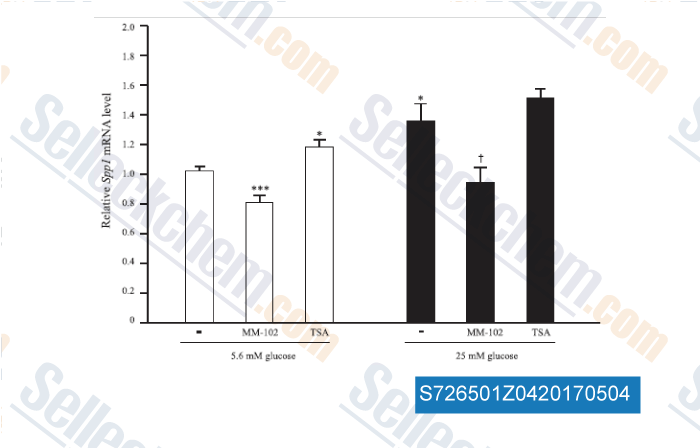
-
Datos de [ , , Biochem Biophys Res Commun, 2016, 469(1):108-13 ]
Sellecks MM-102 (HMTase Inhibitor IX) Ha sido citado por 28 Publicaciones
| Coordinated action of multiple active histone modifications shapes the zygotic genome activation in teleost embryos [ Nat Commun, 2025, 16(1):5222] | PubMed: 40523893 |
| The long non-coding RNA RSDR protects against acute kidney injury in mice by interacting with hnRNPK to regulate DHODH-mediated ferroptosis [ Nat Commun, 2025, 16(1):7483] | PubMed: 40796740 |
| Targeting pancreatic cancer glutamine dependency confers vulnerability to GPX4-dependent ferroptosis [ Cell Rep Med, 2025, 6(2):101928] | PubMed: 39879992 |
| Histone methyltransferase KMT2A promotes pulmonary fibrogenesis via targeting pro-fibrotic factor PU.1 in fibroblasts [ Clin Transl Med, 2025, 15(2):e70217] | PubMed: 39888275 |
| MLL1 downregulation drives hair cell ferroptosis via mitochondrial and endoplasmic reticulum stress mechanisms through PERK-eIF2α-Atf4-Chop and PI3K/Akt-Lrp1 signaling pathway [ Chin Med J (Engl), 2025, 10.1097/CM9.0000000000003633] | PubMed: 40640087 |
| Targeting MLL1/WDR5-Mediated Epigenetic Regulation Mitigates Peritoneal Fibrosis by Reducing p16INK4a [ FASEB J, 2025, 39(8):e70543] | PubMed: 40232893 |
| Fibroblast-specific PRMT5 deficiency suppresses cardiac fibrosis and left ventricular dysfunction in male mice [ Nat Commun, 2024, 15(1):2472] | PubMed: 38503742 |
| Arachidonic acid released by PIK3CA mutant tumor cells triggers malignant transformation of colonic epithelium by inducing chromatin remodeling [ Cell Rep Med, 2024, S2666-3791(24)00179-4] | PubMed: 38614093 |
| MBD2 regulates the progression and chemoresistance of cholangiocarcinoma through interaction with WDR5 [ J Exp Clin Cancer Res, 2024, 43(1):272] | PubMed: 39350229 |
| Deficiency of lncRNA MERRICAL abrogates macrophage chemotaxis and diabetes-associated atherosclerosis [ Cell Rep, 2024, 43(3):113815] | PubMed: 38428421 |
POLÍTICA DE DEVOLUCIÓN
La Política de Devolución Incondicional de Selleck Chemical garantiza una experiencia de compra en línea fluida para nuestros clientes. Si no está satisfecho con su compra de alguna manera, puede devolver cualquier artículo(s) dentro de los 7 días posteriores a su recepción. En caso de problemas de calidad del producto, ya sean problemas relacionados con el protocolo o con el producto, puede devolver cualquier artículo(s) dentro de los 365 días a partir de la fecha de compra original. Siga las instrucciones a continuación al devolver productos.
ENVÍO Y ALMACENAMIENTO
Los productos Selleck se transportan a temperatura ambiente. Si recibe el producto a temperatura ambiente, tenga la seguridad de que el Departamento de Inspección de Calidad de Selleck ha realizado experimentos para verificar que la colocación a temperatura normal durante un mes no afectará la actividad biológica de los productos en polvo. Después de la recogida, guarde el producto de acuerdo con los requisitos descritos en la hoja de datos. La mayoría de los productos Selleck son estables en las condiciones recomendadas.
NO PARA USO HUMANO, DIAGNÓSTICO VETERINARIO O TERAPÉUTICO.