
Datos técnicos
| Fórmula | C26H41N3O5 |
||||||
| Peso molecular | 475.62 | Número CAS | 1211877-36-9 | ||||
| Solubilidad (25°C)* | In vitro | DMSO | 95 mg/mL (199.73 mM) | ||||
| Ethanol | 95 mg/mL (199.73 mM) | ||||||
| Water | Insoluble | ||||||
| In vivo (Agregue los solventes al producto individualmente y en orden.) |
|
||||||
|
* <1 mg/ml significa ligeramente soluble o insoluble. * Tenga en cuenta que Selleck prueba la solubilidad de todos los compuestos internamente, y la solubilidad real puede diferir ligeramente de los valores publicados. Esto es normal y se debe a ligeras variaciones entre lotes. * Envío a temperatura ambiente (Las pruebas de estabilidad demuestran que este producto se puede enviar sin medidas de refrigeración.) |
|||||||
Preparación de soluciones madre
Actividad biológica
| Descripción | MG132 ((S,R,S)-(-)-MG132, Z-Leu-D-Leu-Leu-al) es un potente inhibidor del proteasome (ChTL, TL y PGPH). Este compuesto también inhibe la calpaína (IC50=1,2 μM). Puede utilizarse para inducir modelos animales de la enfermedad de Parkinson. | ||
|---|---|---|---|
| Objetivos |
|
||
| In vitro | MG-132 displays >1000 times more activity than ZLLal in inhibiting the ZLLL-MCA-degrading activity of 20S proteasome with IC50 of 100 nM versus 110 μM. This compound also inhibits calpain with IC50 of 1.2 μM. This chemical induces neurite outgrowth in PC12 cells at an optimal concentration of 20 nM, displaying 500 times more potency than ZLLal. This compound (10 μM) potently inhibits TNF-α-induced NF-κB activation, interleukin-8 (IL-8) gene transcription, and IL-8 protein release in A549 cells by inhibition of proteasome-mediated IκBα degradation. This chemical treatment potently induces p53-dependent apoptosis in KIM-2 cells by 26S proteasome inhibition. Unlike BzLLLCOCHO or PS-341, this compound treatment results in weak inhibition of the chymotrypsinlike (CT-L) and peptidylglutamyl peptide hydrolysing (PGPH) activities of the 26S proteasome, whereas multiple myeloma cells (U266 and OPM-2) are more sensitive to induction of apoptosis by this chemical than BzLLLCOCHO. This compound (1 μM) sensitizes TRAIL-resistant prostate cancer cells by activating the AP-1 family members c-Fos and c-Jun, which, in turn, repress the antiapoptotic molecule c-FLIP(L). This chemical significantly enhances the ability of inositol hexakisphosphate (IP6) to reduce cellular metabolic activity in both PC3 and DU145 androgen-independent prostate cancer (AIPCa) cell lines. |
||
| In vivo | Administration of MG-132 effectively rescues the expression levels and plasma membrane localization of dystrophin, β-dystroglycan, α-bdystroglycan, and α-sarcoglycan in skeletal muscle fibers from mdx mice, reduces muscle membrane damage, and ameliorates the histopathological signs of muscular dystrophy. Treatment with this compound significantly reduces immobilization-induced skeletal muscle atrophy in mice, by downregulating the muscle-specific ubiquitin ligases atrogin-1/MAFbx and MuRF-1 mRNA. |
Protocolo (de referencia)
| Ensayo de quinasa: |
|
|---|---|
| Ensayo celular: |
|
| Estudio en animales: |
|
Referencias
|
Validación de productos por parte del cliente
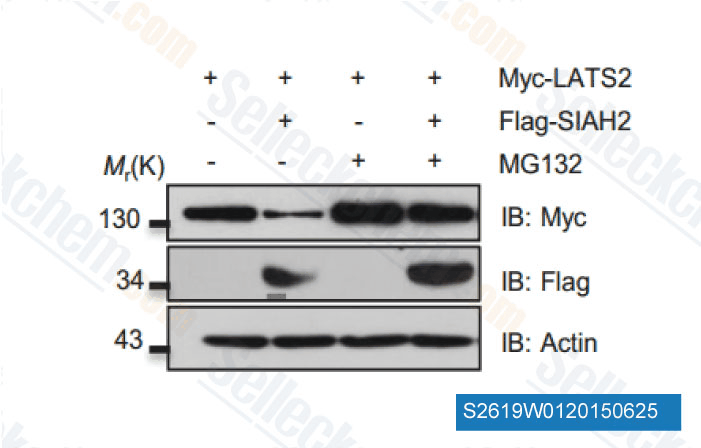
-
Datos de [ Nat Cell Biol , 2015 , 17(1), 95-103 ]

-
Datos de [ Cell Rep , 2015 , 11(9), 1458-73 ]
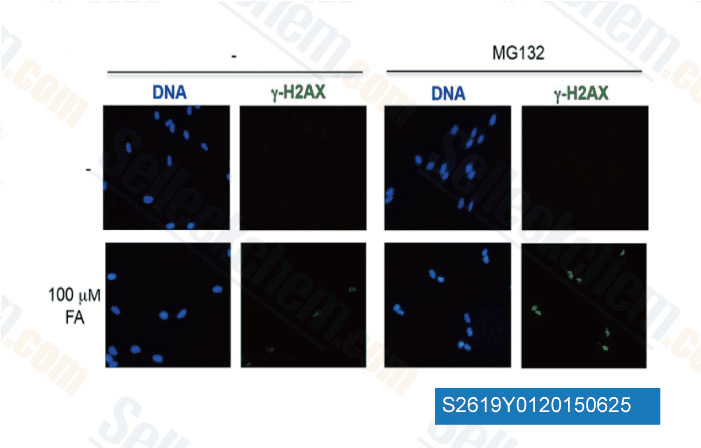
-
Datos de [ Toxicol Appl Pharmacol , 2015 , 286(2), 135-41 ]
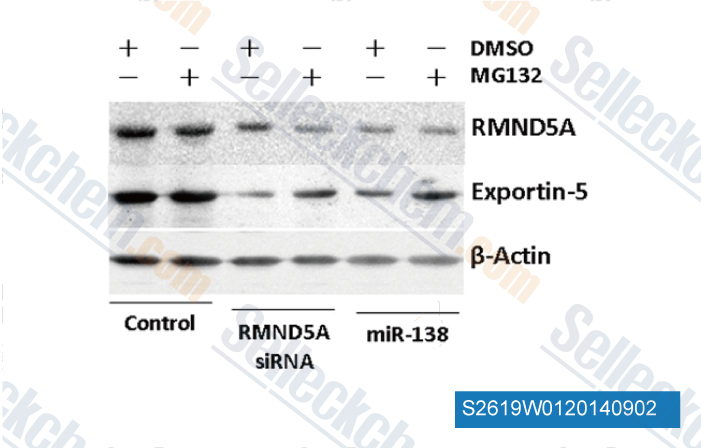
-
Datos de [ Nucleic Acids Res , 2014 , 42(1), 458-74 ]
Selleck's MG132 Ha sido citado por 2546 Publicaciones
| Asperosaponin VI ameliorates acute kidney injury via restoring metabolic-oxidative homeostasis in NRF2 and PPARα dependent manners [ Phytomedicine, February 12, 2026, 157957] | PubMed: 41713218 |
| CircLOC375190 Promotes Mitochondrial Dysfunction and Ferroptosis in Neurons after Stroke by Stabilizing HUWE1 Through Interaction-Induced Ubiquitination and Degradation of IGF2BP2 [ Applied Biochemistry and Biotechnology, February 11, 2026, 3184-3209] | PubMed: 41670946 |
| Promoter demethylation and protein O-GlcNAcylation-mediated enhancement of fatty acid synthase contributes to hepatic steatosis and inflammation in MASLD [ The Journal of Nutritional Biochemistry, December 6, 2025, 110227] | PubMed: 41360204 |
| SplitTurboID mapping of dimeric protein phosphatase complex interactomes [ iScience, April 17, 2026, 115195] | PubMed: 41869563 |
| TNG961 is a selective oral HBS1L molecular glue degrader for the treatment of FOCAD-deleted cancers [ Cancer Discov, 2026, 10.1158/2159-8290.CD-26-0040] | PubMed: 42001523 |
| Cyclophilin A stabilizes the capsid protein p72 to facilitate African swine fever virus replication [ Nat Commun, 2026, 17(1)3624] | PubMed: 41794866 |
| Sororin locks the DNA-exit gate of cohesin to preserve sister-chromatid cohesion [ Nat Commun, 2026, 17(1)2284] | PubMed: 41807408 |
| DNA-PK-mediated phosphorylation of STAT6 establishes a non-canonical type 2 immunity axis to prevent macrophage senescence [ Nat Commun, 2026, 17(1)3123] | PubMed: 41735318 |
| Enhanced Glycolysis-Driven Histone H3K18 Lactylation Regulates Epileptogenesis by Modulating the E3 Ubiquitin Ligase COP1 [ Adv Sci (Weinh), 2026, 13(41):e16985] | PubMed: 42210782 |
| TRIM7 Inhibits Rabies Virus Replication by Promoting K48-Linked Ubiquitination and Degradation of RABV-M [ Emerg Microbes Infect, 2026, 15(1):2667557] | PubMed: 42047619 |
POLÍTICA DE DEVOLUCIÓN
La Política de Devolución Incondicional de Selleck Chemical garantiza una experiencia de compra en línea fluida para nuestros clientes. Si no está satisfecho con su compra de alguna manera, puede devolver cualquier artículo(s) dentro de los 7 días posteriores a su recepción. En caso de problemas de calidad del producto, ya sean problemas relacionados con el protocolo o con el producto, puede devolver cualquier artículo(s) dentro de los 365 días a partir de la fecha de compra original. Siga las instrucciones a continuación al devolver productos.
ENVÍO Y ALMACENAMIENTO
Los productos Selleck se transportan a temperatura ambiente. Si recibe el producto a temperatura ambiente, tenga la seguridad de que el Departamento de Inspección de Calidad de Selleck ha realizado experimentos para verificar que la colocación a temperatura normal durante un mes no afectará la actividad biológica de los productos en polvo. Después de la recogida, guarde el producto de acuerdo con los requisitos descritos en la hoja de datos. La mayoría de los productos Selleck son estables en las condiciones recomendadas.
NO PARA USO HUMANO, DIAGNÓSTICO VETERINARIO O TERAPÉUTICO.