
Datos técnicos
| Fórmula | C23H29FN6O |
||||||
| Peso molecular | 424.51 | Número CAS | 1454682-72-4 | ||||
| Solubilidad (25°C)* | In vitro | DMSO | 3 mg/mL (7.06 mM) | ||||
| Water | Insoluble | ||||||
| Ethanol | Insoluble | ||||||
| In vivo (Agregue los solventes al producto individualmente y en orden.) |
|
||||||
|
* <1 mg/ml significa ligeramente soluble o insoluble. * Tenga en cuenta que Selleck prueba la solubilidad de todos los compuestos internamente, y la solubilidad real puede diferir ligeramente de los valores publicados. Esto es normal y se debe a ligeras variaciones entre lotes. * Envío a temperatura ambiente (Las pruebas de estabilidad demuestran que este producto se puede enviar sin medidas de refrigeración.) |
|||||||
Preparación de soluciones madre
Actividad biológica
| Descripción | LY3009120 (DP-4978) es un potente inhibidor pan-Raf con IC50 de 44 nM, 31-47 nM y 42 nM para A-raf, B-Raf y C-Raf en células A375, respectivamente. Este compuesto induce la autophagy. Fase 1. | ||||||
|---|---|---|---|---|---|---|---|
| Objetivos |
|
||||||
| In vitro | LY3009120 inhibe el crecimiento celular de células A375 y HCT116 con una IC50 de 9,2 y 220 μM, respectivamente. Este compuesto inhibe la tirosina quinasa KDR con una IC50 de 3,9 μM. | ||||||
| In vivo | En ratas portadoras de tumores PDX BRAF V600E ST019VR, LY3009120 (15 o 30 mg/kg, p.o.) muestra una inhibición del crecimiento tumoral dosis-dependiente. En ratas desnudas portadoras de xenoinjertos A375, el tratamiento oral de dosis única con este compuesto (3 a 50 mg/kg, p.o.) muestra una inhibición dosis-dependiente de phospho-ERK, con una dosis para el 50% de inhibición de phospho-ERK (EC50) de 4,36 mg/kg, con una concentración plasmática para lograr el 50% de inhibición de phospho-ERK (EC50) de 68,9 ng/mL o 165 nM. |
Protocolo (de referencia)
| Ensayo de quinasa:[2] |
|
|---|---|
| Ensayo celular:[1] |
|
| Estudio en animales:[1] |
|
Referencias
|
Validación de productos por parte del cliente
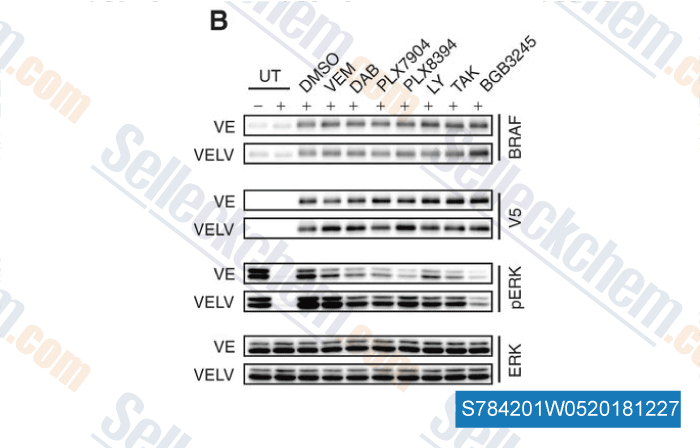
-
Datos de [ , , Cancer Discov, 2018, 8(9):1130-1141 ]
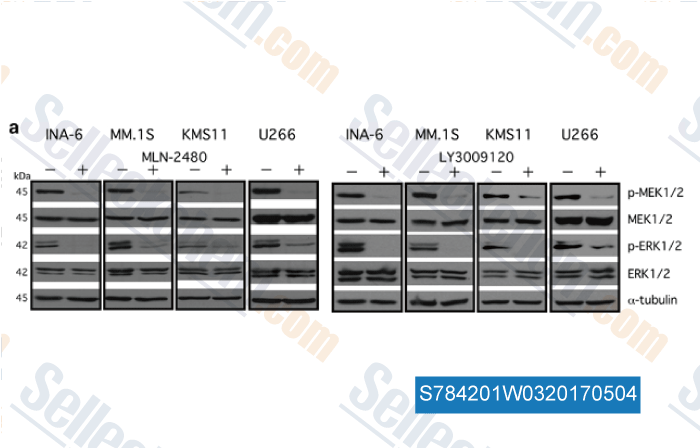
-
Datos de [ , , Leukemia, 2017, 31(4):922-933 ]
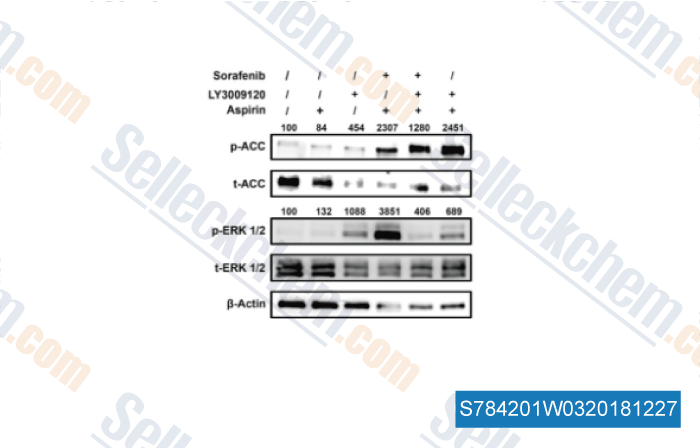
-
Datos de [ , , Clin Cancer Res, 2018, 24(5):1090-1102 ]
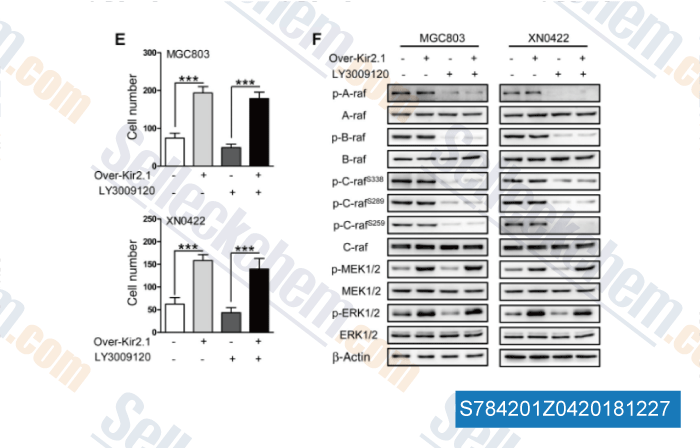
-
Datos de [ , , Cancer Res, 2018, 78(11):3041-3053 ]
Sellecks LY3009120 Ha sido citado por 55 Publicaciones
| RIT1 Drives Oncogenic Transformation and is an Actionable Target in Lung Adenocarcinoma [ Cancer Res, 2025, 10.1158/0008-5472.CAN-24-3819] | PubMed: 40644578 |
| Bioluminescence-based assays for quantifying endogenous protein interactions in live cells [ J Biol Chem, 2025, 301(8):110454] | PubMed: 40617353 |
| MED10 as a Novel Oncogenic Driver in HCC: Promoting Cell Cycle Progression and Proliferation Through RAF1 Activation [ Front Biosci (Landmark Ed), 2025, 30(8):39944] | PubMed: 40917057 |
| H3K4me3 remodeling induced acquired resistance through O-GlcNAc transferase [ Drug Resist Updat, 2023, 71:100993] | PubMed: 37639774 |
| The combination of osimertinib with Raf inhibitor overcomes osimertinib resistance induced by KRAS amplification in EGFR-mutated lung cancer cells [ Exp Cell Res, 2023, 430(1):113722] | PubMed: 37442265 |
| Targeting RAF Isoforms and Tumor Microenvironments in RAS or BRAF Mutant Colorectal Cancers with SJ-C1044 for Anti-Tumor Activity [ Curr Issues Mol Biol, 2023, 45(7):5865-5878] | PubMed: 37504287 |
| BRAFΔβ3-αC in-frame deletion mutants differ in their dimerization propensity, HSP90 dependence, and druggability [ Sci Adv, 2023, 9(35):eade7486] | PubMed: 37656784 |
| RAS-dependent RAF-MAPK hyperactivation by pathogenic RIT1 is a therapeutic target in Noonan syndrome-associated cardiac hypertrophy [ Sci Adv, 2023, 9(28):eadf4766] | PubMed: 37450595 |
| Mutations in ALK signaling pathways conferring resistance to ALK inhibitor treatment lead to collateral vulnerabilities in neuroblastoma cells [ Mol Cancer, 2022, 21(1):126] | PubMed: 35689207 |
| Glutamine deficiency in solid tumor cells confers resistance to ribosomal RNA synthesis inhibitors [ Nat Commun, 2022, 13(1):3706] | PubMed: 35764642 |
POLÍTICA DE DEVOLUCIÓN
La Política de Devolución Incondicional de Selleck Chemical garantiza una experiencia de compra en línea fluida para nuestros clientes. Si no está satisfecho con su compra de alguna manera, puede devolver cualquier artículo(s) dentro de los 7 días posteriores a su recepción. En caso de problemas de calidad del producto, ya sean problemas relacionados con el protocolo o con el producto, puede devolver cualquier artículo(s) dentro de los 365 días a partir de la fecha de compra original. Siga las instrucciones a continuación al devolver productos.
ENVÍO Y ALMACENAMIENTO
Los productos Selleck se transportan a temperatura ambiente. Si recibe el producto a temperatura ambiente, tenga la seguridad de que el Departamento de Inspección de Calidad de Selleck ha realizado experimentos para verificar que la colocación a temperatura normal durante un mes no afectará la actividad biológica de los productos en polvo. Después de la recogida, guarde el producto de acuerdo con los requisitos descritos en la hoja de datos. La mayoría de los productos Selleck son estables en las condiciones recomendadas.
NO PARA USO HUMANO, DIAGNÓSTICO VETERINARIO O TERAPÉUTICO.