
Datos técnicos
| Fórmula | C19H21ClN4 |
||||||
| Peso molecular | 340.85 | Número CAS | 950455-15-9 | ||||
| Solubilidad (25°C)* | In vitro | DMSO | 68 mg/mL (199.5 mM) | ||||
| Water | Insoluble | ||||||
| Ethanol | Insoluble | ||||||
| In vivo (Agregue los solventes al producto individualmente y en orden.) |
|
||||||
|
* <1 mg/ml significa ligeramente soluble o insoluble. * Tenga en cuenta que Selleck prueba la solubilidad de todos los compuestos internamente, y la solubilidad real puede diferir ligeramente de los valores publicados. Esto es normal y se debe a ligeras variaciones entre lotes. * Envío a temperatura ambiente (Las pruebas de estabilidad demuestran que este producto se puede enviar sin medidas de refrigeración.) |
|||||||
Preparación de soluciones madre
Actividad biológica
| Descripción | Liproxstatin-1 es un potente inhibidor de la ferroptosis con una IC50 de 22 nM. | ||
|---|---|---|---|
| Objetivos |
|
||
| In vitro | Liproxstatin-1 es capaz de inhibir la ferroptosis en el rango nanomolar bajo e inhibir el crecimiento de células Gpx4−/− con una IC50 de 22 nM. Este compuesto (50 nM) previene completamente la peroxidación lipídica en células Gpx4−/−. Él (200 nM) protege contra los FINs, como BSO (10 µM), erastina (1 µM) y RSL3 (0,5 µM), de manera dosis-dependiente, mientras que no logra rescatar la muerte celular inducida por estaurosporina (0,2 µM) y H2O2 (200 µM). | ||
| In vivo | Liproxstatin-1 prolonga notablemente la supervivencia en comparación con el grupo tratado con vehículo, retrasa la Ferroptosis en las células tubulares y mitiga el daño tisular en la lesión hepática inducida por isquemia/reperfusión. |
Protocolo (de referencia)
| Ensayo celular: |
|
|---|---|
| Estudio en animales: |
|
Referencias
|
Validación de productos por parte del cliente
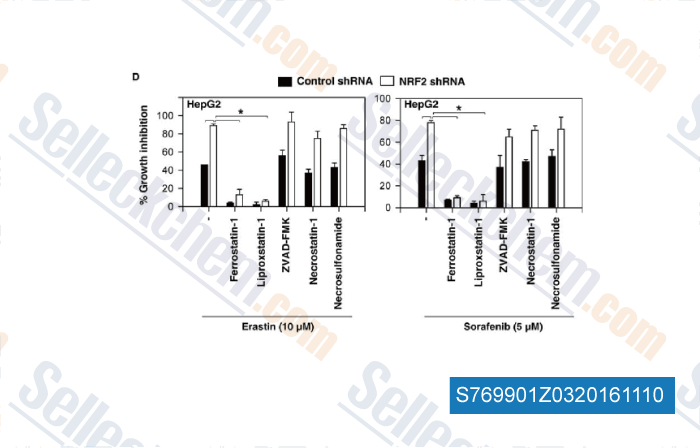
-
,
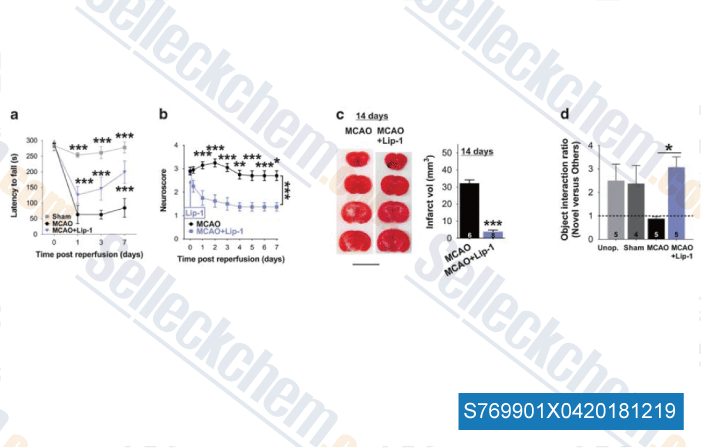
-
Datos de [ , , Mol Psychiatry, 2017, 22(11):1520-1530 ]
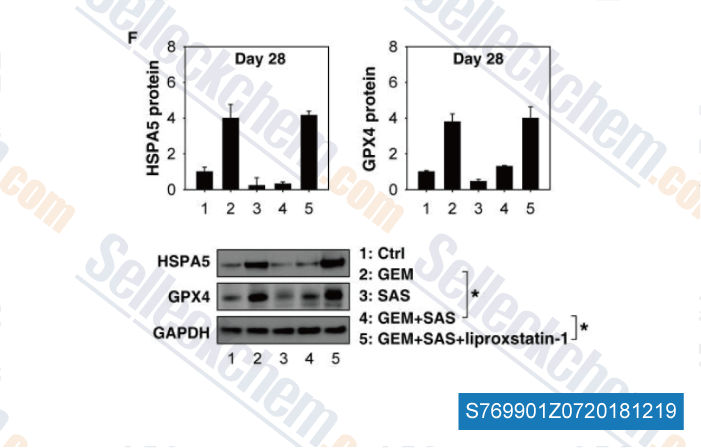
-
Datos de [ , , Cancer Res, 2017, 77(8):2064-2077 ]
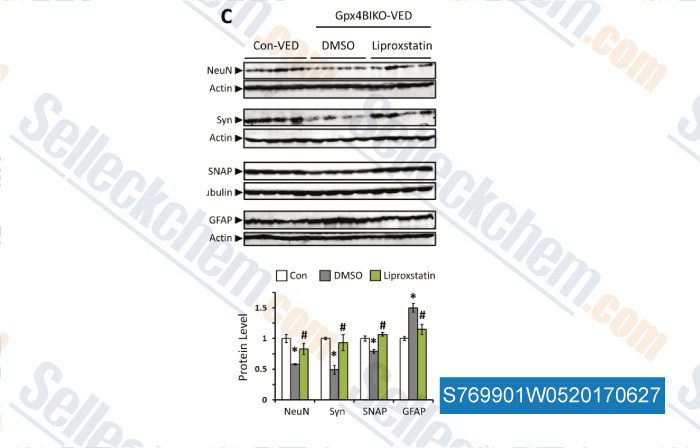
-
Datos de [ , , Redox Biol, 2017, 12:8-17 ]
Sellecks Liproxstatin-1 Ha sido citado por 280 Publicaciones
| Cytosolic cytochrome c represses ferroptosis [ Cell Metab, 2025, S1550-4131(25)00149-4] | PubMed: 40233758 |
| Endothelial but not systemic ferroptosis inhibition protects from antineutrophil cytoplasmic antibody-induced crescentic glomerulonephritis [ Kidney Int, 2025, 107(6):1037-1050] | PubMed: 40122342 |
| S100P is a ferroptosis suppressor to facilitate hepatocellular carcinoma development by rewiring lipid metabolism [ Nat Commun, 2025, 16(1):509] | PubMed: 39779666 |
| Simvastatin overcomes the pPCK1-pLDHA-SPRINGlac axis-mediated ferroptosis and chemo-immunotherapy resistance in AKT-hyperactivated intrahepatic cholangiocarcinoma [ Cancer Commun (Lond), 2025, 10.1002/cac2.70036] | PubMed: 40443016 |
| A transcriptional atlas of gut-innervating neurons reveals activation of interferon signaling and ferroptosis during intestinal inflammation [ Neuron, 2025, S0896-6273(25)00136-9] | PubMed: 40101721 |
| HIF-independent oxygen sensing via KDM6A regulates ferroptosis [ Mol Cell, 2025, 85(15):2973-2987.e6] | PubMed: 40712585 |
| Inhibition of Endoplasmic Reticulum Stress Cooperates with SLC7A11 to Promote Disulfidptosis and Suppress Tumor Growth upon Glucose Limitation [ Adv Sci (Weinh), 2025, 12(7):e2408789] | PubMed: 39739602 |
| Vorapaxar enhanced mitochondria-associated ferroptosis primes cancer immunotherapy via targeting FOXO1/HMOX1 axis [ Cell Rep Med, 2025, 6(10):102371] | PubMed: 41005298 |
| SLC25A1 and ACLY maintain cytosolic acetyl-CoA and regulate ferroptosis susceptibility via FSP1 acetylation [ EMBO J, 2025, 10.1038/s44318-025-00369-5] | PubMed: 39881208 |
| Cathepsin S regulates ferroptosis sensitivity in hepatocellular carcinoma through the KEAP1-NRF2 signaling pathway [ Redox Biol, 2025, 86:103815] | PubMed: 40784043 |
POLÍTICA DE DEVOLUCIÓN
La Política de Devolución Incondicional de Selleck Chemical garantiza una experiencia de compra en línea fluida para nuestros clientes. Si no está satisfecho con su compra de alguna manera, puede devolver cualquier artículo(s) dentro de los 7 días posteriores a su recepción. En caso de problemas de calidad del producto, ya sean problemas relacionados con el protocolo o con el producto, puede devolver cualquier artículo(s) dentro de los 365 días a partir de la fecha de compra original. Siga las instrucciones a continuación al devolver productos.
ENVÍO Y ALMACENAMIENTO
Los productos Selleck se transportan a temperatura ambiente. Si recibe el producto a temperatura ambiente, tenga la seguridad de que el Departamento de Inspección de Calidad de Selleck ha realizado experimentos para verificar que la colocación a temperatura normal durante un mes no afectará la actividad biológica de los productos en polvo. Después de la recogida, guarde el producto de acuerdo con los requisitos descritos en la hoja de datos. La mayoría de los productos Selleck son estables en las condiciones recomendadas.
NO PARA USO HUMANO, DIAGNÓSTICO VETERINARIO O TERAPÉUTICO.