
Datos técnicos
| Fórmula | C13H13N3O3 |
||||||||||
| Peso molecular | 259.26 | Número CAS | 191732-72-6 | ||||||||
| Solubilidad (25°C)* | In vitro | DMSO | 51 mg/mL (196.71 mM) | ||||||||
| Water | Insoluble | ||||||||||
| Ethanol | Insoluble | ||||||||||
| In vivo (Agregue los solventes al producto individualmente y en orden.) |
|
||||||||||
|
* <1 mg/ml significa ligeramente soluble o insoluble. * Tenga en cuenta que Selleck prueba la solubilidad de todos los compuestos internamente, y la solubilidad real puede diferir ligeramente de los valores publicados. Esto es normal y se debe a ligeras variaciones entre lotes. * Envío a temperatura ambiente (Las pruebas de estabilidad demuestran que este producto se puede enviar sin medidas de refrigeración.) |
|||||||||||
Preparación de soluciones madre
Actividad biológica
| Descripción | Lenalidomide es un inhibidor de la secreción de TNF-α con IC50 de 13 nM en PBMC. Lenalidomide (CC-5013) es un ligando de la ubiquitin E3 ligase cereblon (CRBN), y causa ubiquitilación y degradación selectiva de dos factores de transcripción linfoideos, IKZF1 e IKZF3, por la ubiquitin ligasa CRBN-CRL4. Lenalidomide promueve la expresión de la cleaved caspase-3 e inhibe la expresión de VEGF e induce la apoptosis. | ||||||
|---|---|---|---|---|---|---|---|
| Objetivos |
|
||||||
| In vitro | Lenalidomide strongly induces IL-2 and sIL-2R production. This compound-induced tyrosine phosphorylation of CD28 on T cells is followed by a down-stream activation of NF-κB. This compound and pomalidomide inhibits autoubiquitination of CRBN in HEK293 T cells expressing thalidomide-binding competent wild-type CRBN, but not thalidomide-binding defective CRBN(YW/AA). Overexpression of CRBN wild-type protein, but not CRBN(YW/AA) mutant protein, in KMS12 myeloma cells, amplifies pomalidomide-mediated reductions in c-myc and IRF4 expression and increases in p21(WAF-1) expression. Long-term selection for this compound resistance in H929 myeloma cell lines is accompanied by a reduction in CRBN, while in DF15R myeloma cells resistant to both pomalidomide and this chemical, CRBN protein is undetectable. This chemical prevents induction of defects by down-regulating tumor cell inhibitory molecule expression. It prevents induction of tumor-induced T cell lytic synapse dysfunction. This compound treatment blocks CLL cell-induced T cell actin synapse dysfunction, mimicks antibody blockade, and down-regulates expression of CLL inhibitory ligands and their receptors on T cells. This treatment prevents tumor-induced immune suppression in FL, DLBCL, HL, MM, SCC, and OC and down-regulates immunosuppressive ligand expression on all tumor cells examined. CTL killing function significantly increases following antibody blockade of CLL inhibitory ligands or this chemical treatment compared to control treatments. Treatment of autologous CLL-T cell co-cultures with this agent reverses impaired CD8+ T cell lytic synapse formation and granzyme B trafficking. |
||||||
| In vivo | The induction of angiogenesis by bFGF is significantly inhibited by oral treatment of Lenalidomide in a dose-dependent manner. This compound significantly decreases the percentage of vascularized area from 5.16% (control group) to 2.58% (50 mg/kg). It significantly reduces the calculated total MVL from 21.07 (control) to 8.11 (50 mg/kg). This chemical significantly inhibites HUVEC migration through the fibronectin-coated membranes towards 0.1 ng/mL of bFGF at 100 μM, 1 ng/mL of VEGF at concentrations of 10 μM and 100 μM. |
Protocolo (de referencia)
| Ensayo de quinasa: |
|
|---|---|
| Estudio en animales: |
|
Referencias
|
Validación de productos por parte del cliente
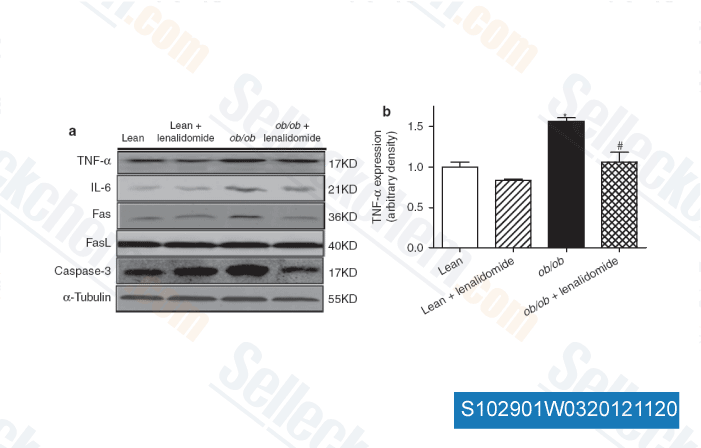
-
Datos de [ Obesity , 2012 , 20, 2174-85 ]

-
, , Harvard Medical School

-
, , Harvard Medical School

-
Datos de [ , , Clin Cancer Res, 2011, 17(10): 3259–71 ]
Selleck's CC-5013 (Lenalidomide) Ha sido citado por 190 Publicaciones
| Dual targeting PD-L1 and 4-1BB to overcome dendritic cell-mediated lenalidomide resistance in follicular lymphoma [ Signal Transduct Target Ther, 2025, 10(1):29] | PubMed: 39828715 |
| IKAROS levels are associated with antigen escape in CD19- and CD22-targeted therapies for B-cell malignancies [ Nat Commun, 2025, 16(1):3800] | PubMed: 40268897 |
| A patient-derived T cell lymphoma biorepository uncovers pathogenetic mechanisms and host-related therapeutic vulnerabilities [ Cell Rep Med, 2025, S2666-3791(25)00102-8] | PubMed: 40147445 |
| Haploinsufficiency of miR-143 and miR-145 reveal targetable dependencies in resistant del(5q) myelodysplastic neoplasm [ Leukemia, 2025, 39(4):917-928] | PubMed: 40000845 |
| The Prolonged Half-Life of the p53 Missense Variant R248Q Promotes Accumulation and Heterotetramer Formation with Wild-Type p53 to Exert the Dominant-Negative Effect [ Cancer Research, 2025, 1978-1996] | PubMed: 40163352 |
| The Prolonged Half-Life of the p53 Missense Variant R248Q Promotes Accumulation and Heterotetramer Formation with Wildtype p53 to Exert the Dominant-Negative Effect [ Cancer Res, 2025, 10.1158/0008-5472.CAN-24-1136] | PubMed: 40163352 |
| Enhancing T cell cytotoxicity in multiple myeloma with bispecific αPD-L1 × αCD3 T cell engager-armed T cells and low-dose bortezomib therapy [ Biomed Pharmacother, 2025, 184:117878] | PubMed: 39891948 |
| Rapid and high-throughput screening of proteolysis targeting chimeras using a dual-reporter system expressing fluorescence protein and luciferase [ BMC Biol, 2025, 23(1):51] | PubMed: 39985000 |
| KAT/3BP: A Metabolism-Targeting Agent with Single and Combination Activity in Aggressive B-Cell Lymphomas [ Cancers (Basel), 2025, 17(12)2034] | PubMed: 40563683 |
| Reposition of lenalidomide as a radiation protector based on LINCS gene expression signatures and its preclinical validation [ Sci Rep, 2025, 15(1):12955] | PubMed: 40234645 |
POLÍTICA DE DEVOLUCIÓN
La Política de Devolución Incondicional de Selleck Chemical garantiza una experiencia de compra en línea fluida para nuestros clientes. Si no está satisfecho con su compra de alguna manera, puede devolver cualquier artículo(s) dentro de los 7 días posteriores a su recepción. En caso de problemas de calidad del producto, ya sean problemas relacionados con el protocolo o con el producto, puede devolver cualquier artículo(s) dentro de los 365 días a partir de la fecha de compra original. Siga las instrucciones a continuación al devolver productos.
ENVÍO Y ALMACENAMIENTO
Los productos Selleck se transportan a temperatura ambiente. Si recibe el producto a temperatura ambiente, tenga la seguridad de que el Departamento de Inspección de Calidad de Selleck ha realizado experimentos para verificar que la colocación a temperatura normal durante un mes no afectará la actividad biológica de los productos en polvo. Después de la recogida, guarde el producto de acuerdo con los requisitos descritos en la hoja de datos. La mayoría de los productos Selleck son estables en las condiciones recomendadas.
NO PARA USO HUMANO, DIAGNÓSTICO VETERINARIO O TERAPÉUTICO.