
Datos técnicos
| Fórmula |
C22H21N3O4
|
||||||
| Peso molecular | 391.42 | Número CAS | 610798-31-7 | ||||
| Solubilidad (25°C)* | In vitro | DMSO | 78 mg/mL (199.27 mM) | ||||
| Ethanol | 6 mg/mL (15.32 mM) | ||||||
| Water | Insoluble | ||||||
| In vivo (Agregue los solventes al producto individualmente y en orden.) |
|
||||||
|
* <1 mg/ml significa ligeramente soluble o insoluble. * Tenga en cuenta que Selleck prueba la solubilidad de todos los compuestos internamente, y la solubilidad real puede diferir ligeramente de los valores publicados. Esto es normal y se debe a ligeras variaciones entre lotes. * Envío a temperatura ambiente (Las pruebas de estabilidad demuestran que este producto se puede enviar sin medidas de refrigeración.) |
|||||||
Preparación de soluciones madre
Actividad biológica
| Descripción | Icotinib (BPI-2009H) es un potente y específico inhibidor de EGFR con un IC50 de 5 nM, y se dirige a EGFR, EGFR(L858R), EGFR(L861Q), EGFR(T790M) y EGFR(T790M, L858R). | ||
|---|---|---|---|
| Objetivos |
|
||
| In vitro | Icotinib (BPI-2009H) inhibe la actividad de EGFR de manera dosis-dependiente, con un valor de IC50 de 5 nM y una inhibición completa a 62,5 nM. Inhibe selectivamente sólo a los miembros de EGFR, incluyendo el tipo salvaje y los mutantes, con eficacias de inhibición del 61-99%. Este compuesto bloquea la fosforilación de tirosina intracelular mediada por EGFR en células de carcinoma epidermoide humano A431 de manera dosis-dependiente. Mientras tanto, en nuestro ensayo de proliferación realizado en las líneas celulares A431, BGC-823, A549, H460, HCT8, KB y Bel-7402, encontramos que la sensibilidad relativa de las líneas celulares a Icotinib es A431 > BGC-823 > A549 > H460 > KB > HCT8 y Bel-7402. Exhibe un amplio espectro de actividad antitumoral y es especialmente efectivo contra tumores que expresan niveles más altos de EGFR. | ||
| In vivo | Icotinib (BPI-2009H) muestra un efecto antitumoral en diferentes tipos de xenoinjertos. A una dosis de 120 mg/kg, inhibe el crecimiento tumoral a una tasa del 51,5%, 31,0% y 67,4% en los xenoinjertos A431, A549 y H460, respectivamente. |
Protocolo (de referencia)
| Ensayo de quinasa:[1] |
|
|---|---|
| Ensayo celular:[1] |
|
| Estudio en animales:[1] |
|
Referencias
|
Validación de productos por parte del cliente
![<p>B. Effect of Icotinib treatment on the subcellular localization of ABCG2 in NCI-H460/MX20 cell. ABCG2 staining is shown in green. DAPI (blue) counterstains the nuclei. C. Effect of Icotinib on the ATPase activity of ABCG2: The BeFx-sensitive specific ATPase activity of ABCG2 was determined in the presence of 0-5 μM of Icotinib as described in supplemental methods. The activity in the absence of Icotinib (basal activity) was considered to be 100%, and % -fold stimulation ± S.D. (Y-axis) was plotted as a function of indicated concentrations of Icotinib (X-axis). D. Effect of Icotinib on the photolabeling of ABCG2 with [125I]-IAAP: Crude membranes from ABCG2 expressing MCF7-FLV1000 cells were photo-crosslinked with [125I]-IAAP in the presence and absence of 0-50 μM of Icotinib as described in supplemental methods. [125I]-IAAP incorporated in ABCG2 band was quantified using ImageQuant software and plotted as % [125I]-IAAP incorporated ± S.D. (Y-axis) as a function of varying concentration of Icotinib (X-axis). The upper panel shows a representative autoradiogram from three independent experiments and the arrow represents the ABCG2 band photo-crosslinked with [125I]-IAAP.</p>](https://file.selleckchem.com/downloads/review/700px/Icotinib-S292201Y0120161107.gif)
-
, , Oncotarget, 2015, 5(12):4529-42.
-
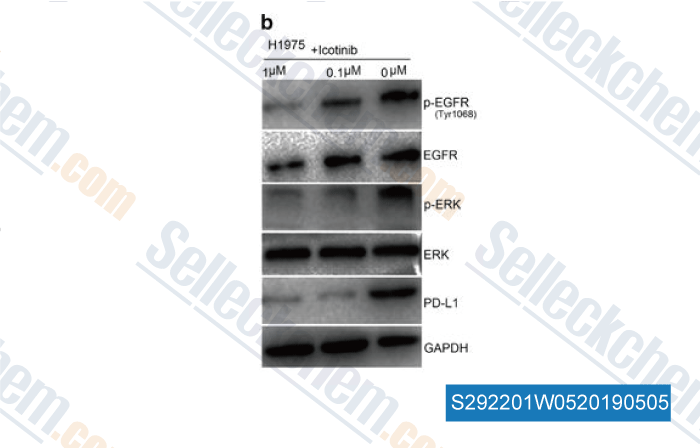
Datos de [ , , Oncogene, 2017, 36(45):6235-6243 ]
Sellecks Icotinib (BPI-2009H) Ha sido citado por 10 Publicaciones
| Patient-derived rhabdomyosarcoma cells recapitulate the genetic and transcriptomic landscapes of primary tumors [ iScience, 2024, 27(10):110862] | PubMed: 39319271 |
| Genetic alterations predict poor efficacy, outcomes and resistance to second-line osimertinib treatment in non-small cell lung cancer [ Am J Cancer Res, 2024, 14(1):33-51] | PubMed: 38323283 |
| A community challenge for a pancancer drug mechanism of action inference from perturbational profile data [ Cell Rep Med, 2022, 3(1):100492] | PubMed: 35106508 |
| Defining the sensitivity landscape of EGFR variants to tyrosine kinase inhibitors [ Transl Res, 2022, S1931-5244(22)00244-4] | PubMed: 36347492 |
| Sensitivity analysis of EGFR L861Q mutation to six tyrosine kinase inhibitors [ Clin Transl Oncol, 2022, 10.1007/s12094-022-02854-3] | PubMed: 35666454 |
| A positive feedback loop formed by NGFR and FOXP3 contributes to the resistance of non-small cell lung cancer to icotinib [ Transl Cancer Res, 2020, 9(2):1044-1052] | PubMed: 35117449 |
| HER2 recruits AKT1 to disrupt STING signalling and suppress antiviral defence and antitumour immunity. [ Nat Cell Biol, 2019, 21(8):1027-1040] | PubMed: 31332347 |
| BIN1 reverses PD-L1-mediated immune escape by inactivating the c-MYC and EGFR/MAPK signaling pathways in non-small cell lung cancer [Wang J Oncogene, 2017, 36(45):6235-6243] | PubMed: 28714960 |
| CD166-mediated epidermal growth factor receptor phosphorylation promotes the growth of oral squamous cell carcinoma [Guodong Jia, et al. Oral Oncology, 2016, 10.1016/j.oraloncology.2016.05.010] | |
| Icotinib antagonizes ABCG2-mediated multidrug resistance, but not the pemetrexed resistance mediated by thymidylate synthase and ABCG2. [Wang DS, et al. Oncotarget, 2015, 5(12):4529-42] | PubMed: 24980828 |
POLÍTICA DE DEVOLUCIÓN
La Política de Devolución Incondicional de Selleck Chemical garantiza una experiencia de compra en línea fluida para nuestros clientes. Si no está satisfecho con su compra de alguna manera, puede devolver cualquier artículo(s) dentro de los 7 días posteriores a su recepción. En caso de problemas de calidad del producto, ya sean problemas relacionados con el protocolo o con el producto, puede devolver cualquier artículo(s) dentro de los 365 días a partir de la fecha de compra original. Siga las instrucciones a continuación al devolver productos.
ENVÍO Y ALMACENAMIENTO
Los productos Selleck se transportan a temperatura ambiente. Si recibe el producto a temperatura ambiente, tenga la seguridad de que el Departamento de Inspección de Calidad de Selleck ha realizado experimentos para verificar que la colocación a temperatura normal durante un mes no afectará la actividad biológica de los productos en polvo. Después de la recogida, guarde el producto de acuerdo con los requisitos descritos en la hoja de datos. La mayoría de los productos Selleck son estables en las condiciones recomendadas.
NO PARA USO HUMANO, DIAGNÓSTICO VETERINARIO O TERAPÉUTICO.