
Datos técnicos
| Fórmula | C18H28ClN3O5S |
|||
| Peso molecular | 433.95 | Número CAS | 747-36-4 | |
| Solubilidad (25°C)* | In vitro | Water | 87 mg/mL (200.48 mM) | |
| DMSO | Insoluble | |||
| Ethanol | Insoluble | |||
|
* <1 mg/ml significa ligeramente soluble o insoluble. * Tenga en cuenta que Selleck prueba la solubilidad de todos los compuestos internamente, y la solubilidad real puede diferir ligeramente de los valores publicados. Esto es normal y se debe a ligeras variaciones entre lotes. * Envío a temperatura ambiente (Las pruebas de estabilidad demuestran que este producto se puede enviar sin medidas de refrigeración.) |
||||
Preparación de soluciones madre
Actividad biológica
| Descripción | Hydroxychloroquine (HCQ) Sulfate es un agente antimalárico utilizado para el tratamiento del lupus eritematoso sistémico, la artritis reumatoide y otras afecciones autoinmunes, inflamatorias y dermatológicas. También actúa como inhibidor de la Autophagy y del toll-like receptor (TLR) 7/9. | ||
|---|---|---|---|
| Objetivos |
|
||
| In vitro | El sulfato de Hydroxychloroquine es un potente inhibidor de la Autophagy. Previene la acidificación lisosomal, interfiriendo así con un paso clave en el proceso autofágico. El tratamiento con HCQ inhibe el crecimiento de las células de carcinoma de células renales (RCC), promueve la apoptosis, inhibe el consumo de oxígeno mitocondrial y aumenta las tasas de glucólisis. |
||
| In vivo | El tratamiento con Hydroxychloroquine Sulfate reduce el tamaño del infarto en un modelo de rata in vivo de lesión por isquemia-reperfusión (I/R) y el efecto cardioprotector de Hydroxychloroquine es dependiente de ERK1/2. Además, el Hydroxychloroquine Sulfate muestra un efecto protector vascular temprano. El HCQ parece prevenir la aparición de disfunción endotelial (DE) en los animales tratados. |
Protocolo (de referencia)
| Ensayo de quinasa: |
|
|---|---|
| Ensayo celular: |
|
Referencias
|
Validación de productos por parte del cliente
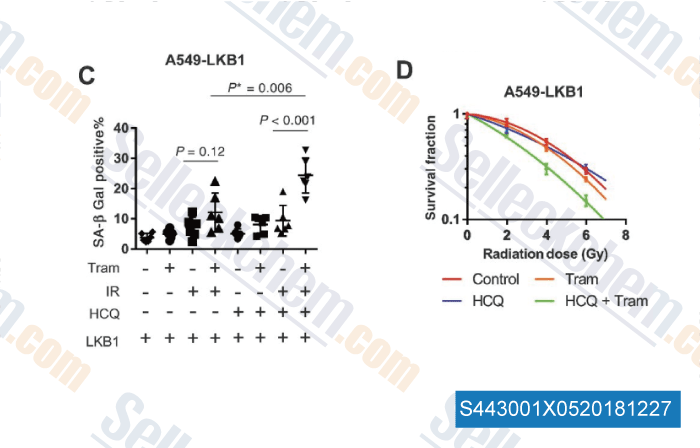
-
Datos de [ , , Clin Cancer Res, 2018, doi:10.1158/1078-0432.CCR-18-1489 ]
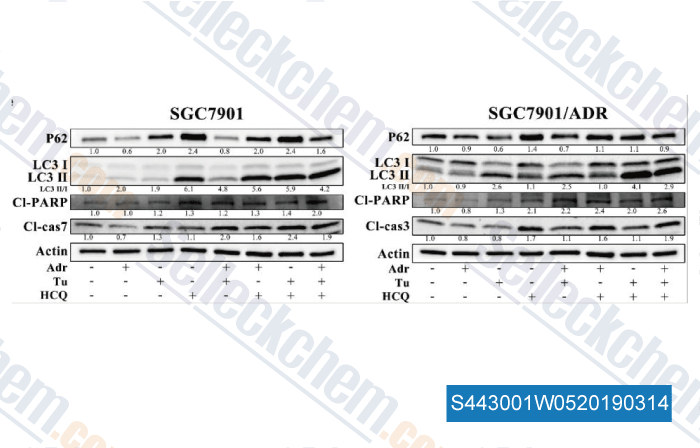
-
Datos de [ , , J Exp Clin Cancer Res, 2018, 37(1):272 ]
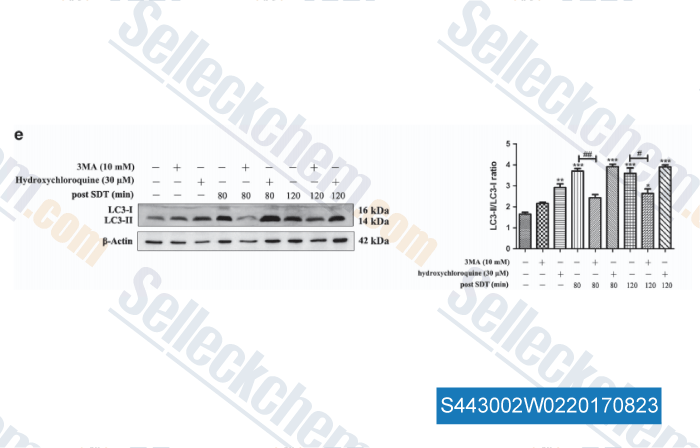
-
Datos de [ , , Cell Death Dis, 2017, 8(1):e2558 ]
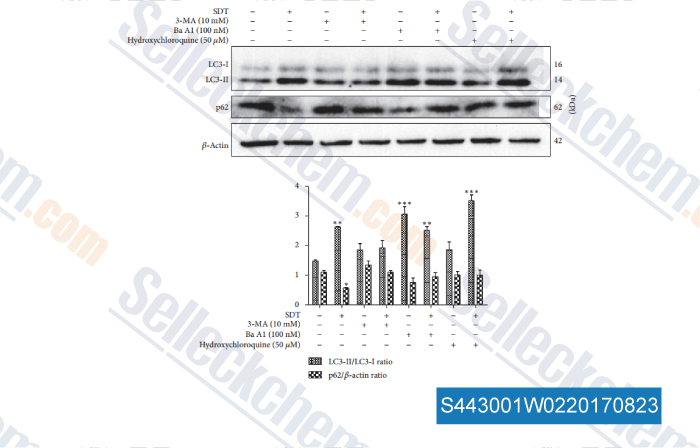
-
Datos de [ , , Oxid Med Cell Longev, 2017, 8519169 ]
Sellecks HCQ (Hydroxychloroquine) Sulfate Ha sido citado por 124 Publicaciones
| Reticulophagy receptor FAM134C restrains BMP receptor signaling [ EMBO J, 2025, 10.1038/s44318-025-00581-3] | PubMed: 41116059 |
| BMAL1-depletion remodels ceramide metabolism to regulate ferroptosis and sorafenib chemosensitivity in acute myeloid leukemia [ iScience, 2025, 28(4):112054] | PubMed: 40241743 |
| MYC Overexpression Enhances Sensitivity to MEK Inhibition in Head and Neck Squamous Cell Carcinoma [ Int J Mol Sci, 2025, 26(2)588] | PubMed: 39859304 |
| Gossypin induces apoptosis and autophagy via the MAPK/JNK pathway in HT‑29 human colorectal cancer cells [ Int J Mol Med, 2025, 56(1)107] | PubMed: 40376978 |
| HCQ reverses the immune imbalance related to severe infections following chemotherapy of acute myeloid leukemia and exhibits inhibitory effects on inflammatory cytokine storms [ Clin Exp Med, 2025, 25(1):294] | PubMed: 40815351 |
| Glycopolymer nanomicelles: pH-responsive drug delivery, endocytosis pathway, autophagy behavior, and the effect of autophagy inhibitors [ J Mater Sci-Mater M, 2025, 36(1):47] | PubMed: 40478478 |
| TRIM22 inhibits the metastasis of colorectal cancer through facilitating β-Catenin degradation [ Exp Cell Res, 2025, 446(2):114473] | PubMed: 39978715 |
| Pyrimethamine Inhibits Human Ovarian Cancer by Triggering Lethal Mitophagy via Activating the p38/JNK/ERK Pathway [ Oncol Res, 2025, 33(9):2421-2434] | PubMed: 40918465 |
| Itaconate drives pro-inflammatory responses through proteasomal degradation of GLO1 [ Biochem Biophys Res Commun, 2025, 747:151292] | PubMed: 39787788 |
| Platelet factor 4 modulates endothelial cell antimicrobial activity to enhance bacterial clearance and improve sepsis outcomes [ bioRxiv, 2025, 2025.09.02.673783] | PubMed: 40950105 |
POLÍTICA DE DEVOLUCIÓN
La Política de Devolución Incondicional de Selleck Chemical garantiza una experiencia de compra en línea fluida para nuestros clientes. Si no está satisfecho con su compra de alguna manera, puede devolver cualquier artículo(s) dentro de los 7 días posteriores a su recepción. En caso de problemas de calidad del producto, ya sean problemas relacionados con el protocolo o con el producto, puede devolver cualquier artículo(s) dentro de los 365 días a partir de la fecha de compra original. Siga las instrucciones a continuación al devolver productos.
ENVÍO Y ALMACENAMIENTO
Los productos Selleck se transportan a temperatura ambiente. Si recibe el producto a temperatura ambiente, tenga la seguridad de que el Departamento de Inspección de Calidad de Selleck ha realizado experimentos para verificar que la colocación a temperatura normal durante un mes no afectará la actividad biológica de los productos en polvo. Después de la recogida, guarde el producto de acuerdo con los requisitos descritos en la hoja de datos. La mayoría de los productos Selleck son estables en las condiciones recomendadas.
NO PARA USO HUMANO, DIAGNÓSTICO VETERINARIO O TERAPÉUTICO.