
Datos técnicos
| Fórmula | C25H22N2O2 |
||||||||||||||
| Peso molecular | 382.45 | Número CAS | 890842-28-1 | ||||||||||||
| Solubilidad (25°C)* | In vitro | DMSO | 76 mg/mL (198.71 mM) | ||||||||||||
| Water | Insoluble | ||||||||||||||
| Ethanol | Insoluble | ||||||||||||||
| In vivo (Agregue los solventes al producto individualmente y en orden.) |
|
||||||||||||||
|
* <1 mg/ml significa ligeramente soluble o insoluble. * Tenga en cuenta que Selleck prueba la solubilidad de todos los compuestos internamente, y la solubilidad real puede diferir ligeramente de los valores publicados. Esto es normal y se debe a ligeras variaciones entre lotes. * Envío a temperatura ambiente (Las pruebas de estabilidad demuestran que este producto se puede enviar sin medidas de refrigeración.) |
|||||||||||||||
Preparación de soluciones madre
Actividad biológica
| Descripción | El GSK650394 es un inhibidor de la cinasa 1 regulada por el suero y los glucocorticoides con un IC50 de 62 nM y 103 nM para SGK1 y SGK2, respectivamente. | ||||
|---|---|---|---|---|---|
| Objetivos |
|
||||
| In vitro | El GSK650394 inhibe el transporte epitelial mediado por SGK1 con un IC50 de 0,6 μM en el ensayo SCC. En las células LNCaP, este compuesto inhibe la potenciación mediada por andrógenos de la fosforilación de Nedd4-2 y el crecimiento celular mediado por andrógenos.Esta sustancia química contrarresta la disminución de la neurogénesis inducida por el cortisol, los cambios en la señalización de Hedgehog y la translocación nuclear del GR. [2] Inhibe la replicación del virus de la gripe al impedir la exportación de vRNP de la gripe al citoplasma de las células A549. |
Protocolo (de referencia)
| Ensayo de quinasa:[1] |
|
|---|---|
| Ensayo celular:[1] |
|
Referencias
|
Validación de productos por parte del cliente
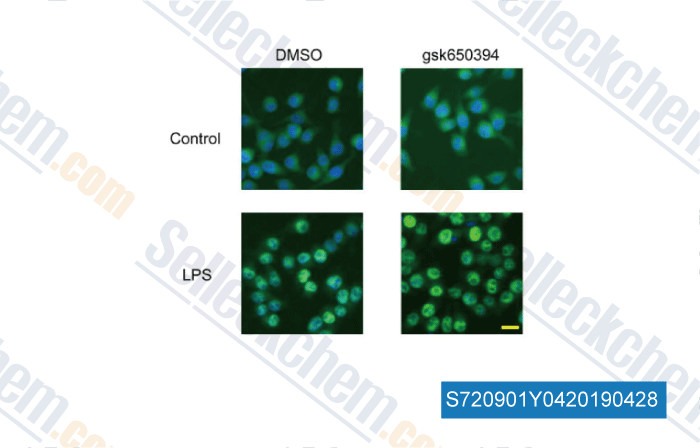
-
Datos de [ , , Biochem Biophys Res Commun, 2016, 478(1):53-59 ]
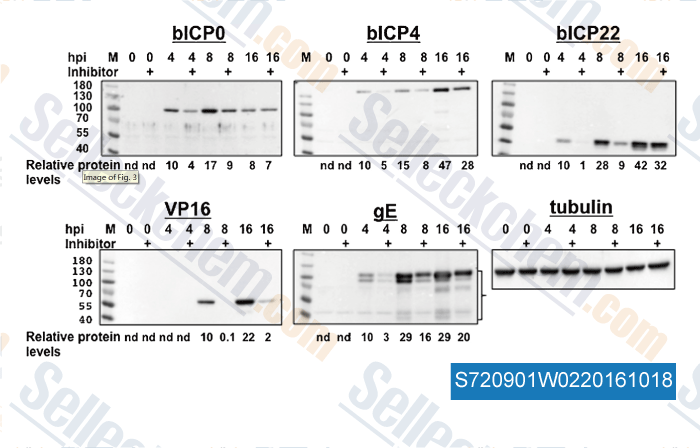
-
Datos de [ , , Virus Res, 2016, 222:106-112. ]
Sellecks GSK650394 Ha sido citado por 24 Publicaciones
| Patient-derived enteroids provide a platform for the development of therapeutic approaches in microvillus inclusion disease [ J Clin Invest, 2023, 133(20)e169234] | PubMed: 37643022 |
| Bacterial DNA promoting inflammation via the Sgk1/Nedd4L/Syk pathway in mast cells contributes to antihistamine non-responsive CSU [ J Leukoc Biol, 2023, qiad025] | PubMed: 36857592 |
| Estrogen-sensitive activation of SGK1 induces M2 macrophages with anti-inflammatory properties and a Th2 response at the maternal-fetal interface [ Reprod Biol Endocrinol, 2023, 21(1):50] | PubMed: 37226177 |
| Inhibition of SGK1 potentiates the anticancer activity of PI3K inhibitor in NSCLC cells through modulation of mTORC1, p‑ERK and β‑catenin signaling [ Biomed Rep, 2023, 19(6):94] | PubMed: 37901878 |
| Therapy Development for Microvillus Inclusion Disease using Patient-derived Enteroids [ bioRxiv, 2023, 2023.01.28.526036] | PubMed: 36747680 |
| Activation of Serum/Glucocorticoid Regulated Kinase 1/Nuclear Factor-κB Pathway Are Correlated with Low Sensitivity to Bortezomib and Ixazomib in Resistant Multiple Myeloma Cells [ Biomedicines, 2021, 9(1)E33] | PubMed: 33406639 |
| Identification and Kinetic Characterization of Serum- and Glucocorticoid-Regulated Kinase Inhibitors Using a Fluorescence Polarization-Based Assay [ SLAS Discov, 2021, 24725552211002465] | PubMed: 33783250 |
| Crosstalk between Hedgehog pathway and the glucocorticoid receptor pathway as a basis for combination therapy in T-cell acute lymphoblastic leukemia [ Oncogene, 2020, 10.1038/s41388-020-01453-2] | PubMed: 32917954 |
| Convergent genomic and pharmacological evidence of PI3K/GSK3 signaling alterations in neurons from schizophrenia patients [ Neuropsychopharmacology, 2020, 10.1038/s41386-020-00924-0] | PubMed: 33288841 |
| Targeting histone K4 trimethylation for treatment of cognitive and synaptic deficits in mouse models of Alzheimer's disease [ Sci Adv, 2020, 6(50)eabc8096] | PubMed: 33298440 |
POLÍTICA DE DEVOLUCIÓN
La Política de Devolución Incondicional de Selleck Chemical garantiza una experiencia de compra en línea fluida para nuestros clientes. Si no está satisfecho con su compra de alguna manera, puede devolver cualquier artículo(s) dentro de los 7 días posteriores a su recepción. En caso de problemas de calidad del producto, ya sean problemas relacionados con el protocolo o con el producto, puede devolver cualquier artículo(s) dentro de los 365 días a partir de la fecha de compra original. Siga las instrucciones a continuación al devolver productos.
ENVÍO Y ALMACENAMIENTO
Los productos Selleck se transportan a temperatura ambiente. Si recibe el producto a temperatura ambiente, tenga la seguridad de que el Departamento de Inspección de Calidad de Selleck ha realizado experimentos para verificar que la colocación a temperatura normal durante un mes no afectará la actividad biológica de los productos en polvo. Después de la recogida, guarde el producto de acuerdo con los requisitos descritos en la hoja de datos. La mayoría de los productos Selleck son estables en las condiciones recomendadas.
NO PARA USO HUMANO, DIAGNÓSTICO VETERINARIO O TERAPÉUTICO.