
Datos técnicos
| Fórmula | C27H29FN8O3 |
||||||
| Peso molecular | 532.57 | Número CAS | 1116235-97-2 | ||||
| Solubilidad (25°C)* | In vitro | DMSO | 107 mg/mL (200.91 mM) | ||||
| Water | Insoluble | ||||||
| Ethanol | Insoluble | ||||||
| In vivo (Agregue los solventes al producto individualmente y en orden.) |
|
||||||
|
* <1 mg/ml significa ligeramente soluble o insoluble. * Tenga en cuenta que Selleck prueba la solubilidad de todos los compuestos internamente, y la solubilidad real puede diferir ligeramente de los valores publicados. Esto es normal y se debe a ligeras variaciones entre lotes. * Envío a temperatura ambiente (Las pruebas de estabilidad demuestran que este producto se puede enviar sin medidas de refrigeración.) |
|||||||
Preparación de soluciones madre
Actividad biológica
| Descripción | GSK1838705A es un potente inhibidor de IGF-1R con una IC50 de 2,0 nM, moderadamente potente para IR y ALK con una IC50 de 1,6 nM y 0,5 nM, respectivamente, y poca actividad sobre otras Protein Tyrosine Kinase. | ||||||
|---|---|---|---|---|---|---|---|
| Objetivos |
|
||||||
| In vitro | GSK1838705A inhibe potente y ATP-competitivamente IGF-1R e IR con valores de appKi de 0,7 nM y 1,1 nM, respectivamente. En células, este compuesto inhibe potentemente la fosforilación de IGF-1R e IR inducida por ligando con una IC50 de 85 nM y 79 nM, respectivamente. Muestra un efecto antiproliferativo significativo en un panel de líneas celulares derivadas de tumores sólidos y hematológicos como las células L-82, SUP-M2, SK-ES y MCF-7 con una EC50 de 24 nM, 28 nM, 141 nM y 203 nM, respectivamente. Esta sustancia química muestra una acumulación de células MCF-7 y NCl-H929 predominantemente en la fase G1 (2N) del ciclo celular. También inhibe ALK con un Ki de 0,35 nM y suprime la proliferación de células de fusión nucleofosmina (NPM)-ALK con una EC50 de 24-88 nM. Este compuesto inhibe potentemente la fosforilación de NPM-ALK en células Karpas-299 y SR-786, mientras que tiene un efecto modesto sobre la fosforilación de STAT3. | ||||||
| In vivo | En ratones con tumores NIH-3T3/LISN, el tratamiento oral de GSK1838705A (60 mg/kg) provoca una inhibición del crecimiento tumoral del 77 %, sin una pérdida de peso significativa. En ratones con tumores COLO 205, la inhibición del crecimiento tumoral por este compuesto (30 mg/kg) es del 80 %. Además, la eficacia antitumoral de este químico también se observa en ratones que portan xenoinjertos HT29 o BxPC3. En ratones, este compuesto (60 mg/kg) conduce a un aumento transitorio de 2 veces en los niveles de glucosa en sangre al inhibir la señalización de IR. Este (60 mg/kg) inhibe el crecimiento de xenoinjertos de Karpas-299 establecidos con una inhibición del crecimiento tumoral del 93 %, sin efecto sobre el peso de las ratas. | ||||||
| Características | Un inhibidor de quinasa de molécula pequeña de IGF-1R y el receptor de insulina. |
Protocolo (de referencia)
| Ensayo de quinasa:[1] |
|
|---|---|
| Ensayo celular:[1] |
|
| Estudio en animales:[1] |
|
Referencias
|
Validación de productos por parte del cliente
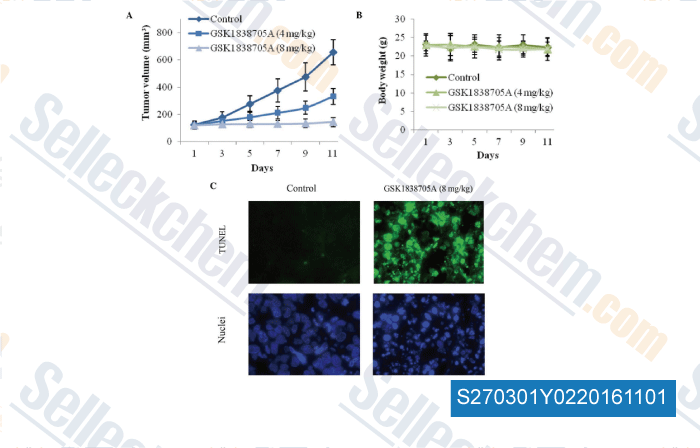
-
, , Mol Med Rep, 2015, 12(4):5641-6.
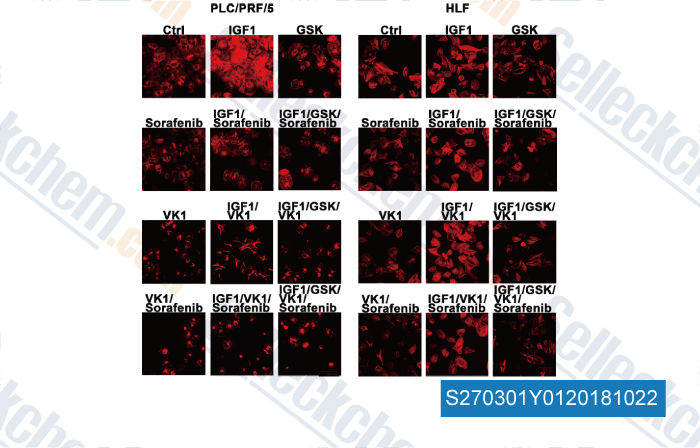
-
Datos de [ , , Cell Oncol (Dordr), 2018, 41(3):283-296 ]
Sellecks GSK1838705A Ha sido citado por 18 Publicaciones
| IGF-binding proteins secreted by cancer-associated fibroblasts induce context-dependent drug sensitization of lung cancer cells [ Sci Signal, 2022, 15(747):eabj5879] | PubMed: 35973030 |
| Targeting Aurora B kinase prevents and overcomes resistance to EGFR inhibitors in lung cancer by enhancing BIM- and PUMA-mediated apoptosis [ Cancer Cell, 2021, S1535-6108(21)00383-4] | PubMed: 34388376 |
| Efficient suppression of NRAS-driven melanoma by co-inhibition of ERK1/2 and ERK5 MAPK pathways. [ J Invest Dermatol, 2020, 3 pii: S0022-202X(20)31407-X] | PubMed: 32376279 |
| Gene Essentiality Profiling Reveals Gene Networks and Synthetic Lethal Interactions with Oncogenic Ras. [ Cell, 2019, 36(2):179-193] | PubMed: 28162770 |
| A Pharmacogenomic Landscape in Human Liver Cancers. [ Cancer Cell, 2019, 36(2):179-193] | PubMed: 31378681 |
| Divergent Polypharmacology-Driven Cellular Activity of Structurally Similar Multi-Kinase Inhibitors through Cumulative Effects on Individual Targets [ Cell Chem Biol, 2019, 10.1016/j.chembiol.2019.06.003] | PubMed: 31257184 |
| Extracellular Glutamate-Induced mTORC1 Activation via the IR/IRS/PI3K/Akt Pathway Enhances the Expansion of Porcine Intestinal Stem Cells [ J Agric Food Chem, 2019, 67(34):9510-9521] | PubMed: 31382738 |
| Ramucirumab and GSK1838705A Enhance the Inhibitory Effects of Low Concentration Sorafenib and Regorafenib Combination on HCC Cell Growth and Motility. [ Cancers (Basel), 2019, 11(6)] | PubMed: 31181647 |
| Strong enhancement by IGF1-R antagonists of hepatocellular carcinoma cell migration inhibition by Sorafenib and/or vitamin K1 [D'Alessandro R, et al. Cell Oncol (Dordr), 2018, 41(3):283-296] | PubMed: 29470830 |
| IGF-1R tyrosine kinase inhibitors and Vitamin K1 enhance the antitumor effects of Regorafenib in HCC cell lines. [ Oncotarget, 2017, 8(61):103465-103476] | PubMed: 29262576 |
POLÍTICA DE DEVOLUCIÓN
La Política de Devolución Incondicional de Selleck Chemical garantiza una experiencia de compra en línea fluida para nuestros clientes. Si no está satisfecho con su compra de alguna manera, puede devolver cualquier artículo(s) dentro de los 7 días posteriores a su recepción. En caso de problemas de calidad del producto, ya sean problemas relacionados con el protocolo o con el producto, puede devolver cualquier artículo(s) dentro de los 365 días a partir de la fecha de compra original. Siga las instrucciones a continuación al devolver productos.
ENVÍO Y ALMACENAMIENTO
Los productos Selleck se transportan a temperatura ambiente. Si recibe el producto a temperatura ambiente, tenga la seguridad de que el Departamento de Inspección de Calidad de Selleck ha realizado experimentos para verificar que la colocación a temperatura normal durante un mes no afectará la actividad biológica de los productos en polvo. Después de la recogida, guarde el producto de acuerdo con los requisitos descritos en la hoja de datos. La mayoría de los productos Selleck son estables en las condiciones recomendadas.
NO PARA USO HUMANO, DIAGNÓSTICO VETERINARIO O TERAPÉUTICO.