
Datos técnicos
| Fórmula | C21H19ClN4O2 |
||||||
| Peso molecular | 394.85 | Número CAS | 1218942-37-0 | ||||
| Solubilidad (25°C)* | In vitro | DMSO | 79 mg/mL (200.07 mM) | ||||
| Water | Insoluble | ||||||
| Ethanol | Insoluble | ||||||
| In vivo (Agregue los solventes al producto individualmente y en orden.) |
|
||||||
|
* <1 mg/ml significa ligeramente soluble o insoluble. * Tenga en cuenta que Selleck prueba la solubilidad de todos los compuestos internamente, y la solubilidad real puede diferir ligeramente de los valores publicados. Esto es normal y se debe a ligeras variaciones entre lotes. * Envío a temperatura ambiente (Las pruebas de estabilidad demuestran que este producto se puede enviar sin medidas de refrigeración.) |
|||||||
Preparación de soluciones madre
Actividad biológica
| Descripción | Setanaxib (GKT137831, GKT831) es un potente inhibidor dual de NADPH oxidase NOX1/NOX4 con un Ki de 110 nM y 140 nM, respectivamente. Este compuesto suprime la producción de reactive oxygen species (ROS) e inhibe parcialmente la ferroptosis. | ||||||
|---|---|---|---|---|---|---|---|
| Objetivos |
|
||||||
| In vitro | Setanaxib (GKT137831) atenúa la liberación de H(2)O(2) inducida por hipoxia, la proliferación celular y la expresión de TGF-β1 y embota las reducciones de PPARγ en HPAECs y HPASMCs. También previene el estrés oxidativo en respuesta a la hiperglucemia en células endoteliales aórticas humanas. |
||||||
| In vivo | En ratones WT y SOD1mut, Setanaxib (GKT137831) (60 mg/kg i.g.) bloquea la fibrosis hepática y regula a la baja los marcadores de estrés oxidativo, inflamación y fibrosis. Este compuesto (60 mg/kg/día p.o.) también atenúa la hipertrofia ventricular derecha inducida por hipoxia crónica, el remodelado vascular, la proliferación de células pulmonares y las alteraciones hipóxicas en la expresión de PPARγ y TGF-β1 pulmonares en un modelo murino de exposición a hipoxia crónica. En ratones diabéticos deficientes en apolipoproteína E, (60 mg/kg/día p.o.) atenúa la aterosclerosis acelerada por diabetes mellitus. Además, en ratones c-hNox4Tg infundidos con AngII, elimina el aumento del estrés oxidativo, suprime la vía de señalización Akt-mTOR y NF-κB y atenúa el remodelado cardíaco. |
Protocolo (de referencia)
| Ensayo celular: |
|
|---|---|
| Estudio en animales: |
|
Referencias
|
Validación de productos por parte del cliente
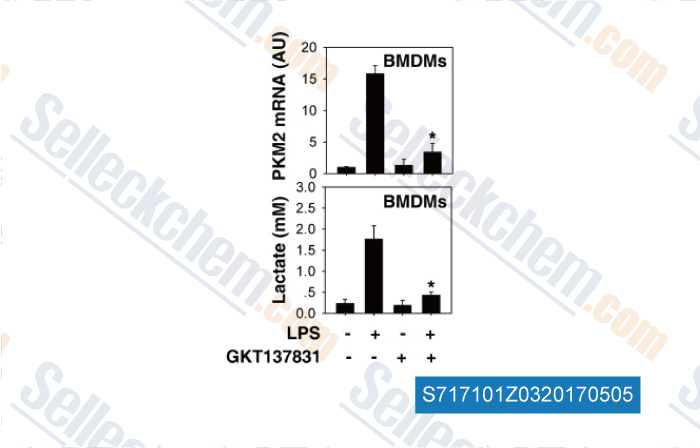
-
, , Mol Med, 2016, doi: 10.2119/molmed.2015.00250
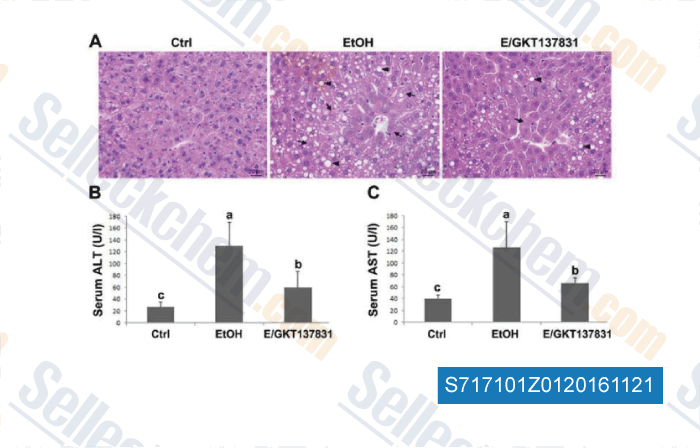
-
Datos de [ , , Biochim Biophys Acta, 2016, 1861(1 Pt A):2912-2921. ]
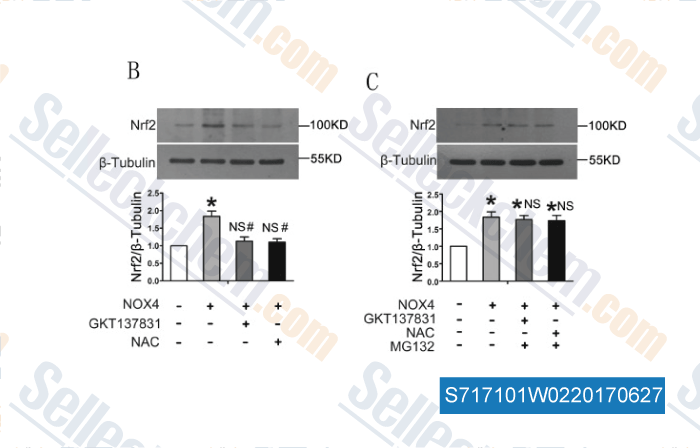
-
Datos de [ , , Exp Cell Res, 2017, 352(2):245-254 ]
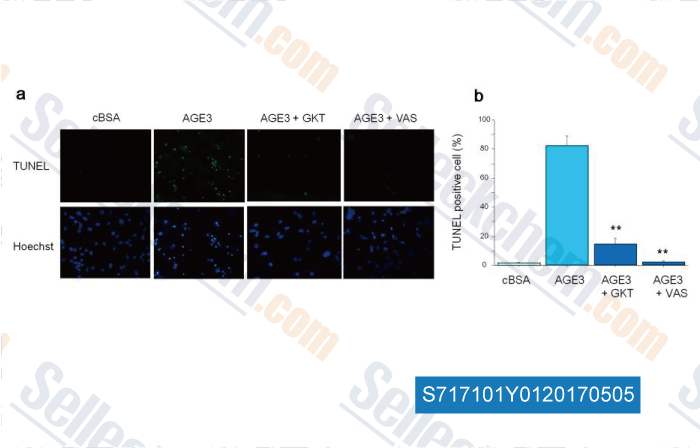
-
Datos de [ , , Int J Mol Sci, 2016, 17(9). pii: E1567 ]
Sellecks Setanaxib (GKT137831) Ha sido citado por 73 Publicaciones
| A bladder-blood immune barrier constituted by suburothelial perivascular macrophages restrains uropathogen dissemination [ Immunity, 2025, S1074-7613(25)00069-X] | PubMed: 40015270 |
| Remote Ischemic Preconditioning Attenuates Mitochondrial Dysfunction and Ferroptosis of Tubular Epithelial Cells by Inhibiting NOX4-ROS Signaling in Acute Kidney Injury [ Int J Biol Sci, 2025, 21(5):2313-2329] | PubMed: 40083709 |
| trans-Endothelial neutrophil migration activates bactericidal function via Piezo1 mechanosensing [ Immunity, 2024, 57(1):52-67.e10] | PubMed: 38091995 |
| Inhibition of neutrophil swarming by type I interferon promotes intracellular bacterial evasion [ Nat Commun, 2024, 15(1):8663] | PubMed: 39375351 |
| Autophagy-mediated activation of the AIM2 inflammasome enhances M1 polarization of microglia and exacerbates retinal neovascularization [ MedComm (2020), 2024, 5(8):e668] | PubMed: 39081514 |
| Autophagy caused by oxidative stress promotes TGF-β1-induced epithelial-to-mesenchymal transition in human peritoneal mesothelial cells [ Cell Death Dis, 2024, 15(5):365] | PubMed: 38806451 |
| Setanaxib mitigates oxidative damage following retinal ischemia-reperfusion via NOX1 and NOX4 inhibition in retinal ganglion cells [ Biomed Pharmacother, 2024, 170:116042] | PubMed: 38118351 |
| LRRC8A drives NADPH oxidase-mediated mitochondrial dysfunction and inflammation in allergic rhinitis [ J Transl Med, 2024, 22(1):1034] | PubMed: 39550567 |
| Sevoflurane Exposure Induces Neuronal Cell Ferroptosis Initiated by Increase of Intracellular Hydrogen Peroxide in the Developing Brain via ER Stress ATF3 Activation [ Mol Neurobiol, 2024, 61(4):2313-2335] | PubMed: 37874483 |
| Fibroblast growth factor 18 alleviates stress-induced pathological cardiac hypertrophy in male mice [ Nat Commun, 2023, 14(1):1235] | PubMed: 36871047 |
POLÍTICA DE DEVOLUCIÓN
La Política de Devolución Incondicional de Selleck Chemical garantiza una experiencia de compra en línea fluida para nuestros clientes. Si no está satisfecho con su compra de alguna manera, puede devolver cualquier artículo(s) dentro de los 7 días posteriores a su recepción. En caso de problemas de calidad del producto, ya sean problemas relacionados con el protocolo o con el producto, puede devolver cualquier artículo(s) dentro de los 365 días a partir de la fecha de compra original. Siga las instrucciones a continuación al devolver productos.
ENVÍO Y ALMACENAMIENTO
Los productos Selleck se transportan a temperatura ambiente. Si recibe el producto a temperatura ambiente, tenga la seguridad de que el Departamento de Inspección de Calidad de Selleck ha realizado experimentos para verificar que la colocación a temperatura normal durante un mes no afectará la actividad biológica de los productos en polvo. Después de la recogida, guarde el producto de acuerdo con los requisitos descritos en la hoja de datos. La mayoría de los productos Selleck son estables en las condiciones recomendadas.
NO PARA USO HUMANO, DIAGNÓSTICO VETERINARIO O TERAPÉUTICO.