
Datos técnicos
| Fórmula | C25H24N4O2 |
||||||||||||||
| Peso molecular | 412.48 | Número CAS | 133052-90-1 | ||||||||||||
| Solubilidad (25°C)* | In vitro | DMSO | 82 mg/mL (198.79 mM) | ||||||||||||
| Ethanol | 1 mg/mL (2.42 mM) | ||||||||||||||
| Water | Insoluble | ||||||||||||||
| In vivo (Agregue los solventes al producto individualmente y en orden.) |
|
||||||||||||||
|
* <1 mg/ml significa ligeramente soluble o insoluble. * Tenga en cuenta que Selleck prueba la solubilidad de todos los compuestos internamente, y la solubilidad real puede diferir ligeramente de los valores publicados. Esto es normal y se debe a ligeras variaciones entre lotes. * Envío a temperatura ambiente (Las pruebas de estabilidad demuestran que este producto se puede enviar sin medidas de refrigeración.) |
|||||||||||||||
Preparación de soluciones madre
Actividad biológica
| Descripción | Bisindolylmaleimide I (GF109203X, GO 6850) es un potente inhibidor de PKC con valores de IC50 de 20 nM, 17 nM, 16 nM y 20 nM para PKC , PKC I, PKC II y PKC en ensayos libres de células, respectivamente. Este compuesto muestra una selectividad más de 3000 veces mayor para PKC en comparación con EGFR, PDGFR y el receptor de insulina. | ||||||||
|---|---|---|---|---|---|---|---|---|---|
| Objetivos |
|
||||||||
| In vitro | Bisindolylmaleimide I (GF109203X) es un inhibidor de PKC competitivo de ATP que previene la agregación plaquetaria inducida por estímulos que activan la PKC, y tiene potencial como herramienta para estudiar la implicación de la PKC en las vías de transducción de señales. También produce actividad de reversión sobre la resistencia a múltiples fármacos mediada por la P-glicoproteína y MRP. La inhibición de PKC por este compuesto reduce significativamente la activación de ERK1/2 estimulada por carbacol y la posterior proliferación de células de cáncer de colon SNU-407. | ||||||||
| In vivo | Bisindolylmaleimide I (GF109203X) inhibe de forma dosis-dependiente la alodinia mecánica inducida por BK en ratas Wistar a una dosis de 10 μg/ratón (i.pl.). | ||||||||
| Características | Mayor selectividad que el inhibidor de PKC estaurosporina. GF109203X es una sonda química para estudiar las vías de transducción de señales de PKC. Potencial para su uso en una variedad de cánceres. |
Protocolo (de referencia)
| Ensayo de quinasa: |
|
|---|---|
| Ensayo celular: |
|
| Estudio en animales: |
|
Referencias
|
Validación de productos por parte del cliente
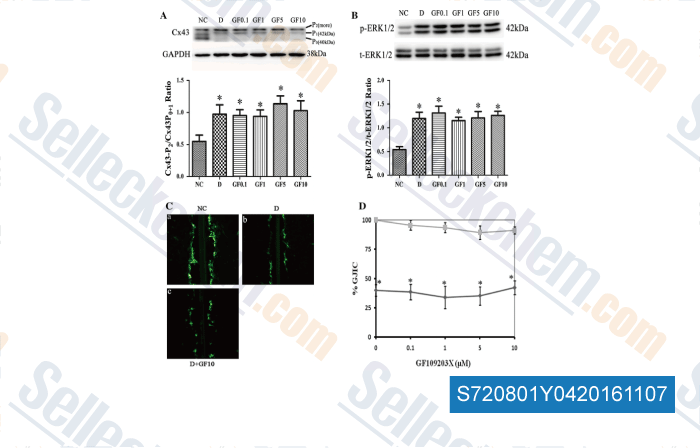
-
, , Mol Cell Biochem, 2015, 400(1-2):213-22.
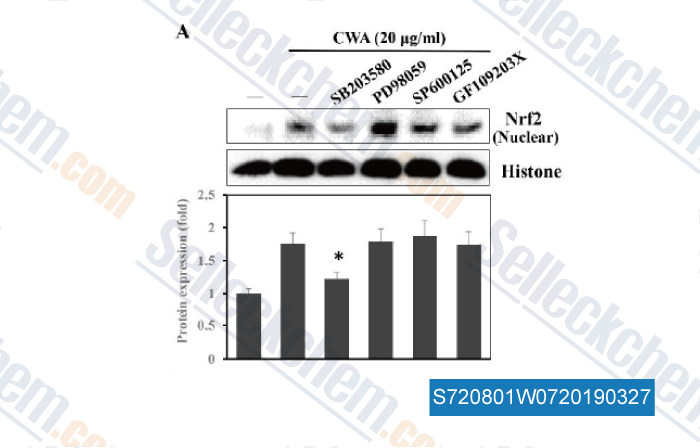
-
Datos de [ , , Free Radic Biol Med, 2018, 129:338-353 ]
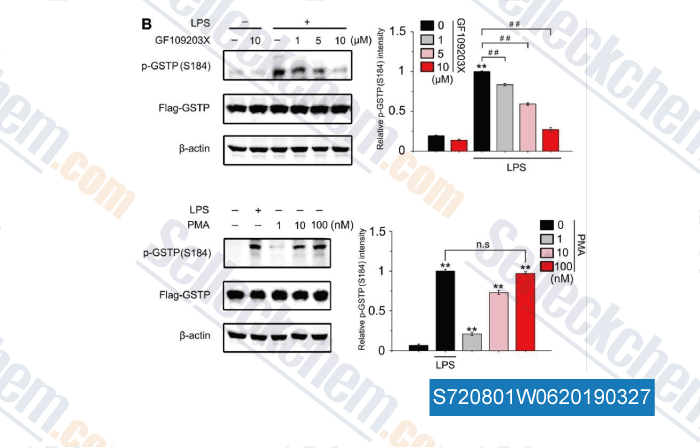
-
Datos de [ , , Front Immunol, 2018, 9:268 ]
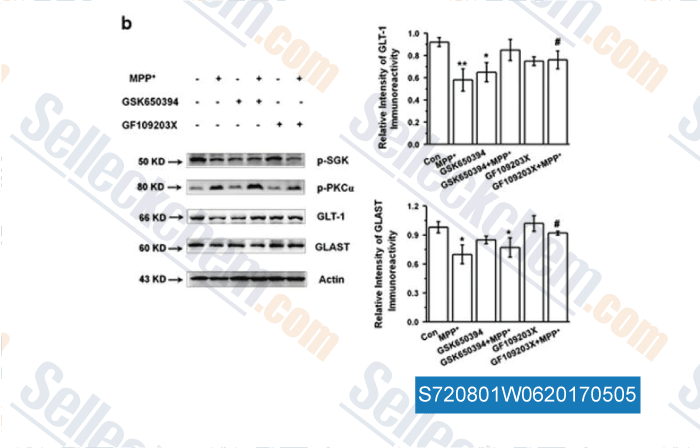
-
Datos de [ , , Cell Death Dis, 2017, 8(2):e2574 ]
Sellecks Bisindolylmaleimide I (GF109203X) Ha sido citado por 64 Publicaciones
| Dynamic phosphorylation of Fascin-1 orchestrates microglial phagocytosis and neurological recovery after spinal cord injury [ J Neuroinflammation, 2025, 22(1):121] | PubMed: 40281563 |
| HEP14-activated PKC-ERK1/2 pathway boosts HEP14-empowered hADSCs for ovarian regeneration and functional restoration [ Commun Biol, 2025, 8(1):1267] | PubMed: 40849553 |
| ELK3 destabilization by speckle-type POZ protein suppresses prostate cancer progression and docetaxel resistance [ Cell Death Dis, 2024, 15(4):274] | PubMed: 38632244 |
| Transcription of microRNAs is regulated by developmental signaling pathways and transcription factors [ Front Cell Dev Biol, 2024, 12:1356589] | PubMed: 38721525 |
| Downregulation of PIK3IP1/TrIP on T cells is controlled by TCR signal strength, PKC, and metalloprotease-mediated cleavage [ J Biol Chem, 2024, 300(12):107930] | PubMed: 39454954 |
| Epithelial TNF controls cell differentiation and CFTR activity to maintain intestinal mucin homeostasis [ J Clin Invest, 2023, 10.1172/JCI163591] | PubMed: 37643009 |
| Lysine methylation promotes NFAT5 activation and determines temozolomide efficacy in glioblastoma [ Nat Commun, 2023, 14(1):4062] | PubMed: 37429858 |
| Neurokinin-1 receptor drives PKCɑ-AURKA/N-Myc signaling to facilitate the neuroendocrine progression of prostate cancer [ Cell Death Dis, 2023, 14(6):384] | PubMed: 37385990 |
| HDAC Inhibition Restores Response to HER2-Targeted Therapy in Breast Cancer via PHLDA1 Induction [ Int J Mol Sci, 2023, 24(7)6228] | PubMed: 37047202 |
| Epicardial Adipose Tissue-Derived Leptin Promotes Myocardial Injury in Metabolic Syndrome Rats Through PKC/NADPH Oxidase/ROS Pathway [ J Am Heart Assoc, 2023, 12(15):e029415] | PubMed: 37489731 |
POLÍTICA DE DEVOLUCIÓN
La Política de Devolución Incondicional de Selleck Chemical garantiza una experiencia de compra en línea fluida para nuestros clientes. Si no está satisfecho con su compra de alguna manera, puede devolver cualquier artículo(s) dentro de los 7 días posteriores a su recepción. En caso de problemas de calidad del producto, ya sean problemas relacionados con el protocolo o con el producto, puede devolver cualquier artículo(s) dentro de los 365 días a partir de la fecha de compra original. Siga las instrucciones a continuación al devolver productos.
ENVÍO Y ALMACENAMIENTO
Los productos Selleck se transportan a temperatura ambiente. Si recibe el producto a temperatura ambiente, tenga la seguridad de que el Departamento de Inspección de Calidad de Selleck ha realizado experimentos para verificar que la colocación a temperatura normal durante un mes no afectará la actividad biológica de los productos en polvo. Después de la recogida, guarde el producto de acuerdo con los requisitos descritos en la hoja de datos. La mayoría de los productos Selleck son estables en las condiciones recomendadas.
NO PARA USO HUMANO, DIAGNÓSTICO VETERINARIO O TERAPÉUTICO.