
Datos técnicos
| Fórmula | C32H47F5O3S |
||||||
| Peso molecular | 606.77 | Número CAS | 129453-61-8 | ||||
| Solubilidad (25°C)* | In vitro | DMSO | 100 mg/mL (164.8 mM) | ||||
| Ethanol | 100 mg/mL (164.8 mM) | ||||||
| Water | Insoluble | ||||||
| In vivo (Agregue los solventes al producto individualmente y en orden.) |
|
||||||
|
* <1 mg/ml significa ligeramente soluble o insoluble. * Tenga en cuenta que Selleck prueba la solubilidad de todos los compuestos internamente, y la solubilidad real puede diferir ligeramente de los valores publicados. Esto es normal y se debe a ligeras variaciones entre lotes. * Envío a temperatura ambiente (Las pruebas de estabilidad demuestran que este producto se puede enviar sin medidas de refrigeración.) |
|||||||
Preparación de soluciones madre
Actividad biológica
| Descripción | Fulvestrant es un antagonista del receptor de estrógeno (ER) con una IC50 de 0,94 nM en un ensayo sin células. Fulvestrant también induce la autophagy y la apoptosis y tiene actividad antitumoral. | ||
|---|---|---|---|
| Objetivos |
|
||
| In vitro | Fulvestrant es un inhibidor eficaz del crecimiento de células MCF-7 ER-positivas (con una IC50 de 0,29 nM) pero sin efecto sobre el crecimiento de células de cáncer de mama humanas BT-20 ER-negativas. Este compuesto causa la acumulación de células en G0/G1 y también reduce la proporción de células capaces de síntesis continua de ADN. Inhibe competitivamente la unión del estradiol al receptor de estrógeno. Este agente bloquea la localización nuclear del ER al alterar la dimerización del receptor y el transporte nucleocitoplasmático dependiente de energía. Debido a la inestabilidad del complejo fulvestrant-ER, la unión de este compuesto con el ER finalmente resulta en una degradación acelerada de la proteína ER. Este químico (10 nM) no solo disminuye los niveles de ARNm de IGF-IR, sino que también disminuye la vida media. El tratamiento con 100 μM de este compuesto conduce a un aumento dependiente del tiempo de los niveles de ARNm de TNFR1 y TRADD en estado estacionario en células MCF-7. Es capaz de regular a la baja la expresión del receptor de andrógenos y disminuye las respuestas androgénicas en células de cáncer de próstata humanas LNCaP. Este agente también atenúa significativamente el crecimiento estimulado por R1881 en un 70%. Es capaz de modular la mitosis y la muerte celular en neuronas cerebelosas inmaduras mediante la activación rápida de MAPK. | ||
| In vivo | Fulvestrant carece de actividad uterotrófica, y cuando se coadministra con estradiol, bloquea eficazmente la acción uterotrófica del estradiol con una ED50 de 0,06 mg/kg/día s.c. en ratas hembra inmaduras. Una única inyección s.c. de 5 mg de esta suspensión del compuesto bloquea completamente el crecimiento de xenoinjertos MCF-7. El crecimiento de los trasplantes del tumor mamario humano BrlO también se suprime eficazmente con 10 μM de este químico. Este compuesto (10 mg/rata, s.c.) reduce la expresión del receptor de andrógenos, la fosforilación de ERK1/2 y la proliferación celular en la próstata ventral de la rata. También muestra actividad anti-angiogénesis en la membrana corioalantoidea del huevo de gallina. |
Protocolo (de referencia)
| Ensayo celular:[1] |
|
|---|---|
| Estudio en animales:[6] |
|
Referencias
|
Validación de productos por parte del cliente
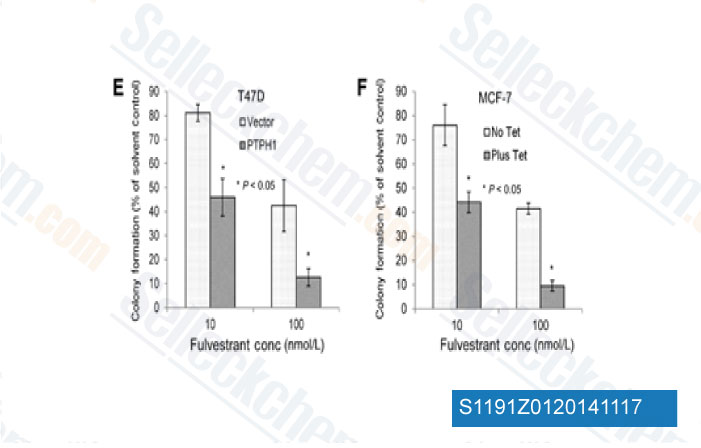
-
Datos de [ Mol Cancer Ther , 2014 , 13(1), 230-8 ]
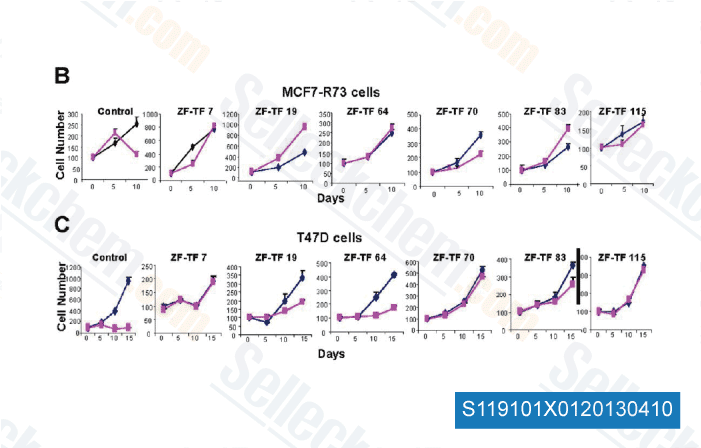
-
Datos de [ PLoS One , 2011 , 6, e21112 ]
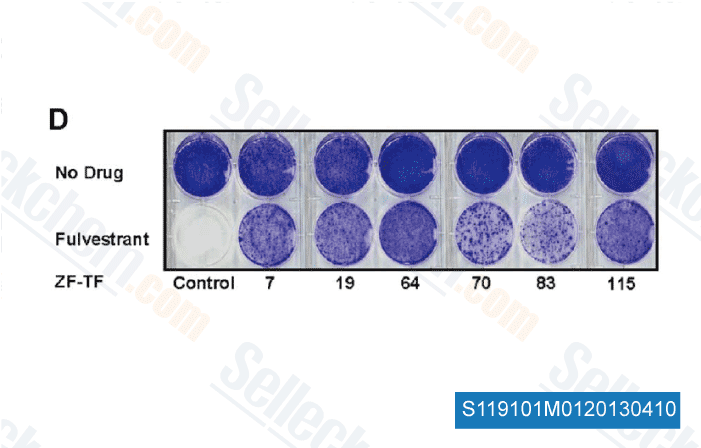
-
Datos de [ PLoS One , 2011 , 6, e21112 ]
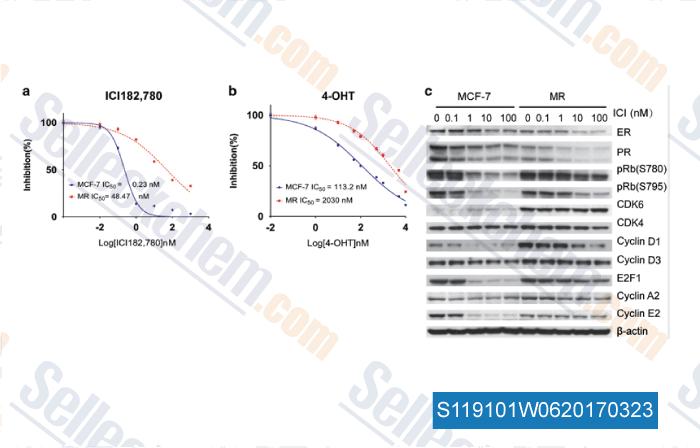
-
, , Oncogene, 2017, 36(16):2255-2264
Sellecks Fulvestrant (ICI-182780) Ha sido citado por 188 Publicaciones
| APOBEC3 mutagenesis drives therapy resistance in breast cancer [ Nat Genet, 2025, 57(6):1452-1462] | PubMed: 40379787 |
| Dual targeting CDK4/6 and CDK7 augments tumor response and anti-tumor immunity in breast cancer models [ J Clin Invest, 2025, e188839] | PubMed: 40794455 |
| Combined inhibition of KAT6A/B and Menin reverses estrogen receptor-driven gene expression programs in breast cancer [ Cell Rep Med, 2025, 6(7):102192] | PubMed: 40516531 |
| A bedside-to-bench translational analysis of NF1 alterations and CDK4/6 inhibitor resistance in hormone receptor-positive metastatic breast cancer [ EBioMedicine, 2025, 118:105828] | PubMed: 40578027 |
| Blocking cancer-fibroblast mutualism inhibits proliferation of endocrine therapy resistant breast cancer [ Mol Syst Biol, 2025, 10.1038/s44320-025-00104-6] | PubMed: 40341770 |
| Selective degradation of FGFR1/2 overcomes antiestrogen resistance in ER+ breast cancer with FGFR1/2 alterations [ Cancer Lett, 2025, 619:217668] | PubMed: 40127812 |
| Targeting estrogen-regulated system xc- promotes ferroptosis and endocrine sensitivity of ER+ breast cancer [ Cell Death Dis, 2025, 16(1):30] | PubMed: 39833180 |
| Oestrogen Receptor Alpha in Myocyte Maintains Muscle Regeneration in Duchenne Muscular Dystrophy [ J Cachexia Sarcopenia Muscle, 2025, 16(2):e13807] | PubMed: 40258782 |
| Annotation-free deep learning algorithm trained on hematoxylin & eosin images predicts epithelial-to-mesenchymal transition phenotype and endocrine response in estrogen receptor-positive breast cancer [ Breast Cancer Res, 2025, 27(1):6] | PubMed: 39800743 |
| Progranulin deficiency associates with postmenopausal osteoporosis via increasing ubiquitination of estrogen receptor α [ Genes Dis, 2025, 12(1):101221] | PubMed: 39559258 |
POLÍTICA DE DEVOLUCIÓN
La Política de Devolución Incondicional de Selleck Chemical garantiza una experiencia de compra en línea fluida para nuestros clientes. Si no está satisfecho con su compra de alguna manera, puede devolver cualquier artículo(s) dentro de los 7 días posteriores a su recepción. En caso de problemas de calidad del producto, ya sean problemas relacionados con el protocolo o con el producto, puede devolver cualquier artículo(s) dentro de los 365 días a partir de la fecha de compra original. Siga las instrucciones a continuación al devolver productos.
ENVÍO Y ALMACENAMIENTO
Los productos Selleck se transportan a temperatura ambiente. Si recibe el producto a temperatura ambiente, tenga la seguridad de que el Departamento de Inspección de Calidad de Selleck ha realizado experimentos para verificar que la colocación a temperatura normal durante un mes no afectará la actividad biológica de los productos en polvo. Después de la recogida, guarde el producto de acuerdo con los requisitos descritos en la hoja de datos. La mayoría de los productos Selleck son estables en las condiciones recomendadas.
NO PARA USO HUMANO, DIAGNÓSTICO VETERINARIO O TERAPÉUTICO.