
Datos técnicos
| Fórmula | C13H10Cl2N2O4S |
||||||||||||||
| Peso molecular | 361.20 | Número CAS | 108409-83-2 | ||||||||||||
| Solubilidad (25°C)* | In vitro | DMSO | 72 mg/mL (199.33 mM) | ||||||||||||
| Water | Insoluble | ||||||||||||||
| Ethanol | Insoluble | ||||||||||||||
| In vivo (Agregue los solventes al producto individualmente y en orden.) |
|
||||||||||||||
|
* <1 mg/ml significa ligeramente soluble o insoluble. * Tenga en cuenta que Selleck prueba la solubilidad de todos los compuestos internamente, y la solubilidad real puede diferir ligeramente de los valores publicados. Esto es normal y se debe a ligeras variaciones entre lotes. * Envío a temperatura ambiente (Las pruebas de estabilidad demuestran que este producto se puede enviar sin medidas de refrigeración.) |
|||||||||||||||
Preparación de soluciones madre
Actividad biológica
| Descripción | FH535 es un inhibidor de la señalización Wnt/β-catenina y también un antagonista dual de PPARγ y PPARδ. | |||
|---|---|---|---|---|
| Objetivos |
|
|||
| In vitro | FH535 antagoniza la transcripción mediada por β-Catenina/Tcf e inhibe el reclutamiento de los coactivadores GRIP1 y β-catenina a PPARδ y PPARγ. Este compuesto muestra un efecto antiproliferativo selectivo en algunas células cancerosas que expresan una vía Wnt/β-catenina alta o activa. Aumenta la citotoxicidad del condensado de humo de cigarrillo y provoca cambios en la señalización de β-catenina y EGR-1. Este químico tiene un valor terapéutico potencial en el tratamiento del cáncer de hígado al dirigirse a las células madre del cáncer de hígado y a las líneas celulares de carcinoma hepatocelular. |
Protocolo (de referencia)
| Ensayo de quinasa:[1] |
|
|---|---|
| Ensayo celular:[1] |
|
Referencias
|
Validación de productos por parte del cliente
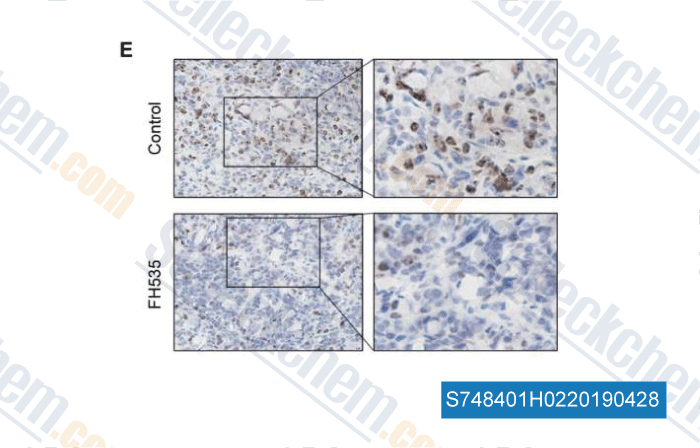
-
Datos de [ , , J Cancer, 2017, 8(16):3142-3153 ]
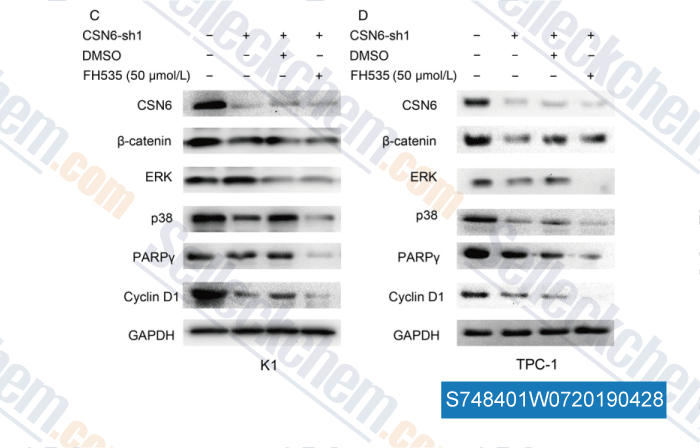
-
Datos de [ , , Cancer Med, 2018, 7(2):285-296 ]
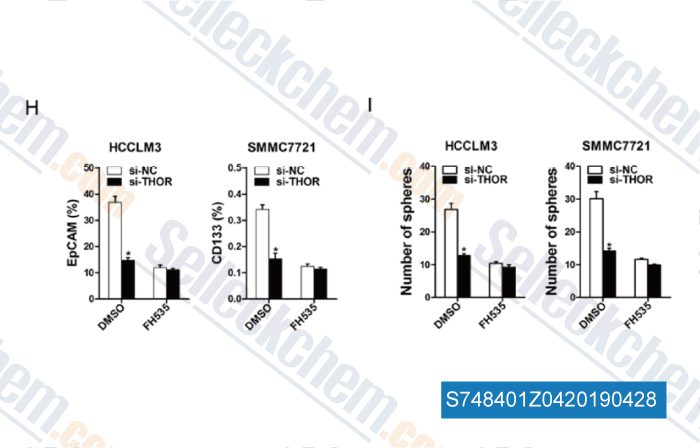
-
Datos de [ , , Gene, 2019, 684:95-103 ]
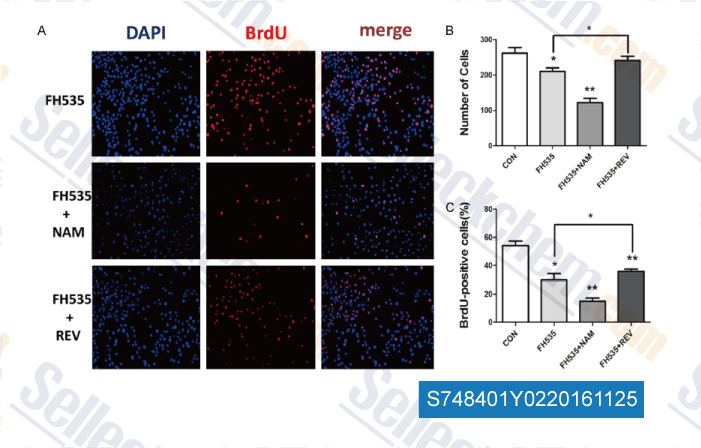
-
Datos de [ , , Int J Clin Exp Pathol, 2016, 9(3):2857-2868. ]
Sellecks FH535 Ha sido citado por 21 Publicaciones
| IL-33 Accelerates Chronic Atrophic Gastritis through AMPK-ULK1 Axis Mediated Autolysosomal Degradation of GKN1 [ Int J Biol Sci, 2024, 20(6):2323-2338] | PubMed: 38617533 |
| N6-Methyladenosine-Mediated Up-Regulation of FZD10 Regulates Liver Cancer Stem Cells' Properties and Lenvatinib Resistance Through WNT/β-Catenin and Hippo Signaling Pathways [ Gastroenterology, 2023, S0016-5085(23)00114-2] | PubMed: 36764493 |
| N6-Methyladenosine-Mediated Up-Regulation of FZD10 Regulates Liver Cancer Stem Cells' Properties and Lenvatinib Resistance Through WNT/β-Catenin and Hippo Signaling Pathways [ Gastroenterology, 2023, 164(6):990-1005] | PubMed: 36764493 |
| Disruption of β-catenin-mediated negative feedback reinforces cAMP-induced neuronal differentiation in glioma stem cells [ Cell Death Dis, 2022, 13(5):493] | PubMed: 35610201 |
| Combinatorial treatment with statins and niclosamide prevents CRC dissemination by unhinging the MACC1-β-catenin-S100A4 axis of metastasis [ Oncogene, 2022, 41(39):4446-4458] | PubMed: 36008464 |
| Establishment and characterization of immortalized sweat gland myoepithelial cells [ Sci Rep, 2022, 12(1):7] | PubMed: 34997030 |
| Immuno-genomic classification of colorectal cancer organoids reveals cancer cells with intrinsic immunogenic properties associated with patient survival [ J Exp Clin Cancer Res, 2021, 40(1):230] | PubMed: 34256801 |
| COX2 confers bone marrow stromal cells to promoting TNFα/TNFR1β-mediated myeloma cell growth and adhesion [ Cell Oncol (Dordr), 2021, 10.1007/s13402-021-00590-4] | PubMed: 33646559 |
| MicroRNA-506-3p increases the response to PARP inhibitors and cisplatin by targeting EZH2/β-catenin in serous ovarian cancers [ Transl Oncol, 2020, 14(2):100987] | PubMed: 33360300 |
| A novel human colon signet-ring cell carcinoma organoid line: establishment, characterization and application [ Carcinogenesis, 2020, 41(7):993-1004] | PubMed: 31740922 |
POLÍTICA DE DEVOLUCIÓN
La Política de Devolución Incondicional de Selleck Chemical garantiza una experiencia de compra en línea fluida para nuestros clientes. Si no está satisfecho con su compra de alguna manera, puede devolver cualquier artículo(s) dentro de los 7 días posteriores a su recepción. En caso de problemas de calidad del producto, ya sean problemas relacionados con el protocolo o con el producto, puede devolver cualquier artículo(s) dentro de los 365 días a partir de la fecha de compra original. Siga las instrucciones a continuación al devolver productos.
ENVÍO Y ALMACENAMIENTO
Los productos Selleck se transportan a temperatura ambiente. Si recibe el producto a temperatura ambiente, tenga la seguridad de que el Departamento de Inspección de Calidad de Selleck ha realizado experimentos para verificar que la colocación a temperatura normal durante un mes no afectará la actividad biológica de los productos en polvo. Después de la recogida, guarde el producto de acuerdo con los requisitos descritos en la hoja de datos. La mayoría de los productos Selleck son estables en las condiciones recomendadas.
NO PARA USO HUMANO, DIAGNÓSTICO VETERINARIO O TERAPÉUTICO.