
Datos técnicos
| Fórmula | C53H83NO14 |
||||||
| Peso molecular | 958.22 | Número CAS | 159351-69-6 | ||||
| Solubilidad (25°C)* | In vitro | DMSO | 100 mg/mL (104.36 mM) | ||||
| Ethanol | 100 mg/mL (104.36 mM) | ||||||
| Water | Insoluble | ||||||
| In vivo (Agregue los solventes al producto individualmente y en orden.) |
|
||||||
|
* <1 mg/ml significa ligeramente soluble o insoluble. * Tenga en cuenta que Selleck prueba la solubilidad de todos los compuestos internamente, y la solubilidad real puede diferir ligeramente de los valores publicados. Esto es normal y se debe a ligeras variaciones entre lotes. * Envío a temperatura ambiente (Las pruebas de estabilidad demuestran que este producto se puede enviar sin medidas de refrigeración.) |
|||||||
Preparación de soluciones madre
Actividad biológica
| Descripción | Everolimus es un inhibidor de mTOR de FKBP12 con un IC50 de 1,6-2,4 nM en un ensayo sin células. Everolimus induce la apoptosis y la autofagia celular e inhibe la proliferación de células tumorales. | ||||
|---|---|---|---|---|---|
| Objetivos |
|
||||
| In vitro | Everolimus exhibe una actividad inmunosupresora comparable a la de la rapamicina. Este compuesto compite con el FK 506 inmovilizado por la unión a FKBP12 biotinilada y muestra un efecto inhibidor en un MLR bidireccional realizado con células esplénicas de ratones BALB/c y CBA con un IC50 de 0,12-1,8 nM. También muestra efectos antiangiogénicos/vasculares en la proliferación de HUVEC inducida por VEGF con un IC50 de 0,12 nM y en la proliferación de HUVEC inducida por bFGF con un IC50 de 0,8 nM, respectivamente. Un estudio reciente muestra que este producto químico presenta efectos inhibidores dependientes de la dosis tanto en las células totales como en las células madre de la línea celular BT474 y en las células de cáncer de mama primarias con un IC50 de 156 nM en las células totales de las células de cáncer de mama primarias y de 71 nM en las células totales de las células BT474. Además, el tratamiento combinado con este compuesto y trastuzumab produce una inhibición significativamente mayor del crecimiento de las células madre cancerosas, con una tasa de inhibición aumentada en más del 50 %. | ||||
| In vivo | Everolimus (0,1 a 10 mg/kg) inhibe de forma dosis-dependiente el crecimiento de las metástasis primarias (oído) y de los ganglios linfáticos del melanoma B16/BL6, con una disminución del número total de vasos y una reducción de los vasos maduros. En un modelo animal de xenoinjerto de células madre BT474, este compuesto muestra reducciones significativas en los tamaños tumorales medios (590,6 mm3), en comparación con el grupo de control con un tamaño tumoral de 698 mm3. Además, el tratamiento combinado con este compuesto y trastuzumab disminuye significativamente el tamaño del tumor de xenoinjerto (410,8 mm3) más que el tratamiento con este compuesto solo. |
Protocolo (de referencia)
| Ensayo de quinasa:[1] |
|
|---|---|
| Ensayo celular:[3] |
|
| Estudio en animales:[3] |
|
Referencias
|
Validación de productos por parte del cliente
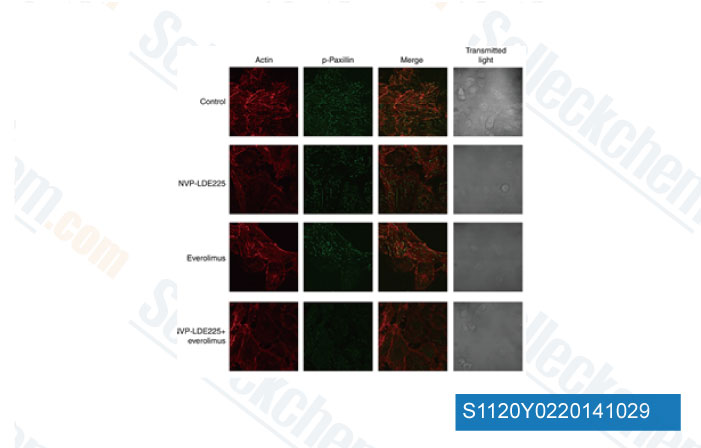
-
Datos de [ Br J Cancer , 2014 , 111(6), 1168-79 ]
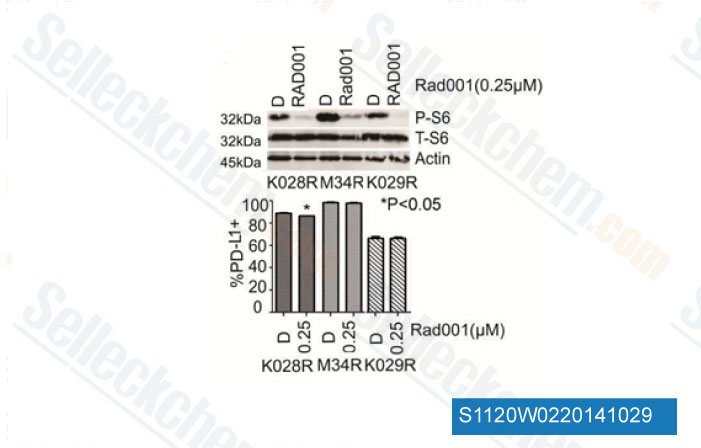
-
Datos de [ Clin Cancer Res , 2013 , 19(3),598-609 ]
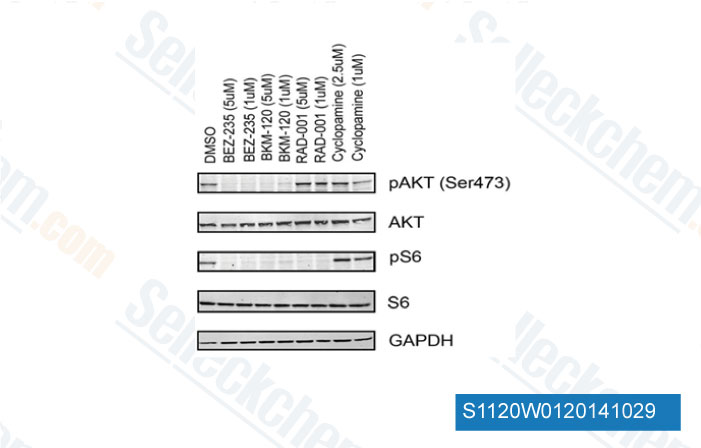
-
Datos de [ Cancer Cell , 2012 , 21(2), 155-67 ]
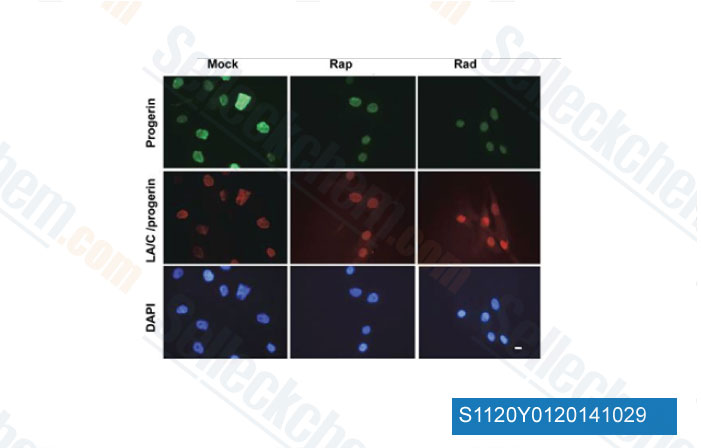
-
Datos de [ Aging (Albany NY) , 2012 , 4(2), 119-32 ]
Sellecks RAD001 (Everolimus) Ha sido citado por 798 Publicaciones
| Proteogenomic characterization of non-functional pancreatic neuroendocrine tumors unravels clinically relevant subgroups [ Cancer Cell, 2025, 43(4):776-796.e14] | PubMed: 40185092 |
| Ataluren improves hematopoietic and pancreatic disorders in Shwachman-Diamond syndrome patients: a compassionate program case-series [ Nat Commun, 2025, 16(1):8189] | PubMed: 40897730 |
| System analysis links SMARCD3 regulons to growth signaling and MEK inhibitor response in everolimus-resistant ER+ breast cancer cells [ Cell Rep Med, 2025, 6(11):102425] | PubMed: 41260207 |
| Haploinsufficiency of miR-143 and miR-145 reveal targetable dependencies in resistant del(5q) myelodysplastic neoplasm [ Leukemia, 2025, 39(4):917-928] | PubMed: 40000845 |
| Pancreatic Neuroendocrine Tumors Secrete Apolipoprotein E to Induce Tip Endothelial Cells That Remodel the Tumor-Stroma Ratio and Promote Cancer Progression [ Cancer Res, 2025, 85(15):2805-2819] | PubMed: 40623046 |
| Targeting the MYC oncogene with a selective bi-steric mTORC1 inhibitor elicits tumor regression in MYC-driven cancers [ Cell Chem Biol, 2025, 32(8):994-1012.e11] | PubMed: 40803322 |
| YAP1 promoter-associated noncoding RNA affects Ewing sarcoma cell tumorigenicity by regulating YAP1 expression [ Cell Mol Biol Lett, 2025, 30(1):63] | PubMed: 40414844 |
| Increased fatty acid delivery by tumor endothelium promotes metastatic outgrowth [ JCI Insight, 2025, 10(9)e187531] | PubMed: 40198126 |
| Molecular control of PDPNhi macrophage subset induction by ADAP as a host defense in sepsis [ JCI Insight, 2025, e186456] | PubMed: 39903516 |
| A phase II trial of mTORC1/2 inhibition in STK11 deficient non small cell lung cancer [ NPJ Precis Oncol, 2025, 9(1):67] | PubMed: 40069402 |
POLÍTICA DE DEVOLUCIÓN
La Política de Devolución Incondicional de Selleck Chemical garantiza una experiencia de compra en línea fluida para nuestros clientes. Si no está satisfecho con su compra de alguna manera, puede devolver cualquier artículo(s) dentro de los 7 días posteriores a su recepción. En caso de problemas de calidad del producto, ya sean problemas relacionados con el protocolo o con el producto, puede devolver cualquier artículo(s) dentro de los 365 días a partir de la fecha de compra original. Siga las instrucciones a continuación al devolver productos.
ENVÍO Y ALMACENAMIENTO
Los productos Selleck se transportan a temperatura ambiente. Si recibe el producto a temperatura ambiente, tenga la seguridad de que el Departamento de Inspección de Calidad de Selleck ha realizado experimentos para verificar que la colocación a temperatura normal durante un mes no afectará la actividad biológica de los productos en polvo. Después de la recogida, guarde el producto de acuerdo con los requisitos descritos en la hoja de datos. La mayoría de los productos Selleck son estables en las condiciones recomendadas.
NO PARA USO HUMANO, DIAGNÓSTICO VETERINARIO O TERAPÉUTICO.