
Datos técnicos
| Fórmula | C21H20N4O3 |
||||||||||
| Peso molecular | 376.41 | Número CAS | 209783-80-2 | ||||||||
| Solubilidad (25°C)* | In vitro | DMSO | 75 mg/mL (199.25 mM) | ||||||||
| Water | Insoluble | ||||||||||
| Ethanol | Insoluble | ||||||||||
| In vivo (Agregue los solventes al producto individualmente y en orden.) |
|
||||||||||
|
* <1 mg/ml significa ligeramente soluble o insoluble. * Tenga en cuenta que Selleck prueba la solubilidad de todos los compuestos internamente, y la solubilidad real puede diferir ligeramente de los valores publicados. Esto es normal y se debe a ligeras variaciones entre lotes. * Envío a temperatura ambiente (Las pruebas de estabilidad demuestran que este producto se puede enviar sin medidas de refrigeración.) |
|||||||||||
Preparación de soluciones madre
Actividad biológica
| Descripción | Entinostat (MS-275, SNDX-275) inhibe fuertemente HDAC1 y HDAC3 con IC50 de 0,51 μM y 1,7 μM en ensayos libres de células, en comparación con HDACs 4, 6, 8 y 10. Este compuesto induce la autophagy y la apoptosis. Fase 3. | ||||
|---|---|---|---|---|---|
| Objetivos |
|
||||
| In vitro | Entinostat (MS-275) muestra una inhibición de las HDACs por el grupo 2'-amino. Induce la acumulación de p21WAF1/CIP1 y gelsolina en células K562, y podría reducir las células en fase S e inducir las células en fase G1 en células A2780. Este compuesto inhibe la proliferación de líneas celulares tumorales humanas, incluyendo A2780, Calu-3, HL-60, K562, St-4, HT-29, KB-3-1, Capan-1, 4-1St y HCT-15 con IC50 de 41,5 nM a 4,71 μM, lo que se debe a la inhibición de HAD. No es sensible a otras HDACs (4, 6, 8 y 10) con IC50 de aproximadamente/superior a 100 μM. Muestra una gran inhibición de las células de leucemia y linfoma humanas, incluyendo U937, HL-60, K562 y Jurkat. MS-275 también disminuye la expresión de ciclina D1 y las proteínas antiapoptóticas Mcl-1 y XIAP. | ||||
| In vivo | Entinostat (MS-275) exhibe una gran actividad antitumoral contra xenoinjertos tumorales humanos, excepto HCT-15, a 49 mg/kg. Demuestra un potencial terapéutico prometedor tanto en malignidades sólidas como hematológicas, así como en la regulación de la expresión génica fisiológica y aberrante. Cuando se combina con IL-2, este compuesto tiene una gran actividad antitumoral en un modelo de xenoinjerto de carcinoma de células renales, lo que se debe a la disminución de las células T reguladoras y al aumento de los esplenocitos. |
Protocolo (de referencia)
| Ensayo de quinasa: |
|
|---|---|
| Ensayo celular: |
|
| Estudio en animales: |
|
Referencias
|
Validación de productos por parte del cliente
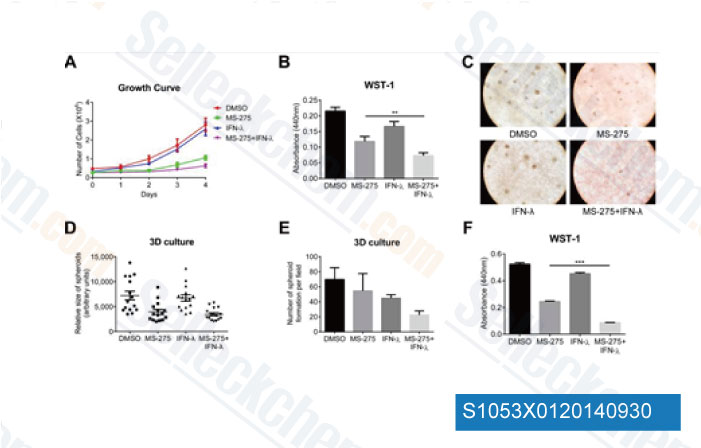
-
Datos de [ PLoS Biol , 2014 , 12, e1001758 ]
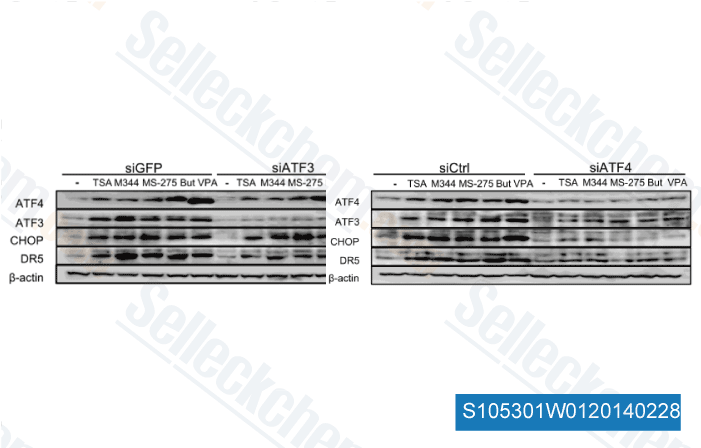
-
Datos de [ Biochem Biophys Res Commun , 2014 , 10.1016/j.bbrc.2014.01.184 ]
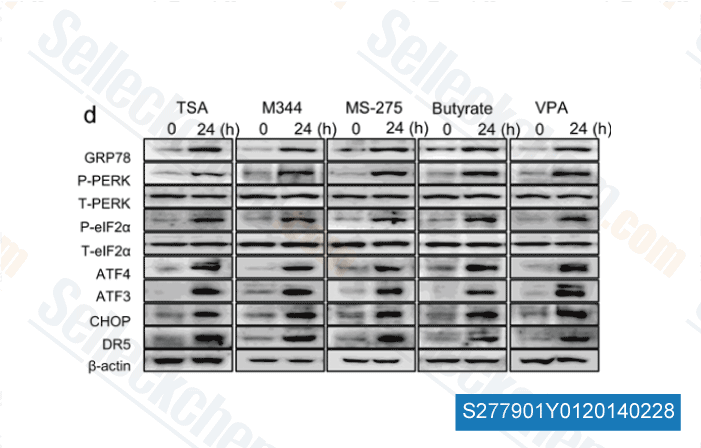
-
Datos de [ Biochem Biophys Res Commun , 2014 , 10.1016/j.bbrc.2014.01.184 ]
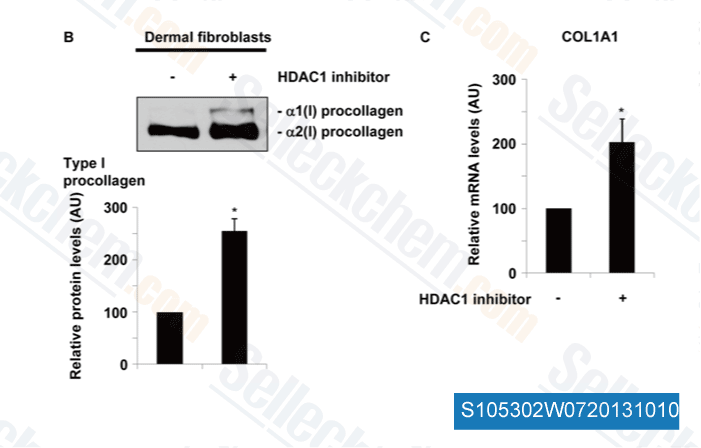
-
Datos de [ PLoS One , 2013 , 8, e74930 ]
Sellecks Entinostat (MS-275) Ha sido citado por 437 Publicaciones
| Reprogramming aerobic metabolism mitigates Streptococcus pyogenes tissue damage in a mouse necrotizing skin infection model [ Nat Commun, 2025, 16(1):2559] | PubMed: 40089471 |
| PROX1 is an early driver of lineage plasticity in prostate cancer [ J Clin Invest, 2025, 135(11)e187490] | PubMed: 40454483 |
| Early growth response 1 as a key regulator of PD-L1 expression and immune evasion in extranodal NK/T-cell lymphoma [ Blood Cancer J, 2025, 15(1):108] | PubMed: 40514360 |
| HDAC1 acts as a tumor suppressor in ALK-positive anaplastic large cell lymphoma: implications for HDAC inhibitor therapy [ Leukemia, 2025, 10.1038/s41375-025-02584-9] | PubMed: 40175628 |
| Stochastic demethylation and redundant epigenetic suppressive mechanisms generate highly heterogeneous responses to pharmacological DNA methyltransferase inhibition [ J Exp Clin Cancer Res, 2025, 44(1):21] | PubMed: 39844304 |
| Dual targeting of CDK6 and LSD1 is synergistic and overcomes differentiation blockade in AML [ EMBO Mol Med, 2025, 10.1038/s44321-025-00296-2] | PubMed: 40883610 |
| Engineering a multilayered 3D stromal barrier model for quantitative analysis of T cell infiltration and cytotoxicity [ Acta Biomater, 2025, S1742-7061(25)00677-4] | PubMed: 40939760 |
| Epigenomic regulation of stemness contributes to the low immunogenicity of the most mutated human cancer [ Cell Rep, 2025, S2211-1247(25)00332-8] | PubMed: 40250424 |
| Pharmacologically induced proteolysis of histone deacetylase-6 attenuates influenza virus replication despite limited anti-tumor effects [ Life Sci, 2025, 363:123401] | PubMed: 39814129 |
| HDAC1-3 inhibition triggers NEDD4-mediated CCR2 downregulation and attenuates immunosuppression in myeloid-derived suppressor cells [ Cancer Immunol Immunother, 2025, 74(3):81] | PubMed: 39891718 |
POLÍTICA DE DEVOLUCIÓN
La Política de Devolución Incondicional de Selleck Chemical garantiza una experiencia de compra en línea fluida para nuestros clientes. Si no está satisfecho con su compra de alguna manera, puede devolver cualquier artículo(s) dentro de los 7 días posteriores a su recepción. En caso de problemas de calidad del producto, ya sean problemas relacionados con el protocolo o con el producto, puede devolver cualquier artículo(s) dentro de los 365 días a partir de la fecha de compra original. Siga las instrucciones a continuación al devolver productos.
ENVÍO Y ALMACENAMIENTO
Los productos Selleck se transportan a temperatura ambiente. Si recibe el producto a temperatura ambiente, tenga la seguridad de que el Departamento de Inspección de Calidad de Selleck ha realizado experimentos para verificar que la colocación a temperatura normal durante un mes no afectará la actividad biológica de los productos en polvo. Después de la recogida, guarde el producto de acuerdo con los requisitos descritos en la hoja de datos. La mayoría de los productos Selleck son estables en las condiciones recomendadas.
NO PARA USO HUMANO, DIAGNÓSTICO VETERINARIO O TERAPÉUTICO.