
Datos técnicos
| Fórmula | C34H33N3O5 |
||||||
| Peso molecular | 563.64 | Número CAS | 143664-11-3 | ||||
| Solubilidad (25°C)* | In vitro | DMSO | 100 mg/mL (177.41 mM) | ||||
| Water | Insoluble | ||||||
| Ethanol | Insoluble | ||||||
| In vivo (Agregue los solventes al producto individualmente y en orden.) |
|
||||||
|
* <1 mg/ml significa ligeramente soluble o insoluble. * Tenga en cuenta que Selleck prueba la solubilidad de todos los compuestos internamente, y la solubilidad real puede diferir ligeramente de los valores publicados. Esto es normal y se debe a ligeras variaciones entre lotes. * Envío a temperatura ambiente (Las pruebas de estabilidad demuestran que este producto se puede enviar sin medidas de refrigeración.) |
|||||||
Preparación de soluciones madre
Actividad biológica
| Descripción | Elacridar (GF120918, GW120918, GG918, GW0918) es un potente inhibidor de P-gp (MDR-1) y BCRP. | ||
|---|---|---|---|
| Objetivos |
|
||
| In vitro | Elacridar (GF120918) inhibe el marcaje de P-glicoproteína (P-gp) por [3H]azidopina con una IC50 de 0,16 μM. En células Caki-1 y ACHN, (2,5 μM) inhibe significativamente el crecimiento celular. Se ha encontrado que la actividad de la P-glicoproteína es inhibida por este compuesto. Su combinación lleva a una reducción significativa en la expresión de ABC Sub-family B Member 2 (ABCG2) en células 786-O. |
||
| In vivo | Elacridar (GF120918) aumenta las concentraciones plasmáticas y cerebrales y las relaciones cerebro-plasma en ratones de tipo salvaje cuando se coadministra por vía oral (100 mg/kg, p.o.), igualando los niveles en ratones Abcb1a/1b; Abcg2-/-. En ratones de la cepa B del virus de la leucemia de Friend, el coeficiente de reparto cerebro-plasma (Kp, cerebro) de este compuesto es de 0,82, 0,43 y 4,31 después del tratamiento intravenoso (2,5 mg/kg), intraperitoneal (100 mg/kg) y oral (100 mg/kg), respectivamente. En ratones Mrp4(-/-), inhibe completamente el transporte mediado por P-gp, sin efectos significativos sobre el transporte mediado por Bcrp1. |
Protocolo (de referencia)
| Ensayo de quinasa: |
|
|---|---|
| Ensayo celular: |
|
| Estudio en animales: |
|
Referencias
|
Validación de productos por parte del cliente
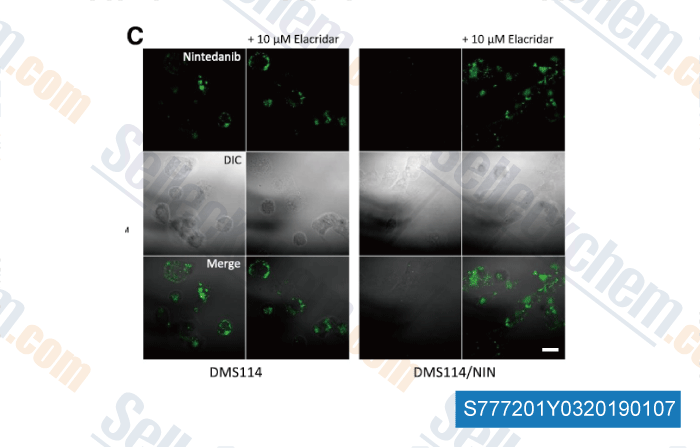
-
Datos de [ , , J Exp Clin Cancer Res, 2017, 36(1):122 ]
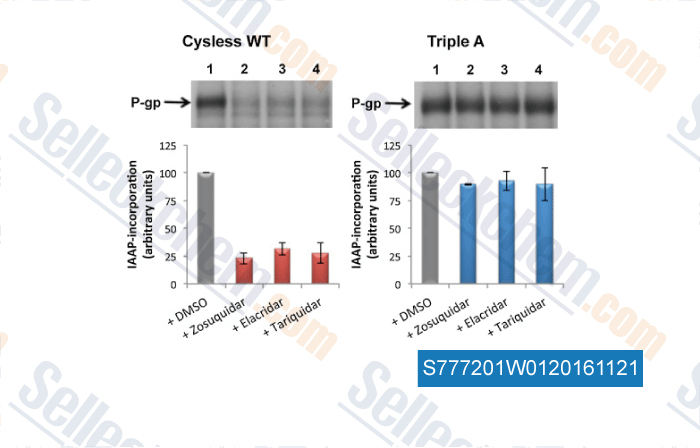
-
Datos de [ , , Biochem Pharmacol, 2016, 101:40-53. ]
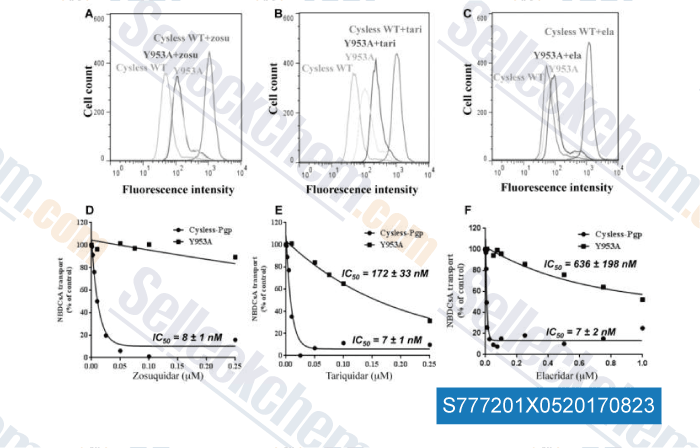
-
Datos de [ , , Biochem Pharmacol, 2016, 101:40-53 ]
Sellecks Elacridar (GF120918) Ha sido citado por 30 Publicaciones
| Identification of the Notch ligand DLK1 as an immunotherapeutic target and regulator of tumor cell plasticity and chemoresistance in adrenocortical carcinoma [ Nat Commun, 2025, 16(1):5511] | PubMed: 40595495 |
| Screening a living biobank identifies cabazitaxel as a strategy to combat acquired taxol resistance in high-grade serous ovarian cancer [ Cell Rep Med, 2025, 6(6):102160] | PubMed: 40466638 |
| Synthesis of carbon dots from spent coffee grounds: transforming waste into potential biomedical tools [ Nanoscale, 2025, 17(16):9947-9962] | PubMed: 40067158 |
| Nbeal2 Inactivation Triggers Abl1 Stabilisation and Dysregulated Subcellular Localisation of the Multi-Drug-Resistant Protein MDR1 (ABCB1) in Mast Cells [ Immunology, 2025, NONE] | PubMed: 41111259 |
| Targeting SUMOylation in ovarian cancer: Sensitivity, resistance, and the role of MYC [ iScience, 2025, 28(6):112555] | PubMed: 40487451 |
| Elacridar Inhibits BCRP Protein Activity in 2D and 3D Cell Culture Models of Ovarian Cancer and Re-Sensitizes Cells to Cytotoxic Drugs [ Int J Mol Sci, 2025, 26(12)5800] | PubMed: 40565261 |
| The Role of Elacridar, a P-gp Inhibitor, in the Re-Sensitization of PAC-Resistant Ovarian Cancer Cell Lines to Cytotoxic Drugs in 2D and 3D Cell Culture Models [ Int J Mol Sci, 2025, 26(3)1124] | PubMed: 39940891 |
| Overcoming ABCB1 mediated multidrug resistance in castration resistant prostate cancer [ Cell Death Dis, 2024, 15(8):558] | PubMed: 39090086 |
| Targeting the glutamine metabolism to suppress cell proliferation in mesenchymal docetaxel-resistant prostate cancer [ Oncogene, 2024, 43(26):2038-2050] | PubMed: 38750263 |
| Abcg2a is the functional homolog of human ABCG2 expressed at the zebrafish blood-brain barrier [ Fluids Barriers CNS, 2024, 21(1):27] | PubMed: 38491505 |
POLÍTICA DE DEVOLUCIÓN
La Política de Devolución Incondicional de Selleck Chemical garantiza una experiencia de compra en línea fluida para nuestros clientes. Si no está satisfecho con su compra de alguna manera, puede devolver cualquier artículo(s) dentro de los 7 días posteriores a su recepción. En caso de problemas de calidad del producto, ya sean problemas relacionados con el protocolo o con el producto, puede devolver cualquier artículo(s) dentro de los 365 días a partir de la fecha de compra original. Siga las instrucciones a continuación al devolver productos.
ENVÍO Y ALMACENAMIENTO
Los productos Selleck se transportan a temperatura ambiente. Si recibe el producto a temperatura ambiente, tenga la seguridad de que el Departamento de Inspección de Calidad de Selleck ha realizado experimentos para verificar que la colocación a temperatura normal durante un mes no afectará la actividad biológica de los productos en polvo. Después de la recogida, guarde el producto de acuerdo con los requisitos descritos en la hoja de datos. La mayoría de los productos Selleck son estables en las condiciones recomendadas.
NO PARA USO HUMANO, DIAGNÓSTICO VETERINARIO O TERAPÉUTICO.