
Datos técnicos
| Fórmula | C25H29Cl2F3N2O4S |
||||||
| Peso molecular | 581.47 | Número CAS | 754240-09-0 | ||||
| Solubilidad (25°C)* | In vitro | DMSO | 100 mg/mL (171.97 mM) | ||||
| Water | 100 mg/mL (171.97 mM) | ||||||
| Ethanol | Insoluble | ||||||
| In vivo (Agregue los solventes al producto individualmente y en orden.) |
|
||||||
|
* <1 mg/ml significa ligeramente soluble o insoluble. * Tenga en cuenta que Selleck prueba la solubilidad de todos los compuestos internamente, y la solubilidad real puede diferir ligeramente de los valores publicados. Esto es normal y se debe a ligeras variaciones entre lotes. * Envío a temperatura ambiente (Las pruebas de estabilidad demuestran que este producto se puede enviar sin medidas de refrigeración.) |
|||||||
Preparación de soluciones madre
Actividad biológica
| Descripción | EHT 1864 2HCl es un potente inhibidor de la Rac family GTPase con Kd de 40 nM, 50 nM, 60 nM y 250 nM para Rac1, Rac1b, Rac2 y Rac3, respectivamente. | ||||||||
|---|---|---|---|---|---|---|---|---|---|
| Objetivos |
|
||||||||
| In vitro | EHT 1864 inhibe selectivamente la formación de lamelipodios inducida por Rac, y revierte específicamente la transformación celular inducida por mutantes constitutivamente activadas de Rac1 y Tiam1. EHT 1864 deteriora fuertemente la proliferación celular inducida por Ras oncogénico en células NIH 3T3 que expresan de forma estable la proteína H-Ras(61L). EHT 1864 también reduce los niveles extracelulares e intracelulares de péptidos Aβ al inhibir la escisión de APP dependiente de γ-secretasa. En neuronas piramidales del hipocampo cultivadas, EHT 1864, a través de la inhibición de Rac1, rescata el fenotipo inducido por la eliminación de Rich2. | ||||||||
| In vivo | EHT 1864 (40 mg/kg i.p.) reduce significativamente los niveles de Abeta 40 y Abeta 42 en cerebros de cobayas. |
Protocolo (de referencia)
| Ensayo de quinasa:[1] |
|
|---|---|
| Ensayo celular:[1] |
|
| Estudio en animales:[2] |
|
Referencias
|
Validación de productos por parte del cliente
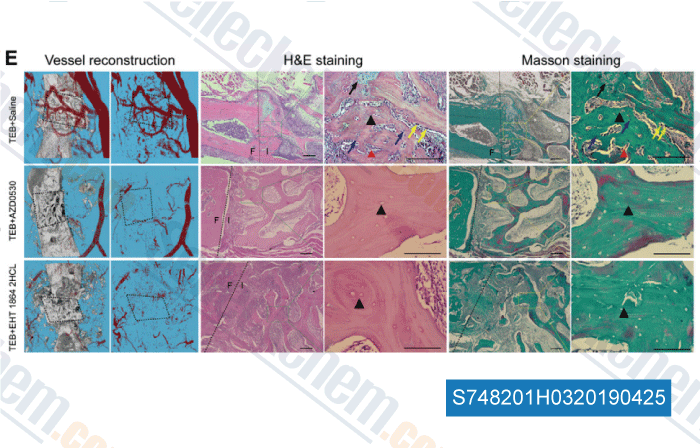
-
Datos de [ , , FASEB J, 2018, 32(4):2197-2211 ]

-
Datos de [ , , Am J Cancer Res, 2018, 8(1):70-80 ]
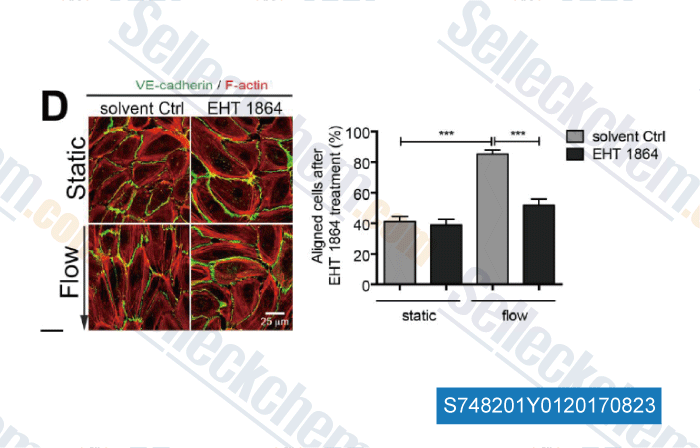
-
Datos de [ , , Mol Biol Cell, 2017, 28(13):1745-1753 ]
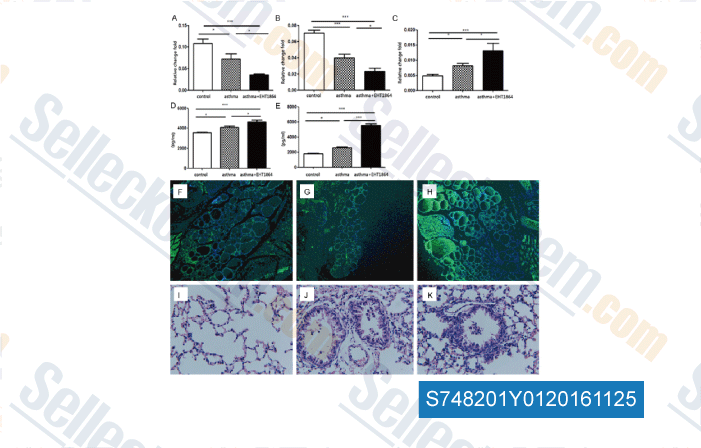
-
Datos de [ , , Int J Clin Exp Pathol, 2016, 9(6):5902-5911. ]
Sellecks EHT 1864 2HCl Ha sido citado por 26 Publicaciones
| PI(3,4,5)P3-mediated Cdc42 activation regulates macrophage podosome assembly [ Cell Mol Life Sci, 2025, 82(1):127] | PubMed: 40126693 |
| Hyperlipidemia drives tumor growth in a mouse model of obesity-accelerated breast cancer growth [ Cancer Metab, 2025, 13(1):39] | PubMed: 40877972 |
| Formation control between leader and migratory follower tissues allows coordinated growth [ Sci Adv, 2025, 11(31):eads2310] | PubMed: 40737421 |
| Gadd45g insufficiency drives the pathogenesis of myeloproliferative neoplasms [ Nat Commun, 2024, 15(1):2989] | PubMed: 38582902 |
| Oct4 controls basement membrane development during human embryogenesis [ Dev Cell, 2024, S1534-5807(24)00175-8] | PubMed: 38579716 |
| RAC1 inhibition ameliorates IBSP-induced bone metastasis in lung adenocarcinoma [ Cell Rep, 2024, 43(8):114528] | PubMed: 39052477 |
| Allometrically scaling tissue forces drive pathological foreign-body responses to implants via Rac2-activated myeloid cells [ Nat Biomed Eng, 2023, 10.1038/s41551-023-01091-5] | PubMed: 37749310 |
| The PMA phorbol ester tumor promoter increases canonical Wnt signaling via macropinocytosis [ Elife, 2023, 12RP89141] | PubMed: 37902809 |
| High-Content and High-Throughput Clonogenic Survival Assay Using Fluorescence Barcoding [ Cancers -Basel), 2023, 15(19)4772] | PubMed: 37835466 |
| Inhibition of exchange proteins directly activated by cAMP as a strategy for broad-spectrum antiviral development [ J Biol Chem, 2023, 299(6):104749] | PubMed: 37100284 |
POLÍTICA DE DEVOLUCIÓN
La Política de Devolución Incondicional de Selleck Chemical garantiza una experiencia de compra en línea fluida para nuestros clientes. Si no está satisfecho con su compra de alguna manera, puede devolver cualquier artículo(s) dentro de los 7 días posteriores a su recepción. En caso de problemas de calidad del producto, ya sean problemas relacionados con el protocolo o con el producto, puede devolver cualquier artículo(s) dentro de los 365 días a partir de la fecha de compra original. Siga las instrucciones a continuación al devolver productos.
ENVÍO Y ALMACENAMIENTO
Los productos Selleck se transportan a temperatura ambiente. Si recibe el producto a temperatura ambiente, tenga la seguridad de que el Departamento de Inspección de Calidad de Selleck ha realizado experimentos para verificar que la colocación a temperatura normal durante un mes no afectará la actividad biológica de los productos en polvo. Después de la recogida, guarde el producto de acuerdo con los requisitos descritos en la hoja de datos. La mayoría de los productos Selleck son estables en las condiciones recomendadas.
NO PARA USO HUMANO, DIAGNÓSTICO VETERINARIO O TERAPÉUTICO.