
Datos técnicos
| Fórmula | C21H22ClN3O3 |
||||||||||
| Peso molecular | 399.87 | Número CAS | 186392-40-5 | ||||||||
| Solubilidad (25°C)* | In vitro | DMSO | 80 mg/mL (200.06 mM) | ||||||||
| Water | Insoluble | ||||||||||
| Ethanol | Insoluble | ||||||||||
| In vivo (Agregue los solventes al producto individualmente y en orden.) |
|
||||||||||
|
* <1 mg/ml significa ligeramente soluble o insoluble. * Tenga en cuenta que Selleck prueba la solubilidad de todos los compuestos internamente, y la solubilidad real puede diferir ligeramente de los valores publicados. Esto es normal y se debe a ligeras variaciones entre lotes. * Envío a temperatura ambiente (Las pruebas de estabilidad demuestran que este producto se puede enviar sin medidas de refrigeración.) |
|||||||||||
Preparación de soluciones madre
Actividad biológica
| Descripción | CP-91149 es un inhibidor selectivo de la glucógeno fosforilasa (GP) con una IC50 de 0,13 μM en presencia de glucosa, 5 a 10 veces menos potente en ausencia de glucosa. | ||
|---|---|---|---|
| Objetivos |
|
||
| In vitro | CP-91149 displays 200-fold higher inhibitory activity against human liver glycogen phosphorylase a (HLGPa) than caffeine (IC50 = 26 μM). This compound (10-100 μM) inhibits -stimulated glycogenolysis in isolated rat hepatocytes in a dose-dependent manner, and in primary human hepatocytes with IC50 of ~2.1 μM. It also potently inhibits the activities of human muscle phosphorylase a and b with IC50 of 0.2 μM and ~0.3 μM, respectively. Treatment with this chemical at 2.5 μM induces inactivation of phosphorylase and sequential activation of glycogen synthase in hepatocytes, and increases glycogen synthesis by 7-fold at 5 mM glucose and by 2-fold at 20 mM glucose. It can partially counteract the effects of phosphorylase overexpression. This compound also potently inhibits brain GP with IC50 of 0.5 μM in A549 cells. Treatment at 10-30 μM causes significant glycogen accumulation in A549 and HSF55 cells. It treatment increases G1-phase cells with a significant reduction of the S-phase population in HSF55 cells, correlated with increased expression of p21 and p27. This chemical also promotes the dephosphorylation and activation of GS (glycogen synthase) in non-engineered or GP-overexpressing cultured human muscle cells, but exclusively in glucose-deprived cells. |
||
| In vivo | Oral administration of CP-91149 to diabetic ob/ob mice at 25-50 mg/kg causes rapid (3 hours) glucose lowering by 100-120 mg/dl without producing hypoglycemia, resulting from inhibition of glycogenolysis in vivo. This compound treatment does not lower glucose levels in normoglycemic, nondiabetic mice. In the non-fasted Goto-Kakizaki (GK) rats, administration of this chemical in combination with CS-917 suppresses hepatic glycogen reduction by CS-917 and decreases plasma glucose more than single administration of CS-917. |
Protocolo (de referencia)
| Ensayo de quinasa: |
|
|---|---|
| Ensayo celular: |
|
| Estudio en animales: |
|
Referencias
|
Validación de productos por parte del cliente
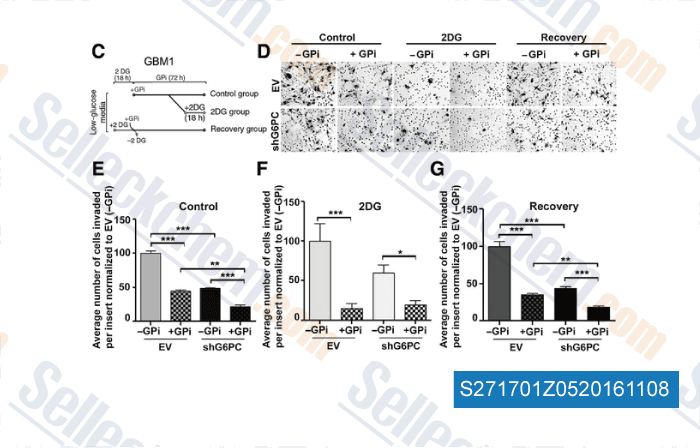
-
, , Mol Cancer Res, 2014, 12(11):1547-59.
Selleck's CP-91149 Ha sido citado por 14 Publicaciones
| Glycogen Metabolism Supports Early Glycolytic Reprogramming and Activation in Dendritic Cells in Response to Both TLR and Syk-Dependent CLR Agonists [ Cells, March 14, 2020, 715] | PubMed: 32183271 |
| Lactate production is a prioritized feature of adipocyte metabolism [ Journal of Biological Chemistry, January 3, 2020, 83-98] | PubMed: 31690627 |
| Regulation of stress granule formation in human oligodendrocytes [ Nat Commun, 2024, 15(1):1524] | PubMed: 38374028 |
| Glycogenesis and glyconeogenesis from glutamine, lactate and glycerol support human macrophage functions [ EMBO Rep, 2024, 10.1038/s44319-024-00278-4] | PubMed: 39424955 |
| Mutant IDH regulates glycogen metabolism from early cartilage development to malignant chondrosarcoma formation [ Cell Rep, 2023, 42(6):112578] | PubMed: 37267108 |
| Glycogen phosphorylase inhibition alongside taxol chemotherapy synergistically elicits ferroptotic cell death in clear cell ovarian and kidney cancers [ bioRxiv, 2023, 10.1101/2023.05.01.538916] | PubMed: None |
| Intracellular energy controls dynamics of stress-induced ribonucleoprotein granules [ Nat Commun, 2022, 13(1):5584] | PubMed: 36151083 |
| TCR activation directly stimulates PYGB-dependent glycogenolysis to fuel the early recall response in CD8+ memory T cells [ Mol Cell, 2022, S1097-2765(22)00538-X] | PubMed: 35738262 |
| A genome-wide CRISPR-Cas9 screen identifies CENPJ as a host regulator of altered microtubule organization during Plasmodium liver infection [ Cell Chem Biol, 2022, S2451-9456(22)00205-7] | PubMed: 35738280 |
| Analysis of the expression, function and signaling of glycogen phosphorylase isoforms in hepatocellular carcinoma [ Oncol Lett, 2022, 24(2):244] | PubMed: 35761940 |
POLÍTICA DE DEVOLUCIÓN
La Política de Devolución Incondicional de Selleck Chemical garantiza una experiencia de compra en línea fluida para nuestros clientes. Si no está satisfecho con su compra de alguna manera, puede devolver cualquier artículo(s) dentro de los 7 días posteriores a su recepción. En caso de problemas de calidad del producto, ya sean problemas relacionados con el protocolo o con el producto, puede devolver cualquier artículo(s) dentro de los 365 días a partir de la fecha de compra original. Siga las instrucciones a continuación al devolver productos.
ENVÍO Y ALMACENAMIENTO
Los productos Selleck se transportan a temperatura ambiente. Si recibe el producto a temperatura ambiente, tenga la seguridad de que el Departamento de Inspección de Calidad de Selleck ha realizado experimentos para verificar que la colocación a temperatura normal durante un mes no afectará la actividad biológica de los productos en polvo. Después de la recogida, guarde el producto de acuerdo con los requisitos descritos en la hoja de datos. La mayoría de los productos Selleck son estables en las condiciones recomendadas.
NO PARA USO HUMANO, DIAGNÓSTICO VETERINARIO O TERAPÉUTICO.