
Datos técnicos
| Fórmula | C24H27N5O2 |
||||||||||
| Peso molecular | 417.5 | Número CAS | 343787-29-1 | ||||||||
| Solubilidad (25°C)* | In vitro | DMSO | 6 mg/mL (14.37 mM) | ||||||||
| Water | Insoluble | ||||||||||
| Ethanol | Insoluble | ||||||||||
| In vivo (Agregue los solventes al producto individualmente y en orden.) |
|
||||||||||
|
* <1 mg/ml significa ligeramente soluble o insoluble. * Tenga en cuenta que Selleck prueba la solubilidad de todos los compuestos internamente, y la solubilidad real puede diferir ligeramente de los valores publicados. Esto es normal y se debe a ligeras variaciones entre lotes. * Envío a temperatura ambiente (Las pruebas de estabilidad demuestran que este producto se puede enviar sin medidas de refrigeración.) |
|||||||||||
Preparación de soluciones madre
Actividad biológica
| Descripción | CP-673451 es un inhibidor selectivo de PDGFRα/β con una IC50 de 10 nM/1 nM en ensayos sin células, exhibe una selectividad >450 veces mayor sobre otros receptores angiogénicos y tiene actividad antiangiogénica y antitumoral. | ||||
|---|---|---|---|---|---|
| Objetivos |
|
||||
| In vitro | CP 673451 es un inhibidor selectivo de PDGFRα/β con una IC50 de 10 nM/1 nM, exhibe una selectividad >450 veces mayor sobre otros receptores angiogénicos. En tumores de glioblastoma, este compuesto (33 mg/kg) proporciona una inhibición >50% del receptor PDGFR-β durante 4 horas, lo que corresponde a una EC50 de 120 ng/mL en plasma al Cmax. En un modelo de angiogénesis con esponja, este inhibidor inhibe el 70% de la angiogénesis estimulada por PDGF-BB a una dosis de 3 mg/kg (q.d. ×5, p.o., lo que corresponde a 5,5 ng/mL al Cmax). Este químico disminuye la tasa de proliferación celular a través de mecanismos que implican la reducción de la fosforilación de GSK-3α y GSK-3β. Tanto en cultivos RD como RUCH2, perjudica la capacidad de formación de rabdoesferas y la diferenciación celular, y provoca un aumento de la senescencia. |
||||
| In vivo | CP 673451 (administración p.o. una vez al día ?0 días de forma rutinaria) inhibe el crecimiento tumoral (ED50 < 33 mg/kg) en varios xenoinjertos tumorales humanos cultivados s.c. en ratones atímicos, incluyendo el carcinoma pulmonar humano H460, los carcinomas de colon humano Colo205 y LS174T, y el glioblastoma multiforme humano U87MG. En ratones portadores de xenoinjertos RUCH2, este compuesto reduce el crecimiento tumoral y la infiltración de células estromales. |
Protocolo (de referencia)
| Ensayo de quinasa: |
|
|---|---|
| Ensayo celular: |
|
| Estudio en animales: |
|
Referencias
|
Validación de productos por parte del cliente
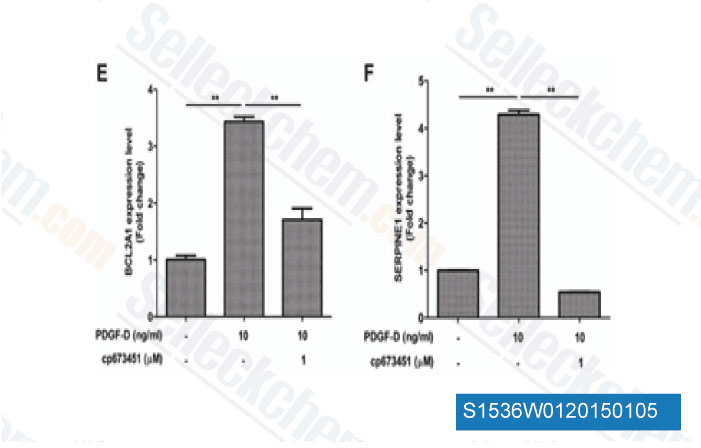
-
Datos de [ Stem Cells , 2014 , 10.1002/stem.1865 ]
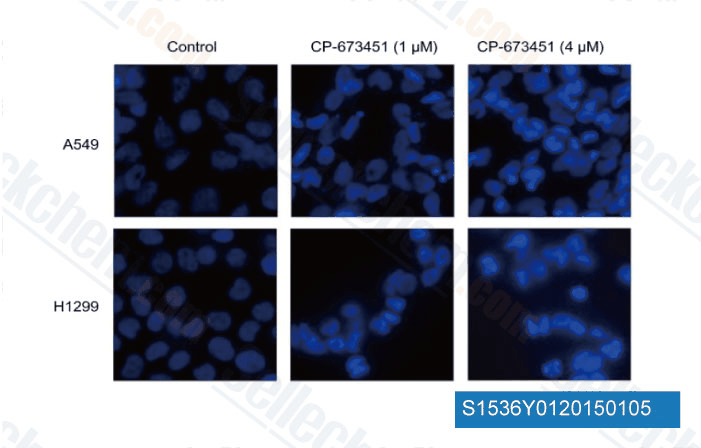
-
Datos de [ Onco Targets Ther , 2014 , 7, 1215-21 ]
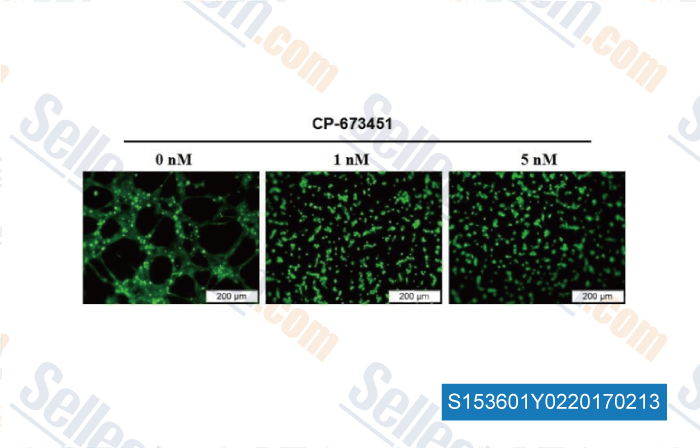
-
Datos de [ , , Environ Toxicol Pharmacol, 2016, 46:168-73. ]
Sellecks CP-673451 Ha sido citado por 36 Publicaciones
| Derivation of embryonic stem cells across avian species [ Nat Biotechnol, 2025, 10.1038/s41587-025-02833-3] | PubMed: 41028831 |
| Tumorigenesis Driven by BRAFV600E Requires Secondary Mutations that Overcome it's Feedback Inhibition of RAC1 and Migration [ Cancer Res, 2025, 10.1158/0008-5472.CAN-24-2220] | PubMed: 39992718 |
| Targeting PDGF signaling of cancer-associated fibroblasts blocks feedback activation of HIF-1α and tumor progression of clear cell ovarian cancer [ Cell Rep Med, 2024, S2666-3791(24)00201-5] | PubMed: 38670097 |
| Combined inhibition of CDK4/6 and AKT is highly effective against the luminal androgen receptor (LAR) subtype of triple negative breast cancer [ Cancer Lett, 2024, 604:217219] | PubMed: 39244005 |
| Exploring the effects of moxibustion on cognitive function in rats with multiple cerebral infarctions from the perspective of glial vascular unit repairing [ Front Pharmacol, 2024, 15:1428907] | PubMed: 39508044 |
| Tumorigenesis driven by the BRAFV600E oncoprotein requires secondary mutations that overcome its feedback inhibition of migration and invasion [ bioRxiv, 2024, 2023.11.21.568071] | PubMed: 38659913 |
| Pericytes protect rats and mice from sepsis-induced injuries by maintaining vascular reactivity and barrier function: implication of miRNAs and microvesicles [ Mil Med Res, 2023, 10(1):13] | PubMed: 36907884 |
| CP-673451, a Selective Platelet-Derived Growth Factor Receptor Tyrosine Kinase Inhibitor, Induces Apoptosis in Opisthorchis viverrini-Associated Cholangiocarcinoma via Nrf2 Suppression and Enhanced ROS [ Pharmaceuticals (Basel), 2023, 17(1)9] | PubMed: 38275995 |
| MiR-3529-3p from PDGF-BB-induced cancer-associated fibroblast-derived exosomes promotes the malignancy of oral squamous cell carcinoma [ Discov Oncol, 2023, 14(1):166] | PubMed: 37668846 |
| Microglia-derived PDGFB promotes neuronal potassium currents to suppress basal sympathetic tonicity and limit hypertension [ Immunity, 2022, S1074-7613(22)00291-6] | PubMed: 35863346 |
POLÍTICA DE DEVOLUCIÓN
La Política de Devolución Incondicional de Selleck Chemical garantiza una experiencia de compra en línea fluida para nuestros clientes. Si no está satisfecho con su compra de alguna manera, puede devolver cualquier artículo(s) dentro de los 7 días posteriores a su recepción. En caso de problemas de calidad del producto, ya sean problemas relacionados con el protocolo o con el producto, puede devolver cualquier artículo(s) dentro de los 365 días a partir de la fecha de compra original. Siga las instrucciones a continuación al devolver productos.
ENVÍO Y ALMACENAMIENTO
Los productos Selleck se transportan a temperatura ambiente. Si recibe el producto a temperatura ambiente, tenga la seguridad de que el Departamento de Inspección de Calidad de Selleck ha realizado experimentos para verificar que la colocación a temperatura normal durante un mes no afectará la actividad biológica de los productos en polvo. Después de la recogida, guarde el producto de acuerdo con los requisitos descritos en la hoja de datos. La mayoría de los productos Selleck son estables en las condiciones recomendadas.
NO PARA USO HUMANO, DIAGNÓSTICO VETERINARIO O TERAPÉUTICO.