
Datos técnicos
| Fórmula | C23H22ClN5O |
|||
| Peso molecular | 419.91 | Número CAS | 405168-58-3 | |
| Solubilidad (25°C)* | In vitro | DMSO | Insoluble | |
| Water | Insoluble | |||
| Ethanol | Insoluble | |||
|
* <1 mg/ml significa ligeramente soluble o insoluble. * Tenga en cuenta que Selleck prueba la solubilidad de todos los compuestos internamente, y la solubilidad real puede diferir ligeramente de los valores publicados. Esto es normal y se debe a ligeras variaciones entre lotes. * Envío a temperatura ambiente (Las pruebas de estabilidad demuestran que este producto se puede enviar sin medidas de refrigeración.) |
||||
Preparación de soluciones madre
Actividad biológica
| Descripción | CHIR-124 es un nuevo y potente inhibidor de Chk1 con una IC50 de 0,3 nM en un ensayo sin células. Muestra una selectividad 2.000 veces mayor contra Chk2 y una actividad entre 500 y 5.000 veces menor contra CDK2/4 y Cdc2. | ||||||||
|---|---|---|---|---|---|---|---|---|---|
| Objetivos |
|
||||||||
| In vitro | CHIR-124 es una pequeña molécula basada en quinolonas que no está estructuralmente relacionada con otros inhibidores conocidos de Chk1. Este compuesto interactúa sinérgicamente con venenos de topoisomerasa (por ejemplo, Camptotecina o SN-38) causando la inhibición del crecimiento en una variedad de líneas celulares cancerosas, incluyendo el carcinoma de mama (MDA-MB-231 y MDA-MB-435) y el carcinoma de colon (SW-620 y Colo205), todas las cuales contienen el gen p53 mutante. Abroga los Cell Cycle Checkpoints S y G2-M inducidos por SN-38 y potencia la apoptosis en células de cáncer de mama MDA-MD-435. La abrogación del Cell Cycle Checkpoint G2-M y la inducción de apoptosis por este químico se potencian con la pérdida de p53. Este compuesto también se dirige potentemente a otras quinasas como PDGFR y Flt3 con IC50 de 6,6 nM y 5,8 nM, respectivamente. |
||||||||
| In vivo | CHIR-124 potencia los efectos inhibidores del crecimiento al abolir el Cell Cycle Checkpoint G2-M y aumentar la apoptosis tumoral en un modelo de xenoinjerto ortotópico de cáncer de mama. |
Protocolo (de referencia)
| Ensayo de quinasa: |
|
|---|---|
| Ensayo celular: |
|
| Estudio en animales: |
|
Referencias
|
Validación de productos por parte del cliente
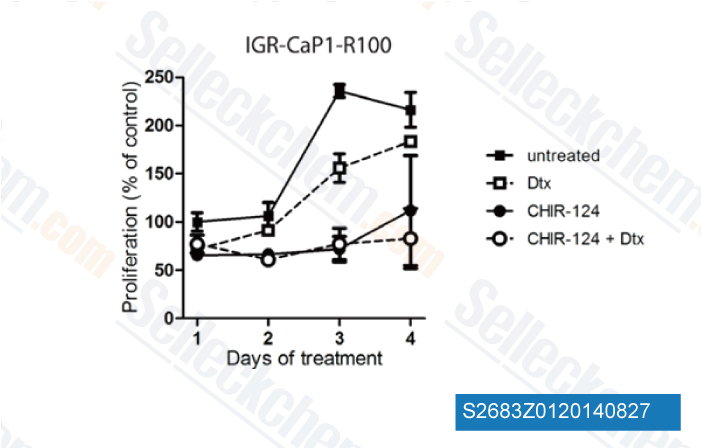
-
Datos de [ Oncotarget , 2014 , 5(3), 667-78 ]
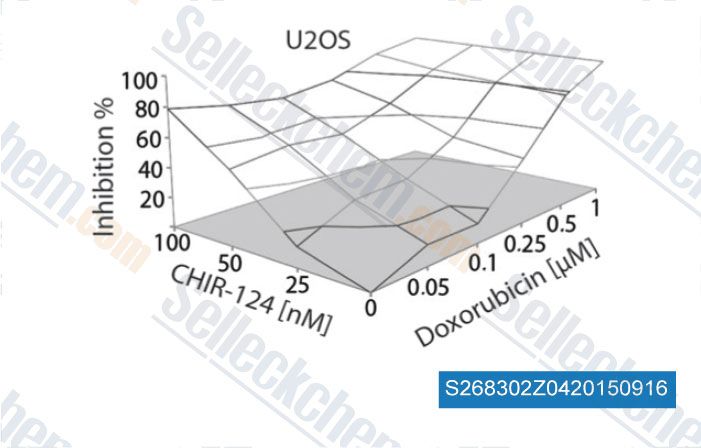
-
Datos de [ , , J Pathol, 2015, 236: 348-359 ]
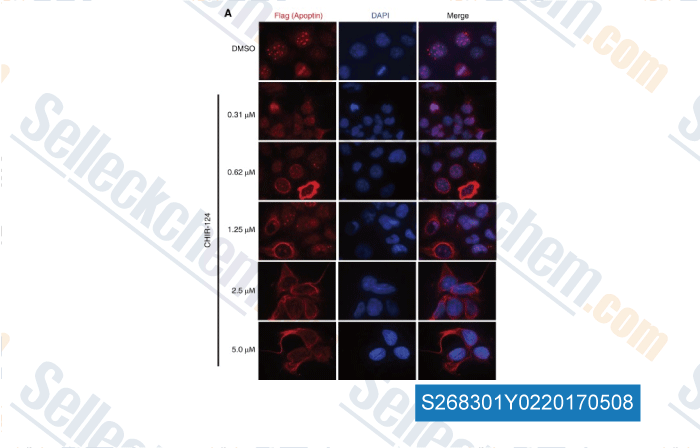
-
Datos de [ , , J Virol, 2016, 90(20):9433-45 ]
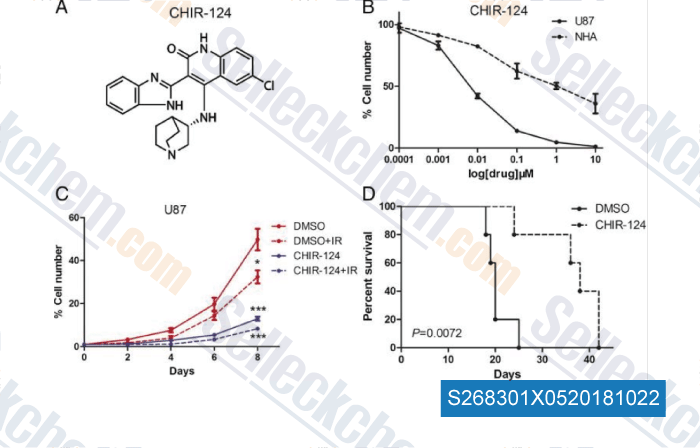
-
Datos de [ , , Transl Oncol, 2018, 11(1):140-146 ]
Sellecks CHIR-124 Ha sido citado por 47 Publicaciones
| A patient-derived T cell lymphoma biorepository uncovers pathogenetic mechanisms and host-related therapeutic vulnerabilities [ Cell Rep Med, 2025, S2666-3791(25)00102-8] | PubMed: 40147445 |
| The mitotic ATR-Chk1 pathway promotes CDK1 activity for faithful chromosome segregation [ Cell Rep, 2025, 44(8):116019] | PubMed: 40705605 |
| Enhancing transcription-replication conflict targets ecDNA-positive cancers [ Nature, 2024, 635(8037):210-218] | PubMed: 39506153 |
| The MYCN oncoprotein is an RNA-binding accessory factor of the nuclear exosome targeting complex [ Mol Cell, 2024, S1097-2765(24)00285-5] | PubMed: 38703770 |
| Replicative senescence is ATM driven, reversible, and accelerated by hyperactivation of ATM at normoxia [ bioRxiv, 2024, 2024.06.24.600514] | PubMed: 38979390 |
| p53-independent tumor suppression by cell-cycle arrest via CREB/ATF transcription factor OASIS [ Cell Rep, 2023, S2211-1247(23)00490-4] | PubMed: 37178686 |
| The MRN complex maintains the biliary-derived hepatocytes in liver regeneration through ATR-Chk1 pathway [ NPJ Regen Med, 2023, 8(1):20] | PubMed: 37024481 |
| The MRN complex maintains the biliary-derived hepatocytes in liver regeneration through ATR-Chk1 pathway [ npj Regenerative Medicine, 2023, 20-2023)] | PubMed: None |
| Alternative Lengthening of Telomeres in Pediatric High-Grade Glioma and Therapeutic Implications [ Cancers (Basel), 2023, 15(12)3070] | PubMed: 37370681 |
| The Autonomous Parvovirus Minute Virus of Mice Localizes to Cellular Sites of DNA Damage Using ATR Signaling [ Viruses, 2023, 15(6)1243] | PubMed: 37376543 |
POLÍTICA DE DEVOLUCIÓN
La Política de Devolución Incondicional de Selleck Chemical garantiza una experiencia de compra en línea fluida para nuestros clientes. Si no está satisfecho con su compra de alguna manera, puede devolver cualquier artículo(s) dentro de los 7 días posteriores a su recepción. En caso de problemas de calidad del producto, ya sean problemas relacionados con el protocolo o con el producto, puede devolver cualquier artículo(s) dentro de los 365 días a partir de la fecha de compra original. Siga las instrucciones a continuación al devolver productos.
ENVÍO Y ALMACENAMIENTO
Los productos Selleck se transportan a temperatura ambiente. Si recibe el producto a temperatura ambiente, tenga la seguridad de que el Departamento de Inspección de Calidad de Selleck ha realizado experimentos para verificar que la colocación a temperatura normal durante un mes no afectará la actividad biológica de los productos en polvo. Después de la recogida, guarde el producto de acuerdo con los requisitos descritos en la hoja de datos. La mayoría de los productos Selleck son estables en las condiciones recomendadas.
NO PARA USO HUMANO, DIAGNÓSTICO VETERINARIO O TERAPÉUTICO.