
Datos técnicos
| Fórmula | C18H20ClN5 |
||||||||||
| Peso molecular | 341.84 | Número CAS | 885499-61-6 | ||||||||
| Solubilidad (25°C)* | In vitro | DMSO | 25 mg/mL (73.13 mM) | ||||||||
| Ethanol | 5 mg/mL (14.62 mM) | ||||||||||
| Water | Insoluble | ||||||||||
| In vivo (Agregue los solventes al producto individualmente y en orden.) |
|
||||||||||
|
* <1 mg/ml significa ligeramente soluble o insoluble. * Tenga en cuenta que Selleck prueba la solubilidad de todos los compuestos internamente, y la solubilidad real puede diferir ligeramente de los valores publicados. Esto es normal y se debe a ligeras variaciones entre lotes. * Envío a temperatura ambiente (Las pruebas de estabilidad demuestran que este producto se puede enviar sin medidas de refrigeración.) |
|||||||||||
Preparación de soluciones madre
Actividad biológica
| Descripción | CCT128930 es un inhibidor potente, ATP-competitivo y selectivo de Akt2 con un IC50 de 6 nM en un ensayo sin células, 28 veces mayor selectividad para Akt2 que la quinasa PKA estrechamente relacionada. Este compuesto induce la detención del ciclo celular, daño en el ADN y Autophagy independiente de la inhibición de Akt. Una dosis alta de este producto químico desencadena la Apoptosis celular en células HepG2. | ||||||
|---|---|---|---|---|---|---|---|
| Objetivos |
|
||||||
| In vitro | CCT128930 exhibe una marcada actividad antiproliferativa contra líneas celulares tumorales humanas deficientes en PTEN, incluyendo células de glioblastoma humano U87MG, células de cáncer de próstata humano LNCaP y células de cáncer de próstata humano PC3 con un GI50 de 6,3 μM, 0,35 μM y 1,9 μM, respectivamente. Además, este compuesto provoca una detención en G1 en células de glioblastoma humano U87MG nulas para PTEN y un bloqueo de la vía Akt. | ||||||
| In vivo | CCT128930 a 25 mg/kg i.p. muestra un marcado efecto antitumoral en xenoinjertos de glioblastoma humano U87MG nulos para PTEN establecidos con una relación tratado:control (T/C) del 48% el día 12. En xenoinjertos de cáncer de mama humano BT474 HER2-positivos y mutantes de PIK3CA, este compuesto a 40 mg/kg también produce un profundo efecto antitumoral con una detención completa del crecimiento y una relación T/C del 29% el día 22. Este producto químico administrado por vía i.v. alcanza una concentración máxima de 6,4 μM en plasma y se elimina con una vida media relativamente corta, un alto volumen de distribución y un aclaramiento rápido, lo que da un área bajo la curva AUC0-∞ de 4,6 μM·h. Administrado por vía i.p. conduce a una concentración plasmática máxima del fármaco de 1,3 μM y la AUC0-∞ correspondiente de 1,3 μM·h. La administración oral de este compuesto conduce a una concentración plasmática máxima de solo 0,43 μM y una AUC0-∞ correspondientemente baja de 0,4 μM·h. |
Protocolo (de referencia)
| Ensayo de quinasa:[1] |
|
|---|---|
| Ensayo celular:[1] |
|
| Estudio en animales:[1] |
|
Referencias
|
Validación de productos por parte del cliente
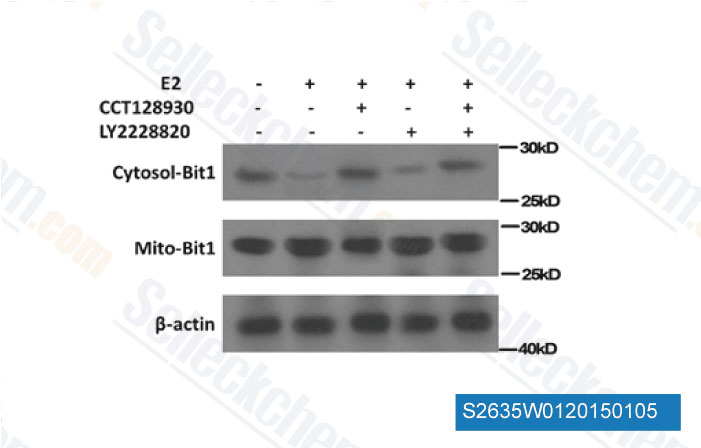
-
Datos de [ DNA Cell Biol , 2014 , 33(12), 847-53 ]
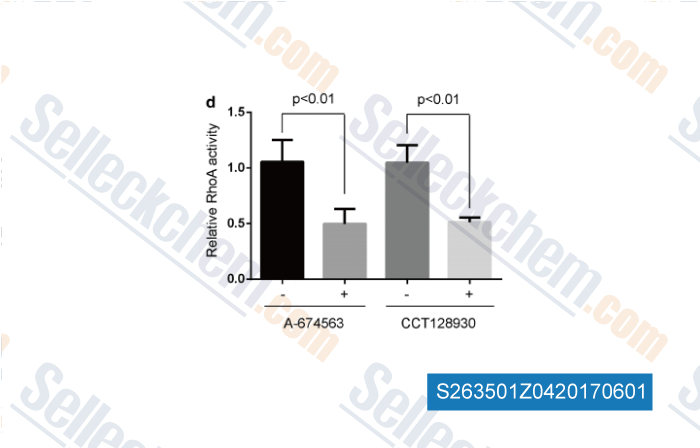
-
, , Cancer Cell Int, 2017, doi: 10.1186/s12935-017-0396-8
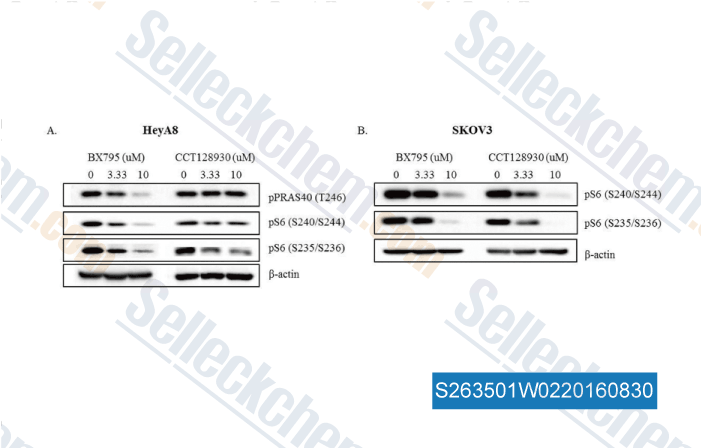
-
Datos de [ , , PLoS One, 2016, 11(5):e0155053. ]
Sellecks CCT128930 Ha sido citado por 34 Publicaciones
| Akt isoform specificity drives intrinsic immune regulation during HSV-1 infection [ Proc Natl Acad Sci U S A, 2025, 122(27):e2504962122] | PubMed: 40601626 |
| Loss of neurofibromin induces inflammatory macrophage phenotypic switch and retinal neovascularization via GLUT1 activation [ Cell Rep, 2025, 44(5):115625] | PubMed: 40279245 |
| The AKT2/SIRT5/TFEB pathway as a potential therapeutic target in non-neovascular AMD [ Nat Commun, 2024, 15(1):6150] | PubMed: 39034314 |
| Structural basis of selective TRPM7 inhibition by the anticancer agent CCT128930 [ Cell Rep, 2024, 43(4):114108] | PubMed: 38615321 |
| Methionine adenosyltransferase2A inhibition restores metabolism to improve regenerative capacity and strength of aged skeletal muscle [ Nat Commun, 2023, 14(1):886] | PubMed: 36797255 |
| PM2.5 induces cardiac malformations via PI3K/akt2/mTORC1 signaling pathway in zebrafish larvae [ Environ Pollut, 2023, 323:121306] | PubMed: 36804889 |
| Functional restoration of lysosomes and mitochondria through modulation of AKT activity ameliorates senescence [ Exp Gerontol, 2023, 173:112091] | PubMed: 36657533 |
| AKT2 reduces IFNβ1 production to modulate antiviral responses and systemic lupus erythematosus [ EMBO J, 2022, 41(6):e108016] | PubMed: 35191555 |
| Increased joint loading induces subchondral bone loss of the temporomandibular joint via the RANTES-CCRs-Akt2 axis [ JCI Insight, 2022, 7(21)e158874] | PubMed: 36173680 |
| Microglia-Neutrophil Interactions Drive Dry AMD-like Pathology in a Mouse Model [ Cells, 2022, 11(22)3535] | PubMed: 36428965 |
POLÍTICA DE DEVOLUCIÓN
La Política de Devolución Incondicional de Selleck Chemical garantiza una experiencia de compra en línea fluida para nuestros clientes. Si no está satisfecho con su compra de alguna manera, puede devolver cualquier artículo(s) dentro de los 7 días posteriores a su recepción. En caso de problemas de calidad del producto, ya sean problemas relacionados con el protocolo o con el producto, puede devolver cualquier artículo(s) dentro de los 365 días a partir de la fecha de compra original. Siga las instrucciones a continuación al devolver productos.
ENVÍO Y ALMACENAMIENTO
Los productos Selleck se transportan a temperatura ambiente. Si recibe el producto a temperatura ambiente, tenga la seguridad de que el Departamento de Inspección de Calidad de Selleck ha realizado experimentos para verificar que la colocación a temperatura normal durante un mes no afectará la actividad biológica de los productos en polvo. Después de la recogida, guarde el producto de acuerdo con los requisitos descritos en la hoja de datos. La mayoría de los productos Selleck son estables en las condiciones recomendadas.
NO PARA USO HUMANO, DIAGNÓSTICO VETERINARIO O TERAPÉUTICO.