
Datos técnicos
| Fórmula | C6H12N2O4Pt |
|||
| Peso molecular | 371.25 | Número CAS | 41575-94-4 | |
| Solubilidad (25°C)* | In vitro | Water | 3.2 mg/mL (8.61 mM) | |
| Ethanol | Insoluble | |||
|
* <1 mg/ml significa ligeramente soluble o insoluble. * Tenga en cuenta que Selleck prueba la solubilidad de todos los compuestos internamente, y la solubilidad real puede diferir ligeramente de los valores publicados. Esto es normal y se debe a ligeras variaciones entre lotes. * Envío a temperatura ambiente (Las pruebas de estabilidad demuestran que este producto se puede enviar sin medidas de refrigeración.) |
||||
Preparación de soluciones madre
Actividad biológica
| Descripción | Carboplatin, un derivado de CDDP, es un inhibidor de la síntesis de DNA que se une al DNA, inhibe la replicación y la transcripción e induce la muerte celular e interfiere con el mecanismo de reparación celular en células A2780, SKOV-3, IGROV-1 y HX62. Induce la formación de entrecruzamientos intercatenarios de DNA y entrecruzamientos de DNA-proteína. Las soluciones son inestables y deben prepararse frescas. No se recomienda DMSO para disolver fármacos a base de platino, lo que puede conducir fácilmente a la inactivación del fármaco. | |
|---|---|---|
| Objetivos |
|
|
| In vitro | Carboplatin exhibe un efecto inhibidor sobre la proliferación celular en un panel de líneas celulares de cáncer de ovario humano, incluyendo células A2780, SKOV3 e IGROV-1 con IC50 de 6,1 μM, 12,4 μM y 2,2 μM, respectivamente. Este compuesto también muestra actividades antiproliferativas en líneas celulares de carcinoide pulmonar, como células UMC-11, H727 y H835 con IC50 de 36,4 μM, 3,4 μM y 35,8 μM, respectivamente. |
|
| In vivo | En xenoinjertos tumorales A2780, Carboplatin (60 mg/kg vía i.p.) administrado como agente único muestra un modesto efecto antitumoral con volúmenes tumorales relativos en el día 6 de 8,4 en comparación con el control de 11,9, y los pesos tumorales del día 6 relativos al control (T/C) del 67%. Para los xenoinjertos VC8 (deficientes en Brca2), este tratamiento con el compuesto retrasa el crecimiento tumoral y reduce la masa tumoral en un 42% en comparación con el grupo vehículo. |
|
| Características | No se recomienda disolver este producto en dimetilsulfóxido (DMSO). |
Protocolo (de referencia)
| Ensayo celular: |
|
|---|---|
| Estudio en animales: |
|
Referencias
|
Validación de productos por parte del cliente
![<p>Detection of apoptotic responses was found to increase in epimorphin-treated A1847 with increasing concentrations of carboplatin compared to those of the untreated controls. Data were normalized to the controls and are represented as means ± S.D. [*p<0.05 compared with control]. Images of apoptotic cells were captured at 10X magnification, with at least 3 images per well, using an upright phase-contrast microscope (T3.15A; Fisher Scientific).</p>](https://file.selleckchem.com/downloads/review/700px/Carboplatin-S121502Z0220130923.gif)
-
Datos de [ PLoS One , 2012 , 8, e72637 ]
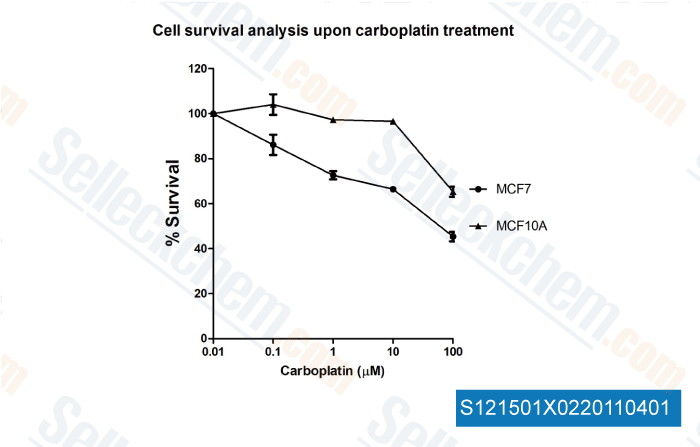
-
, , Dr. Helen Sadik of Johns Hopkins University
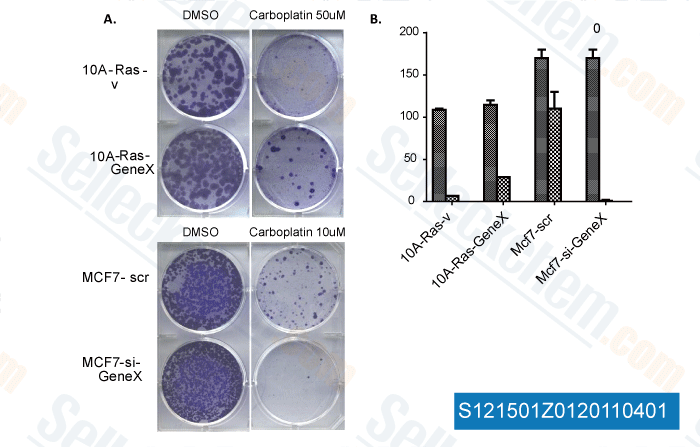
-
, , Dr. Helen Sadik of Johns Hopkins University
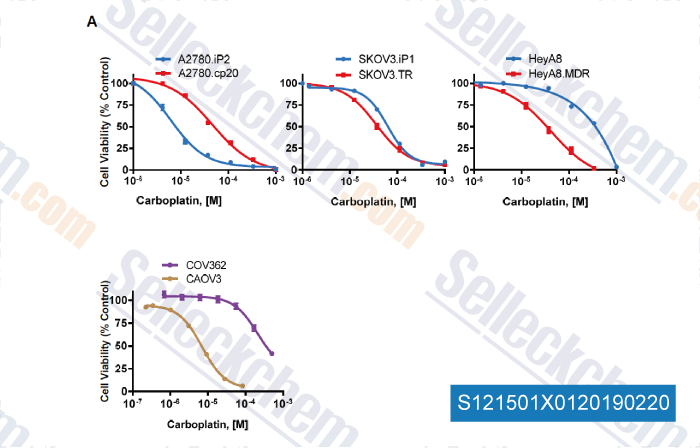
-
Datos de [ , , Cancer Lett, 2018, 436:75-86 ]
Sellecks Carboplatin Ha sido citado por 158 Publicaciones
| Non-canonical dihydrolipoyl transacetylase promotes chemotherapy resistance via mitochondrial tetrahydrofolate signaling [ Nat Commun, 2025, 16(1):8932] | PubMed: 41062483 |
| Screening a living biobank identifies cabazitaxel as a strategy to combat acquired taxol resistance in high-grade serous ovarian cancer [ Cell Rep Med, 2025, 6(6):102160] | PubMed: 40466638 |
| Profiling the Activity of the Potent and Highly Selective CDK2 Inhibitor BLU-222 Reveals Determinants of Response in CCNE1-Aberrant Ovarian and Endometrial Tumors [ Cancer Res, 2025, 10.1158/0008-5472.CAN-24-2360] | PubMed: 39945650 |
| USP9X integrates TGF-β and hypoxia signalings to promote ovarian cancer chemoresistance via HIF-2α-maintained stemness [ Cell Death Dis, 2025, 16(1):312] | PubMed: 40246814 |
| Cancer-metastasis-on-a-chip reveals efficacy of bevacizumab and siRNA in overcoming carboplatin resistance in SKOV3 ovarian cancer within a fibrotic metastatic microenvironment [ Mater Today Bio, 2025, 34:102240] | PubMed: 40917515 |
| Low dose DNA methyltransferase inhibitors potentiate PARP inhibitors in homologous recombination repair deficient tumors [ Breast Cancer Res, 2025, 27(1):8] | PubMed: 39819384 |
| ABCB1 confers resistance to carboplatin by accumulating stem-like cells in the G2/M phase of the cell cycle in p53null ovarian cancer [ Cell Death Discov, 2025, 11(1):132] | PubMed: 40175339 |
| Homologous Repair-Deficient Pancreatic Cancer: Refined Targeting of DNA Damage Response is an Effective Therapeutic Strategy [ United Eur Gastroent, 2025, 13(7):1328-1342] | PubMed: 40823818 |
| NAD+ Boosting Through NRH Supplementation Enhances Treatment Efficacy in EOC In Vitro [ Int J Mol Sci, 2025, 26(4)1719] | PubMed: 40004182 |
| O 6-methylguanine DNA methyltransferase (MGMT) expression in U1242 glioblastoma cells enhances in vitro clonogenicity, tumor implantation in vivo, and sensitivity to alisertib-carboplatin combination treatment [ Front Cell Neurosci, 2025, 19:1552015] | PubMed: 40336841 |
POLÍTICA DE DEVOLUCIÓN
La Política de Devolución Incondicional de Selleck Chemical garantiza una experiencia de compra en línea fluida para nuestros clientes. Si no está satisfecho con su compra de alguna manera, puede devolver cualquier artículo(s) dentro de los 7 días posteriores a su recepción. En caso de problemas de calidad del producto, ya sean problemas relacionados con el protocolo o con el producto, puede devolver cualquier artículo(s) dentro de los 365 días a partir de la fecha de compra original. Siga las instrucciones a continuación al devolver productos.
ENVÍO Y ALMACENAMIENTO
Los productos Selleck se transportan a temperatura ambiente. Si recibe el producto a temperatura ambiente, tenga la seguridad de que el Departamento de Inspección de Calidad de Selleck ha realizado experimentos para verificar que la colocación a temperatura normal durante un mes no afectará la actividad biológica de los productos en polvo. Después de la recogida, guarde el producto de acuerdo con los requisitos descritos en la hoja de datos. La mayoría de los productos Selleck son estables en las condiciones recomendadas.
NO PARA USO HUMANO, DIAGNÓSTICO VETERINARIO O TERAPÉUTICO.